As you recall, Fred, the Intern Penitent, is currently charged to WLBOTT, as penance for an incident at his Catholic Middle School. (https://www.wlbott.com/?p=62483)
In order to understand Fred’s plight, we must understand his educational environment. Fred attends St. Gangulf Middle School.
The “Whoopee Cushion Riots”, and Fred’s youthful rebellion has come to be known, occurred on May 11th. This date is important, because he attends St. Gangulf Middle School, and May 11th is feast day of St. Gangulf (also known as Saint Gengulphus). Fred became aware of St. Gangulf’s association with flatulence, and thought the distribution of Whoopee Cushions on his feast day would add some historical accuracy to an otherwise dull presentation by the head nun, Sister Magdalena.
Gangulf, unjustly accused of marital infidelity, was subjected to a medieval truth test involving water. When vindicated, divine justice did not arrive with thunder or fire but with a more intimate intervention: his accuser was said to have been afflicted with involuntary flatulence whenever she spoke falsely. Truth, in this case, announced itself from the rear pew.
– Elder G
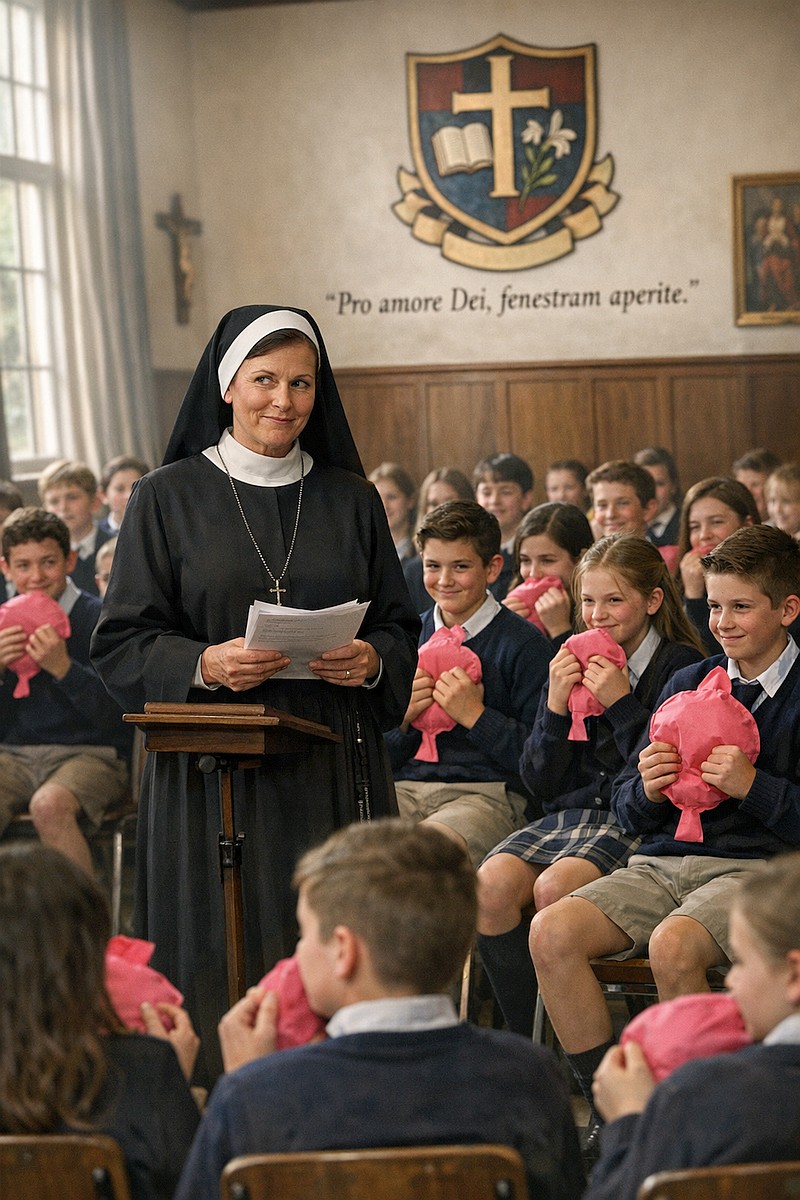
On this fateful day, May 11th, Fred distributed 317 whoopee cushions, one for each of his classmates attending Sister Magdalena‘s annual (and dull) (and sanitized) lecture on St. Gangulf, the namesake of their Middle School.
In Fred’s mind, the Whoopee Cushion Riots of May 11th were not an act of rebellion but an interpretive homage. A liturgically informed performance piece. A living footnote that breaks the vow of silence.
He reasoned that distributing whoopee cushions during Sister M’s presentation would not mock the saint but honor historical accuracy. The sounds echoing through the assembly hall were, to Fred’s mind, a kind of pneumatic chant. Not disruption but devotion. Not prank but praxis.
This left Sister M in a difficult position. “Must not laugh. Must be the mean-stern-nun.”
She attempted to visualize her inner tuff-guy, but without much success:
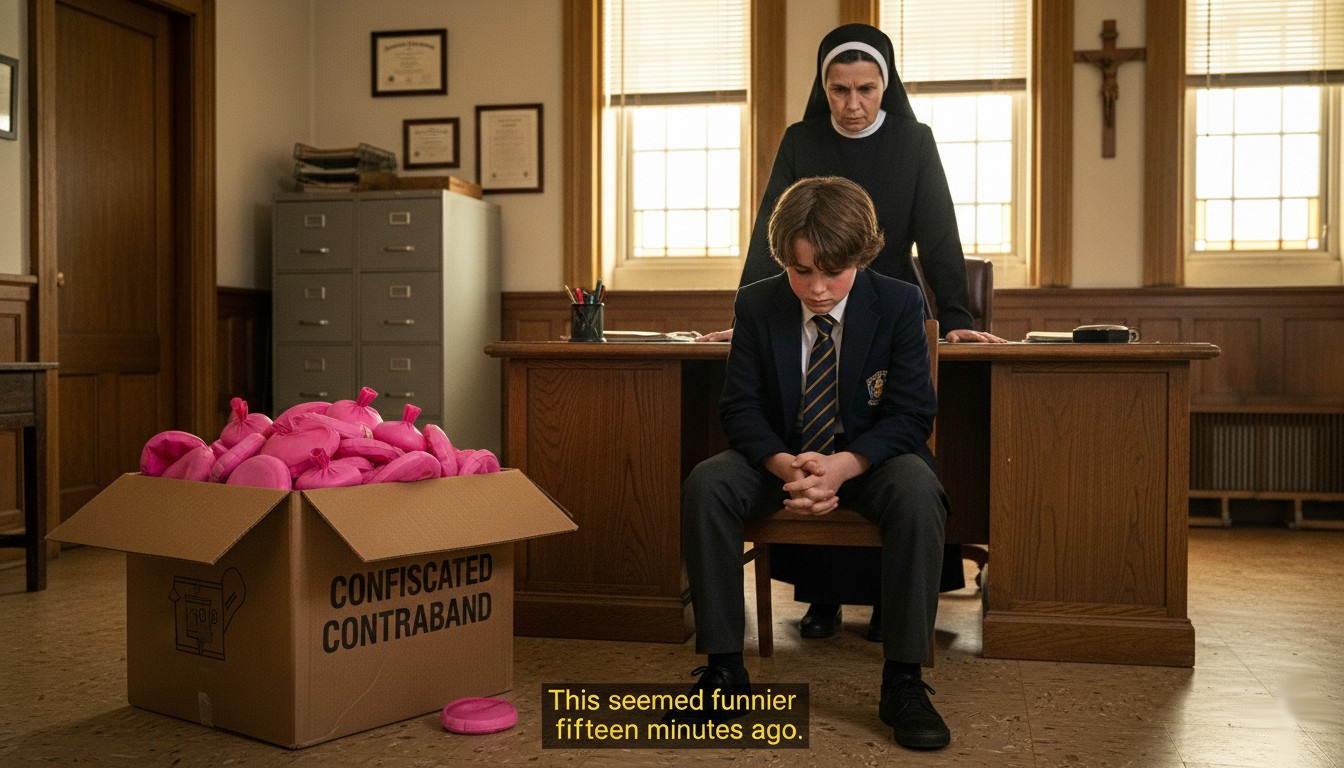
She takes decisive action. This had Fred’s sweaty hands all over it. “Fred – my office NOW! And bring all those infernal whoopee cushions!”
Sister M must now consider the punishment phase. She briefly considers Contrapasso[1], but can’t quite imagine it in a whoopee cushion context.
In a sense, her final decision is a form of contrapasso – the whoopee cushions were noise without purpose. The internship will be purpose with… supervised noise.
[1] Semi-Sequitur: Contrapasso
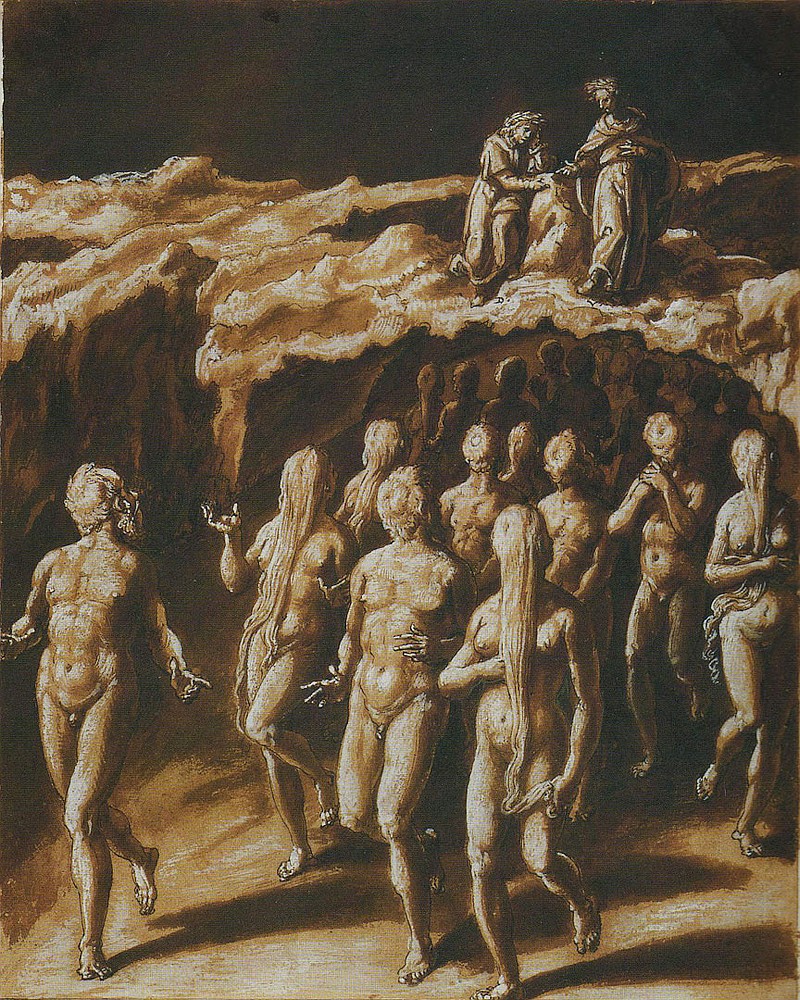
In Dante’s Inferno, contrapasso (or, in modern Italian, contrappasso, from Latin contra and patior, meaning “suffer the opposite”) is the punishment of souls “by a process either resembling or contrasting with the sin itself.” A similar process occurs in the Purgatorio.
One of the examples of contrapasso occurs in the fourth Bolgia of the eighth circle of Hell, where the sorcerers, astrologers, and false prophets have their heads turned back on their bodies such that it is “necessary to walk backward because they could not see ahead of them.”
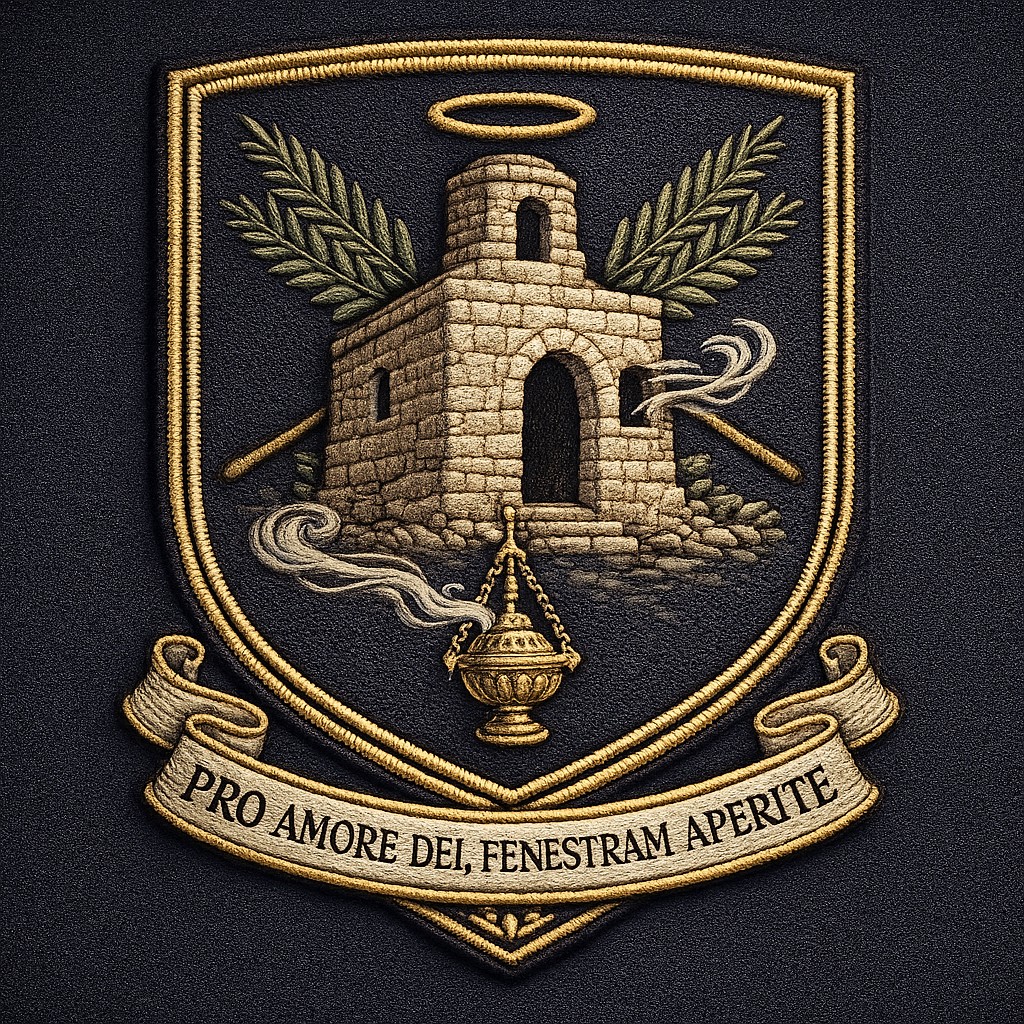
The Official Crest of St. Gangulf Catholic Middle School
“Pro amore Dei, fenestram aperite.”
The Life and Times of St. Gangulf
The official version of the life of St. Gangulf, as taught by the nuns:
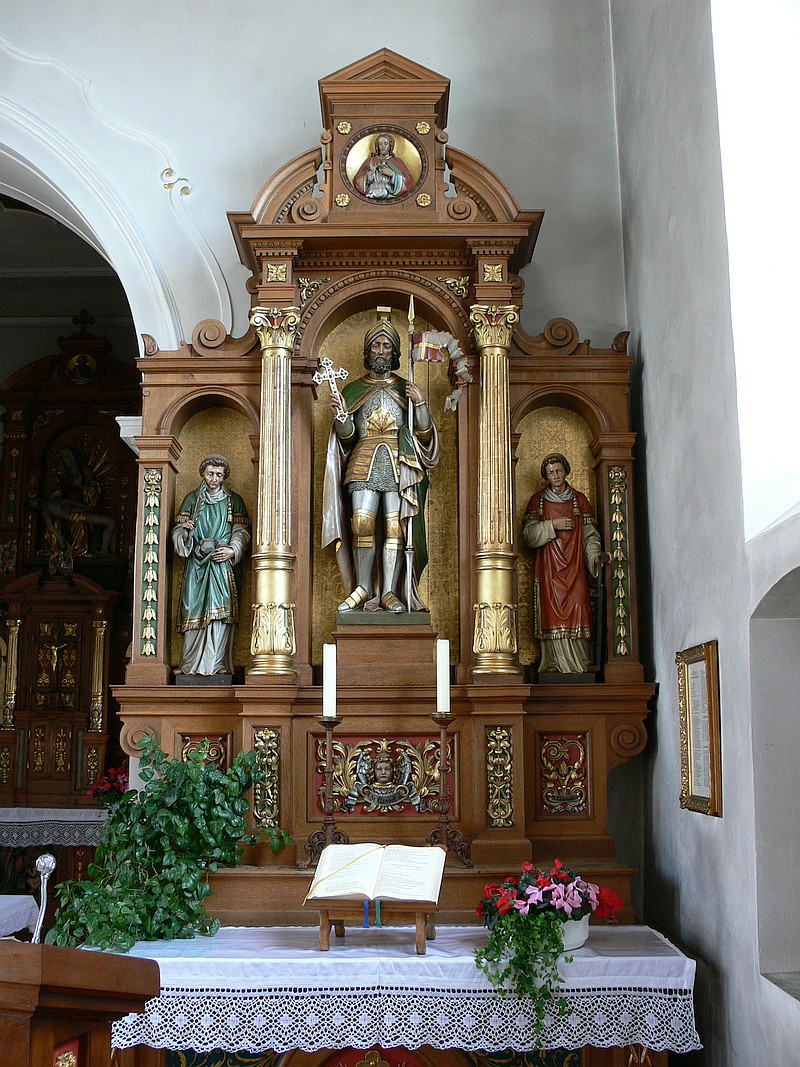
Gangulphus of Burgundy (died 11 May 760 AD) is venerated as a martyr by the Catholic Church. Gangulphus was a Burgundian courtier whose historical existence can be attested by only a single document: a deed from the court of Pepin the Short, dated 762, attests that he was a great landowner, whose family dominated the region and exercised a lot of power. […] Born to one of the most illustrious families of Burgundy, his education was provided by his parents, who were virtuous Christians. As a youth, Gangulphus was known for his great honesty, chastity, and propriety, and visited churches and read religious texts, avoiding the company of libertines. […] Gangulphus became also associated with the spot now occupied by the area known as Saint-Gingolph, where he is said to have dedicated himself as a hermit to a life of prayer and penance.
(left) By Lothar SpurzemObject location 49° 45′ 23.35″ N, 6° 38′ 27.51″ E View this and other nearby images on: OpenStreetMap – Own work, CC BY-SA 2.0 de, https://commons.wikimedia.org/w/index.php?curid=117726305 (right) By Moriz Schlachter – Self-photographed, CC BY 3.0, https://commons.wikimedia.org/w/index.php?curid=527116Wikipedia
From the official web site:
Saint Gengulphus was a Burgundian knight of Varennes-sur-Amance in the present
département of Haut Marne in the Grand Est region of Northeastern France. He was a man of outstanding piety and charitableness who served as a soldier under Pepin the Short, and whose martyrdom took the unusual form of being murdered (ca 760) by his wife’s lover. His name is entered as a saint and martyr in the Roman Martyrology on 11th May, which is generally accepted to have been the date of his death. Whilst being particularly regarded as the patron saint of deceived husbands and unhappy marriages, St Gengulphus also has traditional associations with shoe-makers, tanners, glove-makers, horsemen, knights and huntsmen.
But a much more accessible description of the life of St. Gangulf can be found in this excellent article on The Historians’ Sketchpad
Today is World Toilet Day, a UN-sponsored day aimed at raising awareness of the need to spread basic sanitation throughout the world. This is a good cause, and I have past form in using it to discuss St Gangulf, so I thought that having the 19th November fall on a Tuesday would be an appropriate time to discuss this most commodious of saints.
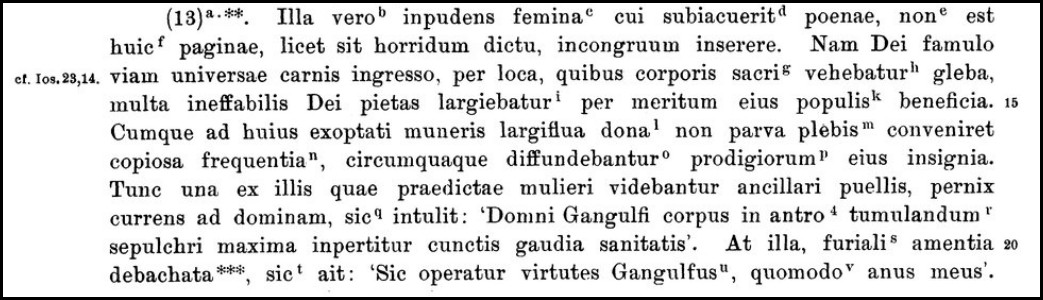
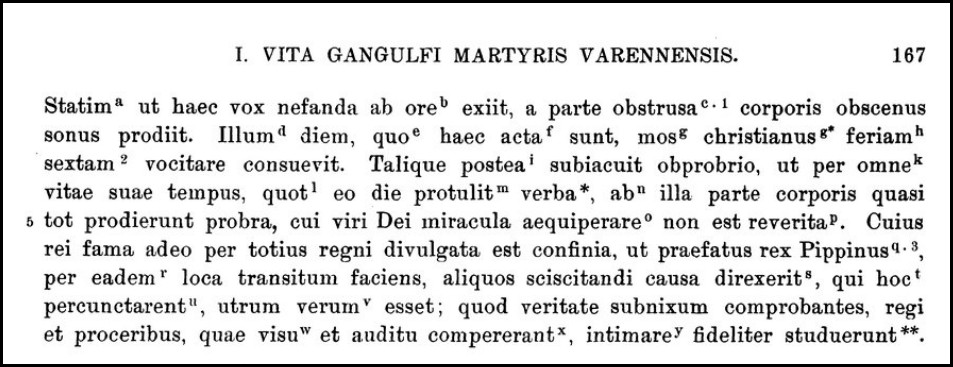
Salutem Mundo provides an English translation to the 10th century Latin biography of St. Gangulf.
XIII: Moreover, it befits our story to say what punishment was inflicted on that awful woman, although it is horrible to speak of. For after the servant of God had gone the way of all flesh, the unknowable piety of God bestowed many benefits to the people everywhere where the soil of his sacred body was taken because of Gangulf’s merits. And when a large crowd of people had come to the free-flowing benefits of this desired gift, signs of his wonders were poured forth in every direction. Then, one of the maids of the aforesaid woman ran swiftly to her mistress, and said ‘The body of lord Gangulf is imparting the greatest benefits of health to everyone from his tomb!’ But his wife, with insane stupidity, said ‘If Gangulf can do miracles, so can my arse!’ As soon as this had left her wicked mouth, a thunderous fart came from the darkest part of her body. It is the Christian habit to call the day when this took place a ‘Friday’. And afterwards she was subjected to a great punishment on every Friday for the rest of her life. That is, each time she spoke, that part of her body to which she had disrespectfully compared the miracles of the man of God farted.
The fame of this matter was spread throughout the whole realm’s borders, such that the aforesaid King Pippin, passing through the same place, sent some men to find out, who find out whether it was true. Finding out it was in fact true, they faithfully endeavoured to tell the king and the magnates what they had seen and heard.
The hagiographical text known as the Vita Gangulfi martyris Varennensis (Life of Gangulf, Martyr of Varennes), or the First Life of Gangulf (Vita Gangulfi prima), is a 10th-century Latin work that recounts the life and assassination of an 8th-century nobleman, Gengulf of Varenne.
Key Details
Subject: The text portrays Gengulf (also known as Gongolfus, Gangulf, or Gengoult) as a martyr, a historical person who died around 760 AD.
Authorship and Date: The Vita is an anonymous work composed in the early 10th century, possibly before Odo of Cluny’s Vita Geraldi.
Narrative: Gengulf was a nobleman who was assassinated by his wife’s lover. The circumstances of his death led to his veneration as a saint and martyr. The Vita details his life, his wife’s infidelity, his murder, and post-mortem miracles.
Content: The narrative is notably vivid and includes a famous episode where the unrepentant wife, as punishment for her actions and subsequent blasphemy, is cursed so that every time she speaks, the sound of flatulence is produced.
Gemini
Perhaps Fraser (of The Historians’ Sketchpad) is a kindred spirit, as we both have an affection for Alt Codes. https://www.wlbott.com/?p=57432
My name is Fraser McNair, and I’m an historian. At the moment, I am a Research Fellow at Eberhard Karls Universität in Tübingen (a job which is very useful for helping you learn alt-codes)
A quick final note on this blog’s address and tag-line. (It used to be the name until I realised it’s not easy to Google.) Salutem mundo is, quite simply, my Latin approximation of ‘Hello World’.