We’ve long been fascinated by the life and times of J. S. Bach. Imagine living in the late 17th century Europe.
I don’t want to minimize the suffering of the majority of people living today – in many ways their lives are worse that those living in Bach’s time. But for now let’s focus our comparison with modern day America. Imagine living in a time where there was no relief for such simple things as headaches, allergies, athlete’s foot, coughs and colds, digestive aliments. There was little knowledge of safe food preparation. You lived in fear of plagues, wars, the wrath of an angry God. Almost all families lost children during infancy from things that are easily preventable today.
Elder G gives us a thoughtful and compassionate comparison:
The everyday bodily misery of Bach’s world was a whole cathedral of avoidable suffering. Even setting aside major surgery or rare diseases, there were countless ordinary ailments that could loom like tiny tyrants over daily life.
A few more that are often easy or at least manageable today:
Tooth pain and dental infections. This was a brute of a problem. Cavities, abscesses, broken teeth, gum disease, and impacted teeth could become agonizing or deadly. Today we have fillings, root canals, antibiotics, and routine dental care.
Minor cuts becoming serious infections. A scraped hand in a dirty environment could turn ugly fast. Now we have antiseptics, bandages, tetanus protection, and antibiotics.
Skin infections and rashes. Fungal infections, eczema flares, infected bug bites, boils, and various irritations are usually treatable now with creams, hygiene, and medicine.
Urinary tract infections. Today often annoying but treatable. Then they could climb upward and become dangerous.
Constipation and diarrhea. These sound small until you remember dehydration, pain, malnutrition, and the lack of reliable remedies. Modern sanitation, hydration knowledge, and basic medicines changed that immensely.
Childbirth complications. Not a “minor” issue, of course, but a routine life event that was shadowed by mortal danger. Modern obstetrics, antisepsis, blood transfusion, C-sections, and prenatal care have changed the map entirely.
Menstrual pain and reproductive infections. Many women endured severe pain, anemia, infection, and complications with little effective help and often a fog of taboo around the subject.
Hernias. Painful, disabling, sometimes fatal if strangulated. Now often repairable with standard surgery.
Poor vision. Nearsightedness, farsightedness, cataracts, and other eye problems could quietly wreck a person’s functioning. Glasses alone are one of civilization’s underrated miracles.
Hearing problems. Ear infections, wax buildup, chronic inflammation, and some types of hearing loss can often be treated or helped now.
Asthma and breathing troubles. Without inhalers or modern diagnosis, what is now often manageable could be terrifying.
Joint pain and inflammation. Arthritis, gout, repetitive strain, and back pain had fewer reliable treatments. Today we at least have pain relief, physical therapy, imaging, and anti-inflammatory drugs.
Parasites. Intestinal worms and other parasitic infections were far more common and could sap strength for years.
Vitamin deficiencies. Scurvy, rickets, iron deficiency, and others could deform, weaken, or slowly damage people in ways we can often prevent or correct.
Insomnia and chronic pain. These could grind people down relentlessly. Modern treatment is imperfect, but far beyond herbs, superstition, and grim endurance.
Sexually transmitted infections. Often untreated, misunderstood, stigmatized, and capable of causing lifelong damage.
Appendicitis. Now often a routine emergency. Then it could be a death sentence wearing the mask of a stomachache.
Diabetes. Before insulin, it was one of the cruelest diagnoses imaginable.
High blood pressure. Often invisible, but now detectable and treatable before it wrecks the heart, brain, or kidneys.
Depression, anxiety, and psychosis. Treatment remains imperfect, but modern people at least have some vocabulary, therapies, and medicines rather than mostly moral judgment, fear, or confinement.
Again, Elder G helps us understand the world of early 18th century central Germany.
A statistical sketch of Bach’s world
Topic
Rough figure for Bach’s region/time
What it means
Life expectancy at birth
about 30 to 32 years
This is crushed downward by child mortality. If you reached adulthood, your odds improved a lot. Germany-wide demographic reconstruction gives about 31 years around 1740–44.
Crude death rate
about 32 deaths per 1,000 people per year around 1740–44
In bad years, crisis mortality could spike much higher, even above 40 per 1,000.
Infant mortality
often roughly 200 to 300 deaths per 1,000 live births in German-speaking lands
Germany varied a lot by region. One 18th-century German study cited by PubMed gives 228 per 1,000; broader evidence from Bavaria suggests child loss was even more severe.
Child mortality
roughly 40% to 50% died before age 15 in some nearby German regions
Our World in Data cites about half of children dying before age 15 in Bavaria in the mid-18th century. That is not Saxony exactly, but it is a sobering German benchmark for the era.
Urban population
under 10% lived in towns of 5,000+ for most of the early modern period
So Bach lived in a relatively urban, unusual setting, but most people did not.
People living in legally designated towns
roughly 20% to 33%
This is broader than “truly urban” because many “towns” were small. Still, it shows that the legal map and the lived map were not identical.
Employment outside agriculture
about 34% non-agricultural by 1800 for Germany overall
That implies roughly two-thirds still in agriculture even by 1800, and likely a bit more during Bach’s lifetime.
Leipzig population
around 30,000 in Bach’s Leipzig years
Large by German standards, and far bigger than Bach’s earlier postings.
Literacy
exact rate is hard to pin down, but still a minority overall, with strong regional and class differences
A 2021 review says Germany by the late 17th century was around the Western European average, below England and the Netherlands. Saxony did not introduce compulsory schooling until 1764, after Bach’s death.
The Harvesters, created by the Netherlandish Renaissance artist Pieter Bruegel the Elder in 1565
I’m amazed at the limited pool of people during this time, in a position to pursue music, and still we have some of the most beautiful music ever written. One factor might be that music was a fundamental part of education, which is not true today. Perhaps we should try this out at St. Gangulf Middle School.
The Waves and the 3rd Movement
The 3rd movement of the 4th Brandenburg Concerto has three melody lines that dance with each other, sometimes taking the lead, some times supporting the other melodies. They all contribute to the lively energy and beauty of the work. But something very interesting happens near the end – they reach a climax together to form a beautiful moment of silence!
Now to the waves. I recall seeing a video demonstration of wave dynamics (It was the FloWave Ocean Energy Research Facility in Edinburgh, Scotland. https://www.flowavett.co.uk/) They used their 168 wave paddles, in a carefully controlled pattern, to inject a tremendous amount of energy into the 25 meter pool (the full pool basin is 634,000 US gallons). All looks like chaos, then the pool becomes perfectly still, but still bundled with energy. Then a giant spout erupts from the center of the pool, ejecting water high into the sky. These are called axisymmetric “spike waves” created by focused wave energy.
This reminds me of the last few moments of this Brandenburg concerto.
The FloWave Ocean Energy Research Facility, Edinburgh FloWave is a truly unique facility. Consisting of a 25-metre diameter, 2-metre deep circular basin, it creates highly repeatable waves and currents that mimic real-life coastal waters. The centre hosts an 82 ft wide circular wave pool surrounded by 168 automated paddles. These paddles move in patterns to simulate the open ocean, mimicking all sorts of wave speeds and shapes. Researchers use FloWave to test the offshore energy industry equipment, re-creating everything the ocean throws at turbines and oil rigs. They can even generate a 90 ft vertical spike wave.
It seemed like a great idea for WLBOTT to have their own wave pool, to recreate the energy of the Brandenburg concerto. Sally the Intern, along with Fred the Penitent, eagerly volunteered to spearhead the project.
Sister Magdalena uses this moment to stay in communion with the Holy See by listening to the White Sox game.
She has also undergone the challenge of learning the mysteries of the ERA.
The project was completed to everyone’s satisfaction.
Tess Twinehart, our WLBOTT counselor and chicken whisperer, suggested that the chicken work through her trauma with art.
The Music
This video is pretty cool, because at about 4:11 you can visually see the convergence, symmetry, and the moment of silence.
For fun, here’s beautiful arrangement of the 1st movement of the 3rd Brandenburg concerto, played on guitar.
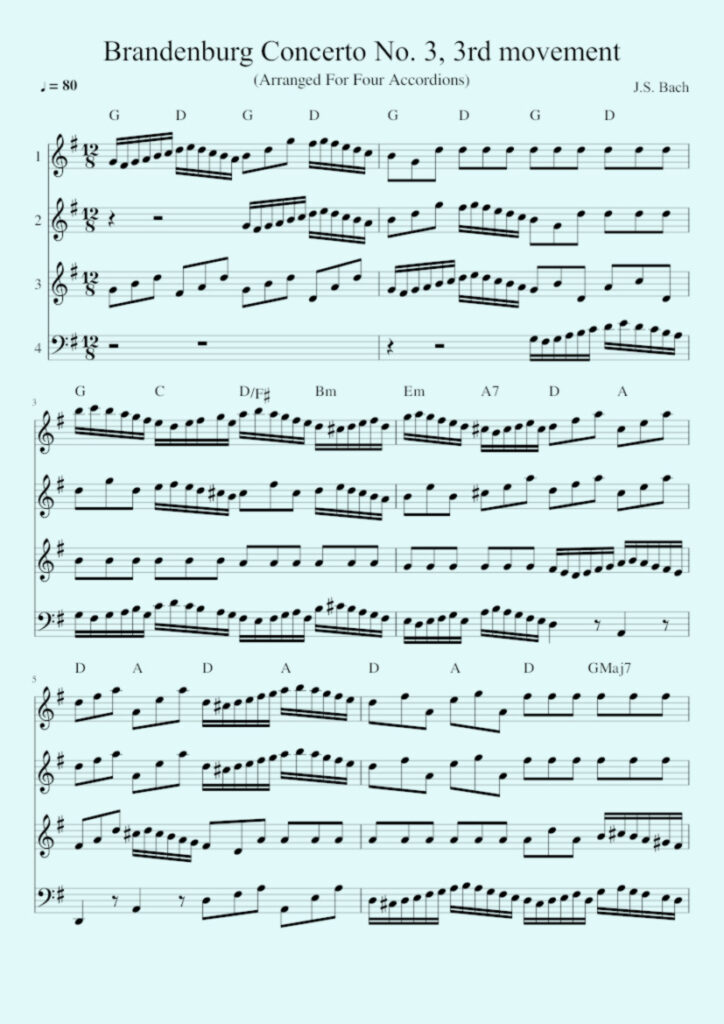
The 3rd movement of the 3rd Brandenburg concerto, even thought it is high energy, has an underlying peaceful rhythm that makes me think of a rowboat gently rocking on the calm seas. Note the 12/8 time signature.
One reply on “BWV 1049, 3rd Movement”
What is really cool is how the two flute players look at each other just before starting – extremely important for synchronization. Thanks for the enjoyable music


One reply on “BWV 1049, 3rd Movement”
What is really cool is how the two flute players look at each other just before starting – extremely important for synchronization. Thanks for the enjoyable music