A reasonably priced violin will range in price from about $259 to a little over $23,000,000[1]. Rentals start around $35/month. You can probably build your own with odds and ends around your garage.
[1] The most expensive violin ever sold is the 1715 “Baron Knoop” Stradivarius, which is valued at approximately $23 million. You may have to wait until it comes up in auction.
Step 2: Tune the Violin
[ed note: insert Tuna-Fish joke here]
You must tune your violin. Playing open strings may be the only time you play an actual note for a long, long time.
The easiest way to tune your violin is to get your teacher to tune it for you. They appreciate being involved in this step of your learning journey.
If your teacher is not available, there are other sound references you can use to tune the beast.
a) digital tuner
Although once quite expensive, many fine digital tuners can now be purchased for under a million dollars.
b) harmonica
We traveled to the former Soviet Union, where Olga was rumored to have an 88 note harmonica. As a former Olympic weight lifter, she was able to wrangle this beast.
Olga turned out to be a sweetheart, and after the tuning session, she took us out for tea and black bread. And the stories she told!
c) tuning forks
The dinner table is a good location to tune your violin, because forks are readily available.
d) have a friend with a bagpipe?
Semi-Sequitur: Einstein’s Violin
There is a fascinating story in the July 2018 issue of Strings Magazine that talks about Einstein’s love of music, his violin (he called her “Lina”) and his amateur fundraiser performances. Of his debut performance, the New York Times said he “insisted that there be no attempt to criticize his playing or to describe what he did, or failed to do, once he entered the ballroom. His feeling on the matter . . . was that he did not object to having this theory of relativity criticized, but was unwilling to have public comment on his ability as an amateur violinist.”
First Position
What is the first position on the violin?
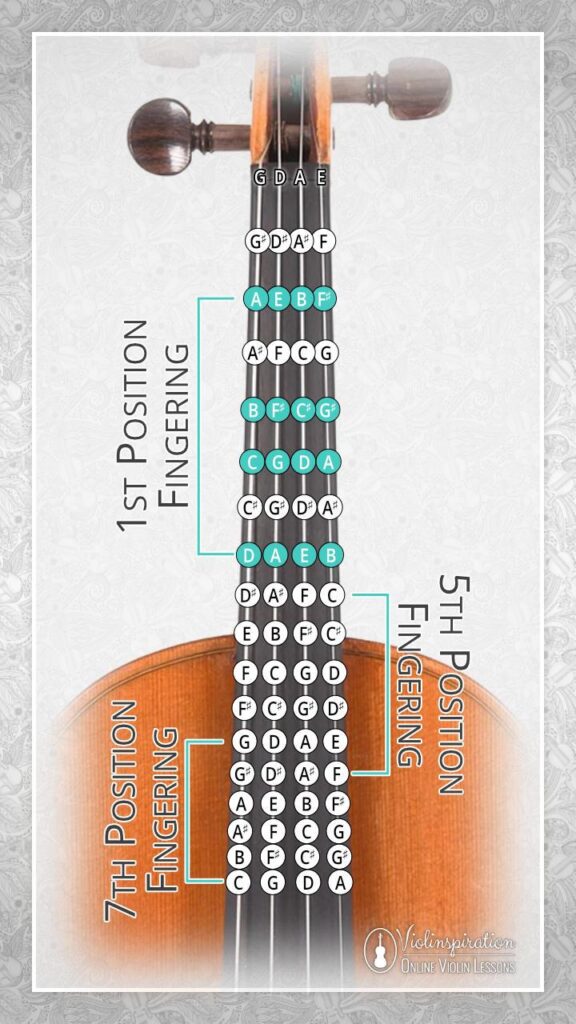
First position is the easiest position to find on the violin and the first you learn. The notes of the first position start one note above the open string. For example the first finger (index finger) on the A string is placed on the note B. The further fingers are placed one note higher for each finger. In the first position your hand is located at start of the fingerboard near the peg box.
Zlata, author of the Violin Lounge web site, is an accomplished violinist and instructor from the Netherlands. From her bio:
In June 2019, I transitioned to 100% online teaching to focus on curriculum development. Now I focus on recording chamber music collaborations and helping violinists around the world improve their bow technique.
On a personal note: I’m a mother of seven (including three sets of twins!), a self-described chocolate addict, and based in Huizen, Netherlands. As an introvert, transitioning to online work has been perfect for me.
What is the Highest Position on the Violin? The highest position on the violin is the 14th. However, if you’d like to play the highest note (A7) with the third finger (instead of the fourth), then you are in the 15th position! In practice, 14th position is very difficult to play in. The highest position music is usually written for is the eighth.
How Do Violinists Know Where to Put Their Fingers? Violinists learn to know where to put their fingers on the fingerboard by using fingering tapes, charts, checking the pitch of played notes with a tuner, and learning to recognize the pitches. Along the way, violinists develop also muscle memory, so playing in tune gets easier and tapes can be removed.
How Many Notes Are on the Violin? The violin has 51 notes from the lowest note – G3 – to the highest note – A7, including all semitones (closest notes to each other in western music). Since you can play all tones between them too, it makes for an infinite number of notes.
Final Note While this may feel like it’s very complicated, do not despair.