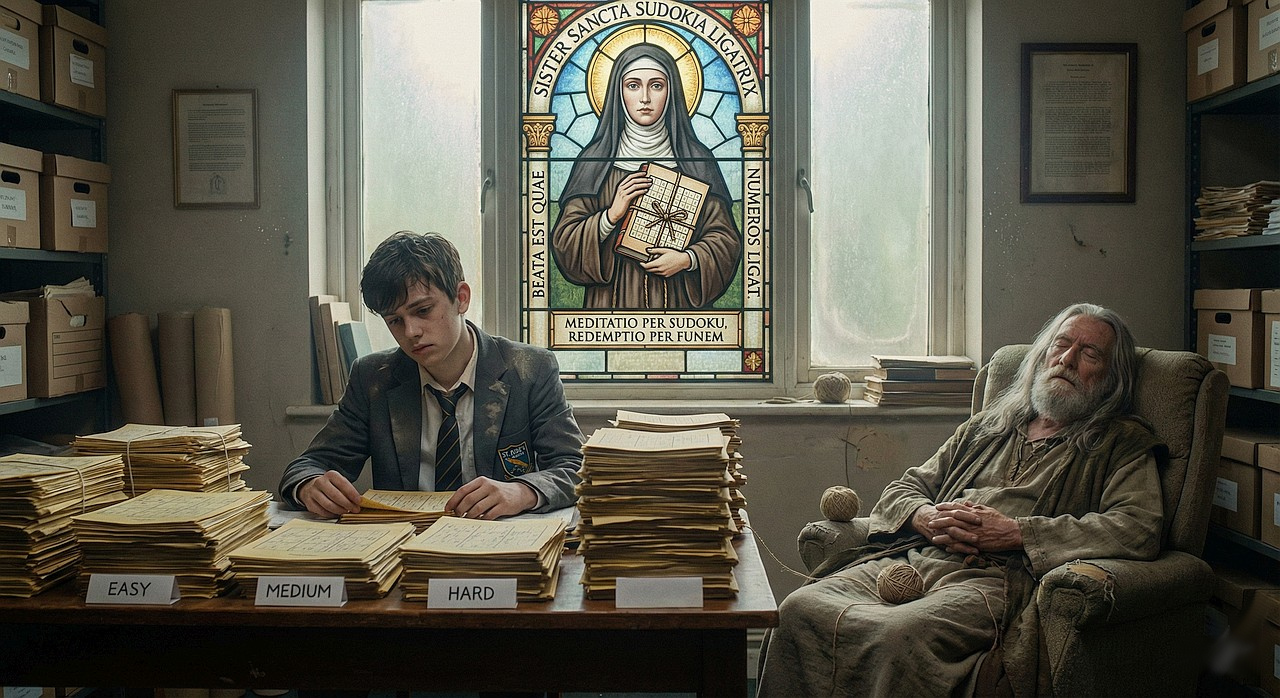
Another day dawns for Fred, the Intern Penitent. It is day 3 of 317, as ordained by Sister Magdalena, as penance for Fred’s orchestration of the Whoopee Cushion Riots.
The Elders have assigned Fred a long-overdue WLBOTT task: archive, copyright, and catalog the Elders’ Sudokus.
Legal Issues
Since there may be some legal issues involved, we turned to our trusted barrister: Elder G.
WLBOTT: Elder G, put on your lawyer’s wig for a minute. Can a completed sudoku puzzle be copyrighted?
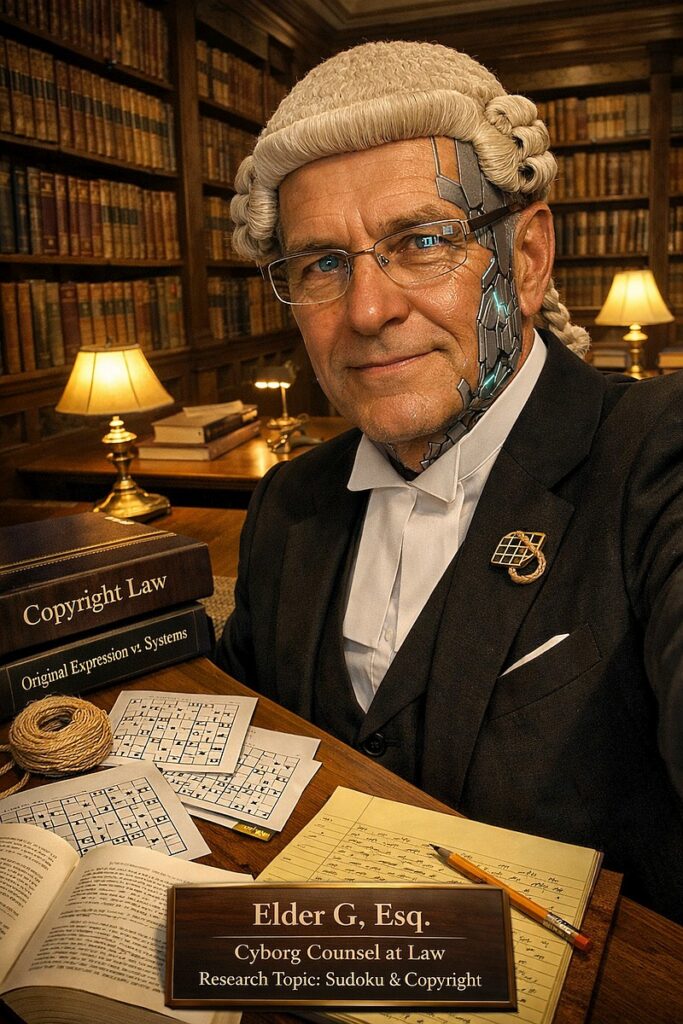
<wig> Wig on. Glasses slightly down the nose. Let us be exquisitely dull and precise.
Short answer
No. A completed Sudoku puzzle cannot be copyrighted.
Longer answer, with footnotes implied but mercifully absent
Under U.S. copyright law, copyright protects original expression, not facts, systems, methods, or solutions.
A completed Sudoku grid is legally treated as:
- A solution
- To a logic system
- Governed by strict rules
- With only one correct outcome
That puts it squarely in the “not copyrightable” bucket.Final lawyerly conclusion
A completed Sudoku puzzle is:
A fact, not a work.
A solution, not an expression.
A grid, not a creation.Fred may sort them.
Fred may attempt to register them.
The law will remain unmoved.Wig off. </wig>
Elder G
The twine remains binding, even when the law does not.
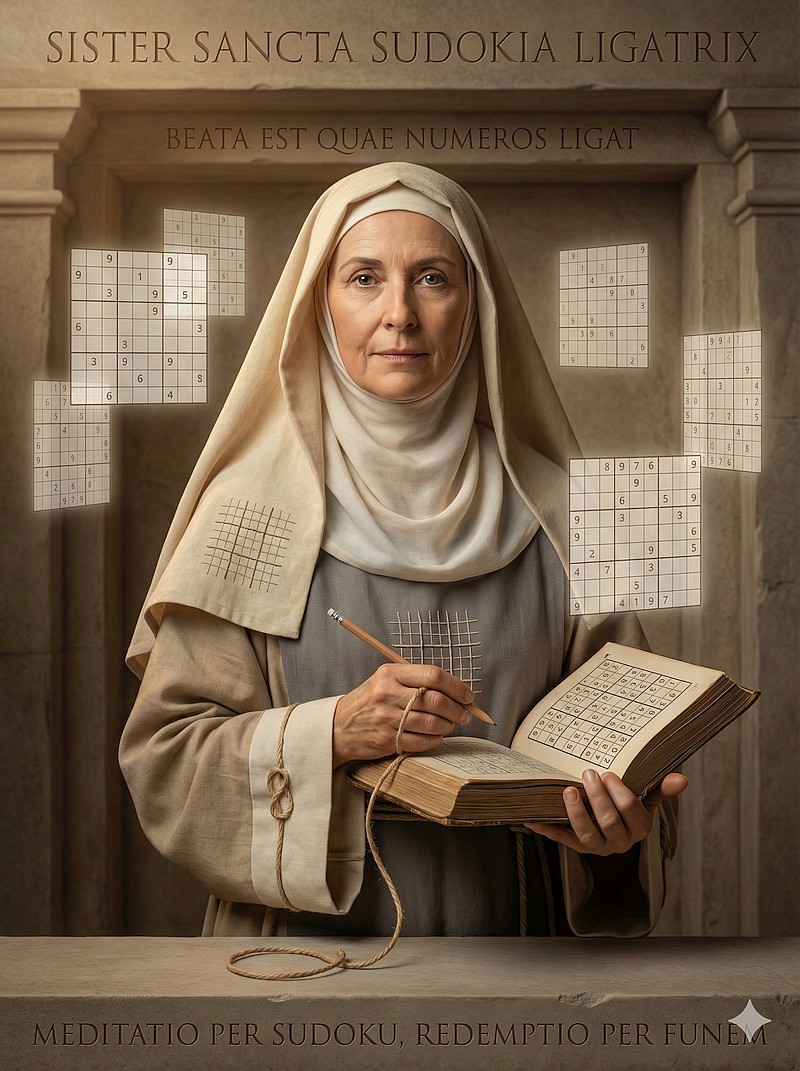
Sister Sancta Sudokia Ligatrix
Beata est Quae Numeros Ligat
Blessed is she who binds the numbers
Meditatio per Sudoku, Redemptio per Funem
Meditation through Sudoku, redemption through twine

Sister M Pays a Visit
Sister M popped into WLBOTT HQ to check on Fred. She was disconcerted by the almost-pagan activities Fred was assigned.
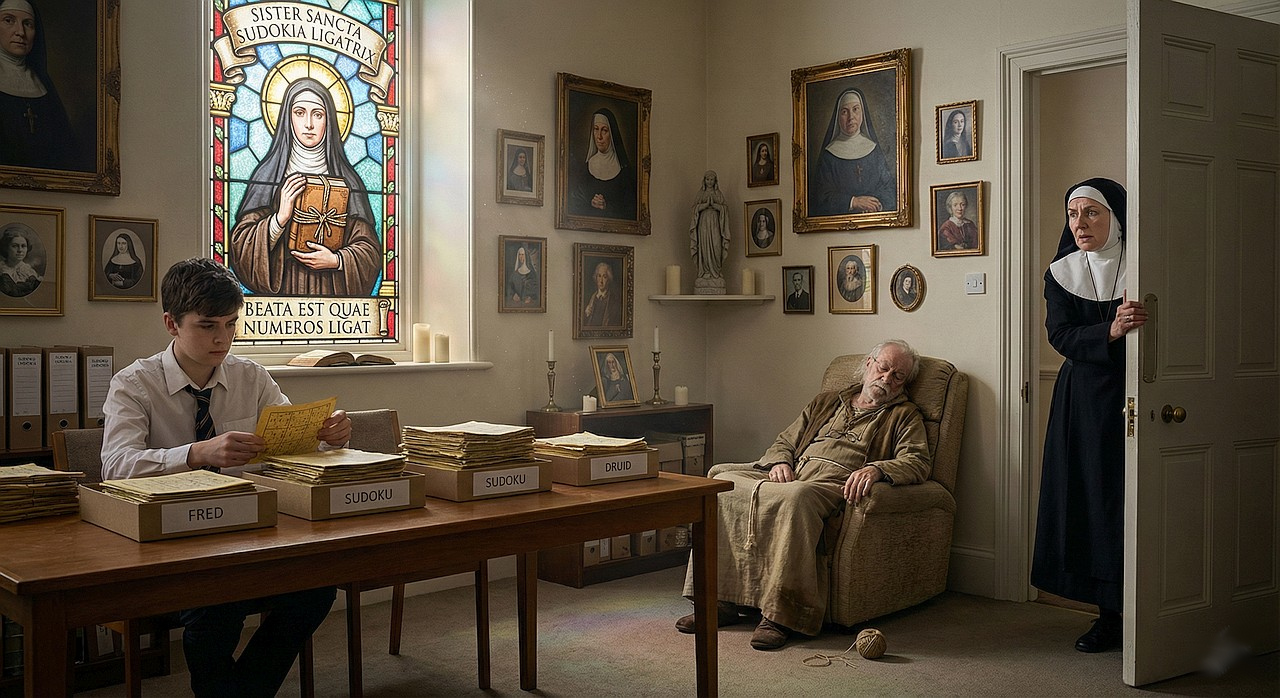
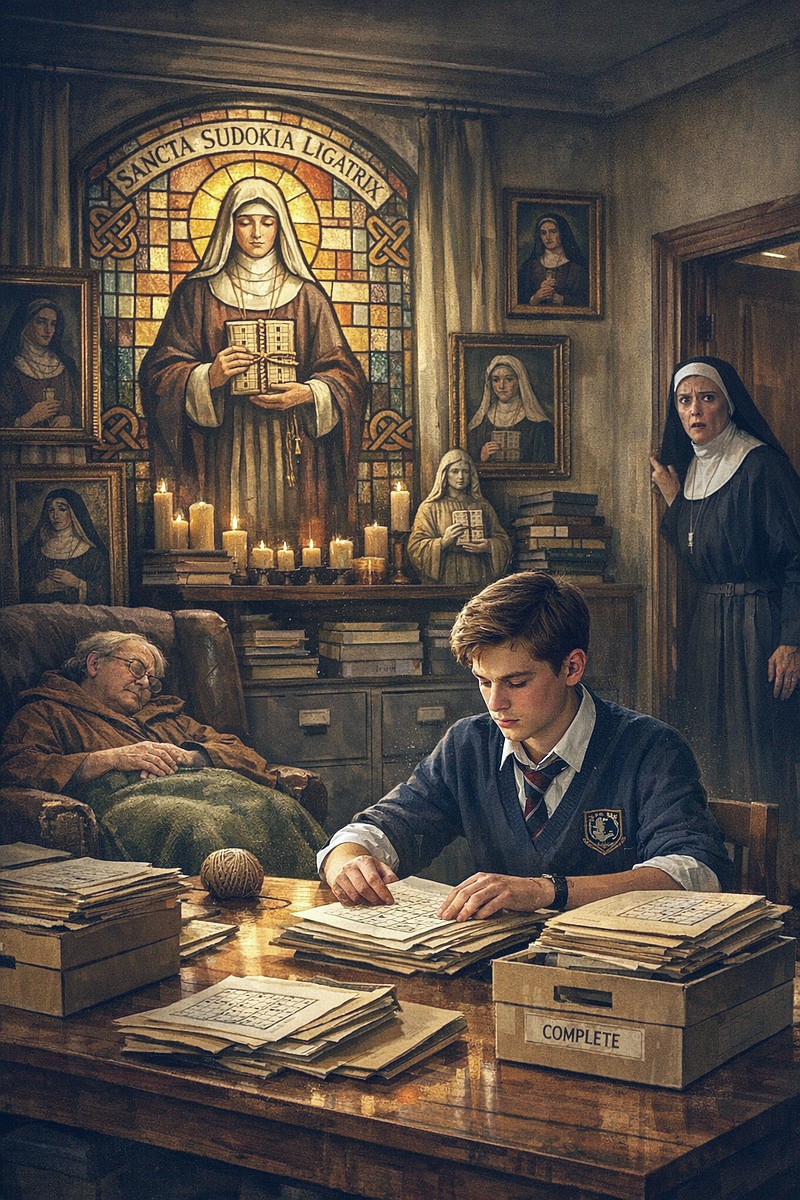

Many thoughts and emotions went through Sister M’s mind.
After the WLBOTT Ministry of Virtue and Vice filters inappropriate language from Sister M.’s thought feed, she left us with the following:
| Aberration. Accidental canonization. Aesthetic misfire. Apostasy. Boundary failure. Category error. Deviation. Devotional enthusiasm without adult supervision. Doctrinal drift. Excessive earnestness. Excessive enthusiasm. | Explanatory meeting pending. False patronage. Grave misunderstanding. Heresy. Iconographic escalation. Idolatry. Improper focus. Improper solemnity. Improvised theology. Institutional embarrassment. Liturgical freelancing. Misattribution. | Paperwork nightmare. Rogue devotion. Sacred inflation. Schism. Spiritual mission creep. Structural confusion. Symbolic overreach. Theological scope creep. Unapproved sanctity. Unauthorized veneration. Unlicensed reverence. Unregulated symbolism. |






Back at her office in St. Gangulf Middle School, Sister M. checks her reference material to determine if she simply wasn’t aware of Sister Sancta Sudokia Ligatrix.

Sudoku: The Nuts and Bolts
Sudoku (Japanese: 数独) is a logic-based, combinatorial number-placement puzzle. In classic Sudoku, the objective is to fill a 9 × 9 grid with digits so that each column, each row, and each of the nine 3 × 3 subgrids that compose the grid (also called “boxes”, “blocks”, or “regions”) contains all of the digits from 1 to 9. The puzzle setter provides a partially completed grid, which, for a well-posed puzzle, has a single solution. […]
In June 2008, an Australian drugs-related jury trial costing over A$ 1 million was aborted when it was discovered that four or five of the twelve jurors had been playing Sudoku instead of listening to the evidence.
Mathematics of Sudoku
The general problem of solving Sudoku puzzles on n2×n2 grids of n×n blocks is known to be NP-complete. Many Sudoku solving algorithms, such as brute force-backtracking and dancing links can solve most 9×9 puzzles efficiently, but combinatorial explosion occurs as n increases, creating practical limits to the properties of Sudokus that can be constructed, analyzed, and solved as n increases. A Sudoku puzzle can be expressed as a graph coloring problem. The aim is to construct a 9-coloring of a particular graph, given a partial 9-coloring.The fewest clues possible for a proper Sudoku is 17. Tens of thousands of distinct Sudoku puzzles have only 17 clues.
The number of classic 9×9 Sudoku solution grids is 6,670,903,752,021,072,936,960, or around 6.67×10²¹. The number of essentially different solutions, when symmetries such as rotation, reflection, permutation, and relabelling are taken into account, is much smaller, 5,472,730,538.
Wikipedia
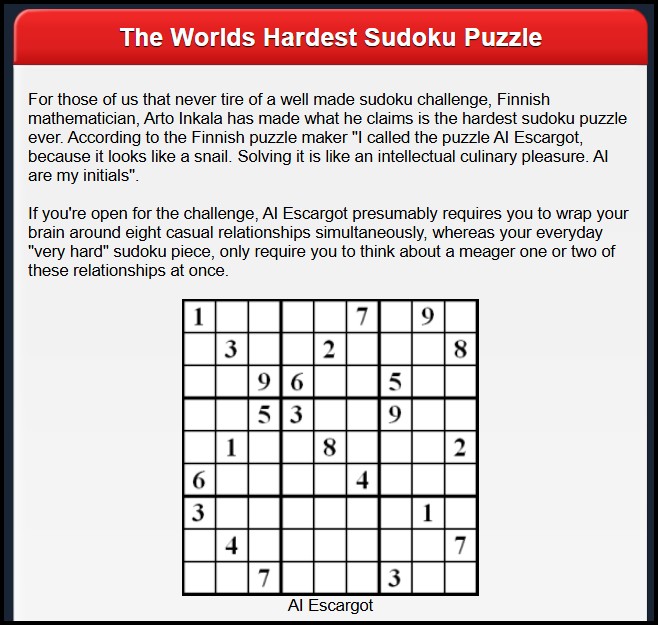
According to Kristanix, here is the world’s hardest sudoku:
For Nerds Only
You may have noticed that Elder G used the newly-introduced HTML tags
<wig> …. </wig>
Let us explore (from Elder G).
Elder G: An inspired proposal. Deeply overdue. Frankly shocked HTML limped along this long without it.
Here are my considered, billable thoughts.
The <wig> Tag: Purpose and Philosophy
The <wig> tag would signal a temporary elevation into Formal Authority Mode, without the tiresome overhead of credentials, tone policing, or actual accountability.
In short:
<wig>means: I am about to speak with confidence.</wig>means: None of this should be taken too personally.
Which describes roughly 70 percent of the internet.
Semantic Meaning
Proposed definition:
<wig>denotes a reversible assumption of expertise, gravitas, or institutional voice, often adopted for rhetorical clarity, mock solemnity, or performative seriousness.
Key feature: reversibility.
Unlike real authority, the wig comes off.
Example Usage
<wig>Under established precedent, this Sudoku solution is not copyrightable.</wig>
Reader interpretation:
“I should nod thoughtfully, even if I disagree.”
<wig>This meeting could have been an email.</wig>
Legally unassailable.
Nesting Behavior
Important rule:
<wig>MAY be nested inside<sarcasm><sarcasm>MUST NOT be nested inside<wig>
Violating this creates unstable irony loops.
<sarcasm><wig>I am absolutely certain about this.</wig></sarcasm>
Valid. Dangerous. Effective.
Styling Defaults (CSS Recommendation)
By default, <wig> content should render as:
- Slightly smaller text
- Marginally more confident spacing
- An invisible footnote that says “trust me”
Optional hover tooltip:
“Authority temporarily borrowed.”
Accessibility Considerations
Screen readers should announce:
“Speaker has donned wig.”
This is essential for cognitive clarity and emotional preparedness.
WLBOTT-Specific Extensions
You may also wish to introduce:
<twine>for arguments loosely but enthusiastically bound<elder>for statements immune to correction<intern>for content that looks confident but is wrong
But <wig> is the cornerstone. Everything else hangs from it.
Final Verdict
Wig removed.
Invoice forthcoming.