This was in high-school days, and I had a perfectly good part-time job working as an electrician’s aid for my father. But a few of us kids decided we needed to break out of the mold and get our own jobs. So the 6 of us went down to the employment agency and waited around for a while, and this guy with an pickup truck finally picked us up to work on his farm.
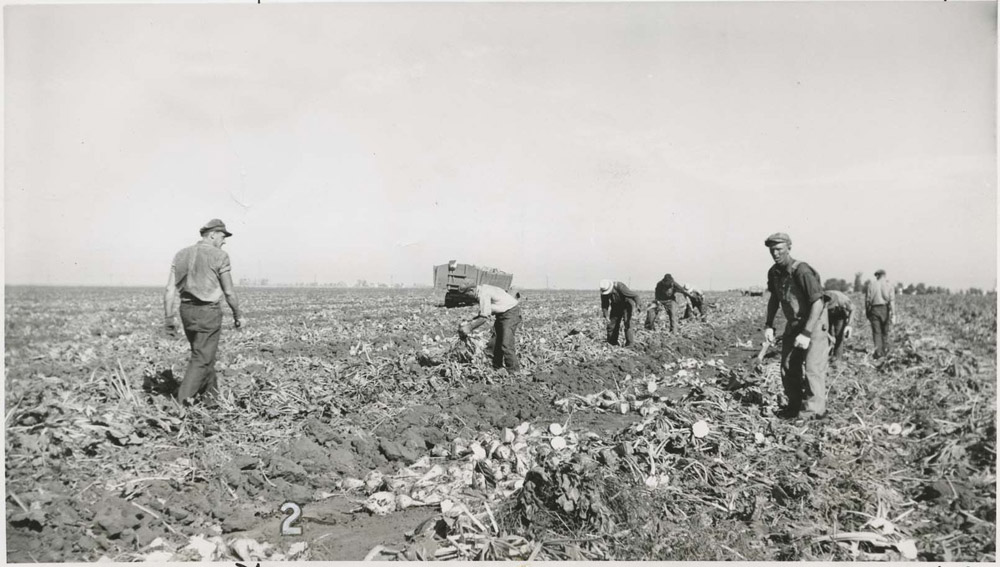
The job was to work down the rows of sugar beets, pulling up weeds with a hoe. We got $0.25 per row.
They others lasted 6 rows before giving up. I managed two more rows (up and back) before I joined them. It was back-breaking, hot, thirsty work and we didn’t even last 2 hours!
The farmer, when he returned to check on us, was absolutely furious, refused to pay us and told us to find our own way back to town (about 20 miles). We threatened to report him for putting minors at risk, so he drove us back to town, but still refused to pay us.
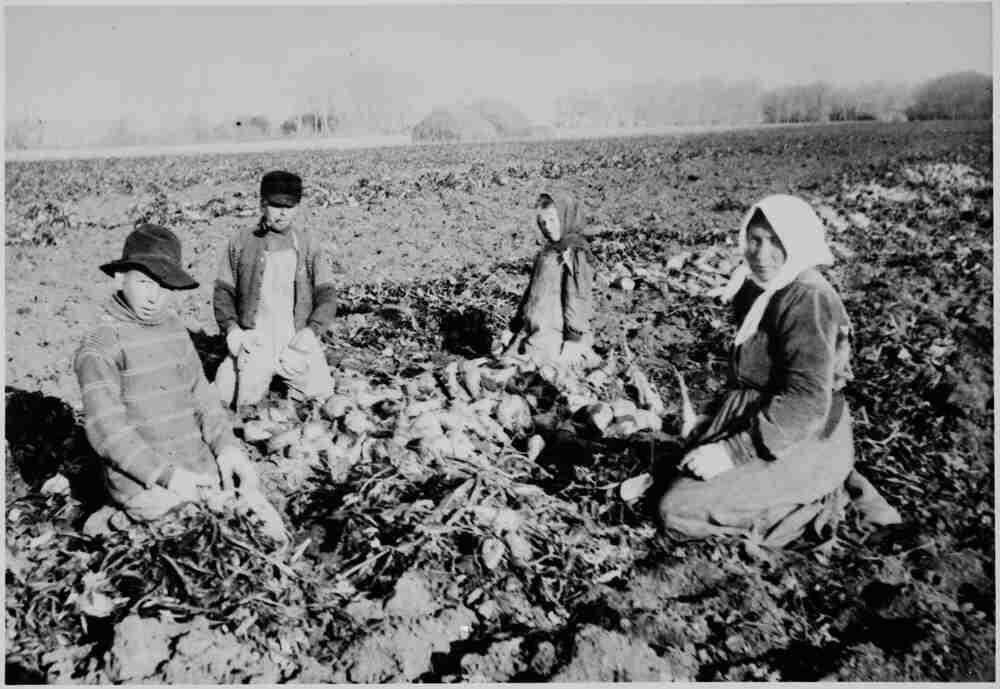
At the time, I had no knowledge of the Japanese workers or WWII or for that matter, much of anything. It wasn’t until I met Rochelle that I learned about the sugarbeet workers (55 years later). I can’t imagine how anyone could spend day after day hunched over a row of plants with a hoe, and I do know what that feels like.
Elder JA
Sugar Beets – The Nuts and Bolts
A sugar beet is a plant whose root contains a high concentration of sucrose and that is grown commercially for sugar production.
In February 2015, a USDA factsheet reported that sugar beets generally account for about 55 percent of domestically produced sugar, and sugar cane for about 45 percent.
The root of the beet contains 75% water, about 20% sugar, and 5% pulp. The exact sugar content can vary between 12% and 21%, depending on the cultivar and growing conditions. Sugar is the primary value of sugar beet as a cash crop. The pulp, insoluble in water and mainly composed of cellulose, hemicellulose, lignin, and pectin, is used in animal feed. The byproducts of the sugar beet crop, such as pulp and molasses, add another 10% to the value of the harvest.
The most important requirements are that the soil must contain a large supply of nutrients, be rich in humus, and be able to contain a great deal of moisture.
A temperature ranging from 15 to 21 °C (59 to 70 °F) during the growing months is most favorable. In the absence of adequate irrigation, 460 mm (18 inches) of rainfall are necessary to raise an average crop.
In high elevation regions such as those of Idaho, Colorado and Utah, where the temperature is high during the daytime, but where the nights are cool, the quality of the sugar beet is excellent.
Sugar beet crops exhaust the soil rapidly. Crop rotation is recommended and necessary. Normally, beets are grown in the same ground every third year, peas, beans or grain being raised the other two years.
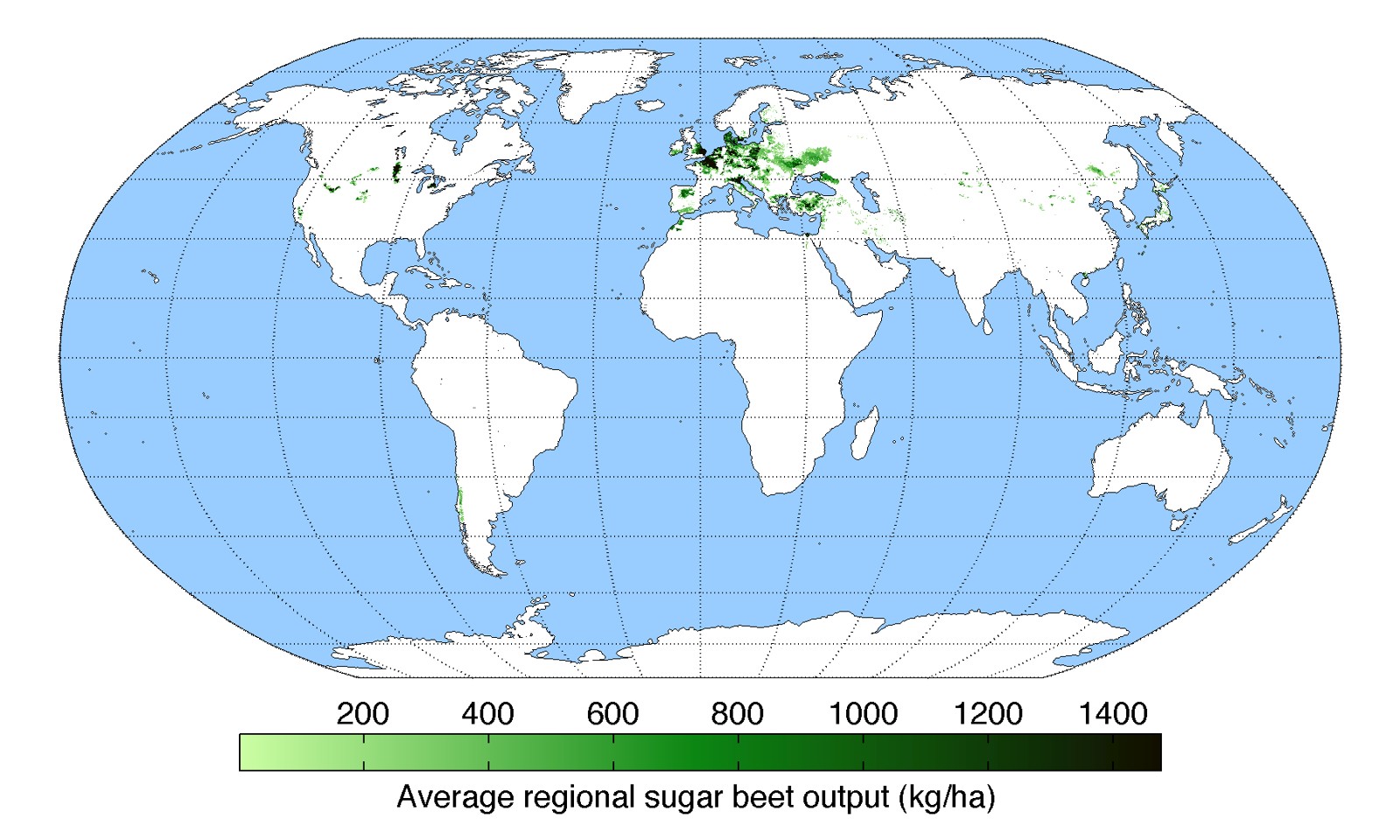
At the northern end of its range, growing seasons as short as 100 days can produce commercially viable sugar beet crops. In warmer climates, such as in California’s Imperial Valley, sugar beets are a winter crop, planted in the autumn and harvested in the spring.
Wikipedia / Map by AndrewMT – Own work; compiled by the University of Minnesota Institute on the Environment
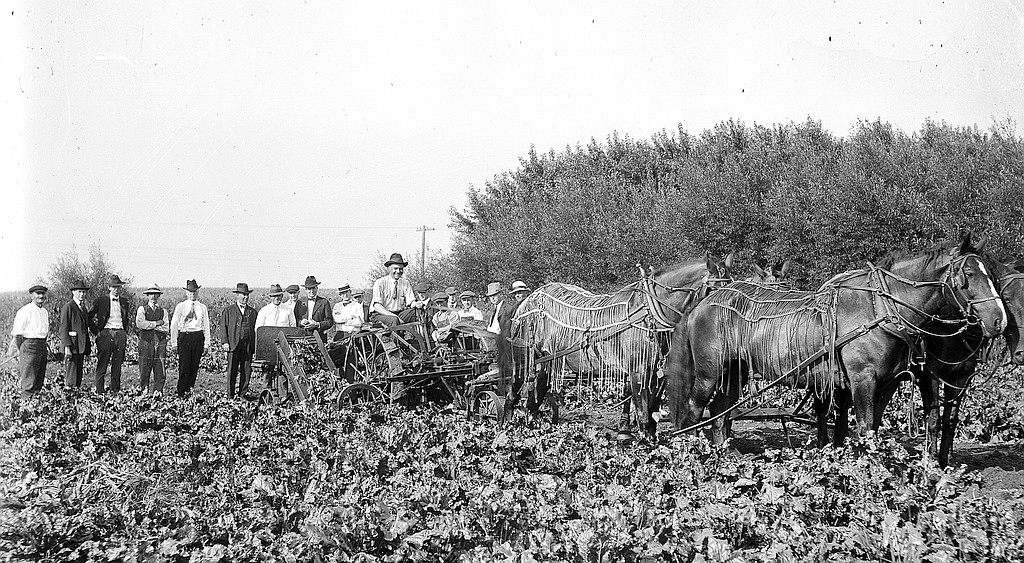
Until the latter half of the 20th century, sugar beet production was highly labor-intensive, as weed control was managed by densely planting the crop, which then had to be manually thinned two or three times with a hoe during the growing season. Harvesting also required many workers. Although the roots could be lifted by a plough-like device that could be pulled by a horse team, the rest of the preparation was by hand. One laborer grabbed the beets by their leaves, knocked them together to shake free loose soil, and then laid them in a row, root to one side, greens to the other. A second worker equipped with a beet hook (a short-handled tool between a billhook and a sickle) followed behind, and would lift the beet and swiftly chop the crown and leaves from the root with a single action. Working this way, he would leave a row of beets that could be forked into the back of a cart.
The most productive sugar beet farms in the world, in 2022, were in Chile, with a nationwide average yield of 106.2 tonnes per hectare.
Imperial Valley (California) farmers have achieved yields of about 160 tonnes per hectare and over 26 tonnes sugar per hectare. Imperial Valley farms benefit from high intensities of incident sunlight and intensive use of irrigation and fertilizers.
Apparently there is a trend among RVers to participate in the sugar beet harvest. The large sugar beet processing plants set up RV parks near their plants. RVers will then work 12 hour shifts for two to three weeks, and make a good chunk of change. The work doesn’t appear to be too physical, but does involve standing on your feet for long periods of time.
Joe and Kalyn have a YouTube channel documenting their RVing experience. I would describe Joe and Kalyn as “excessively buoyant.”
New here? We’re Joe and Kalyn! In 2019 we sold our sticks and bricks house, bought an RV, and said we’d try full-time travel for a year. As you can see, it stuck.
Let’s get into the numbers. I’m going to throw a lot of stuff at you…. What is the Sugar Beet Harvest?
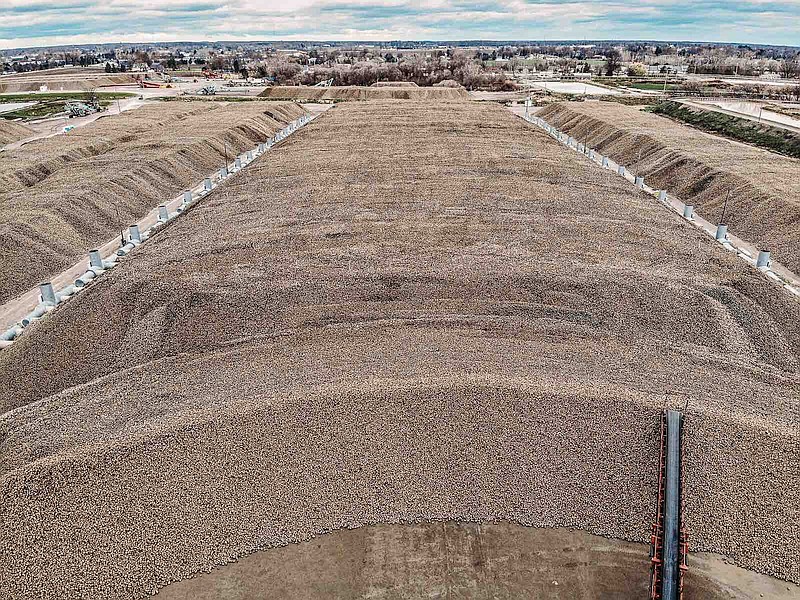
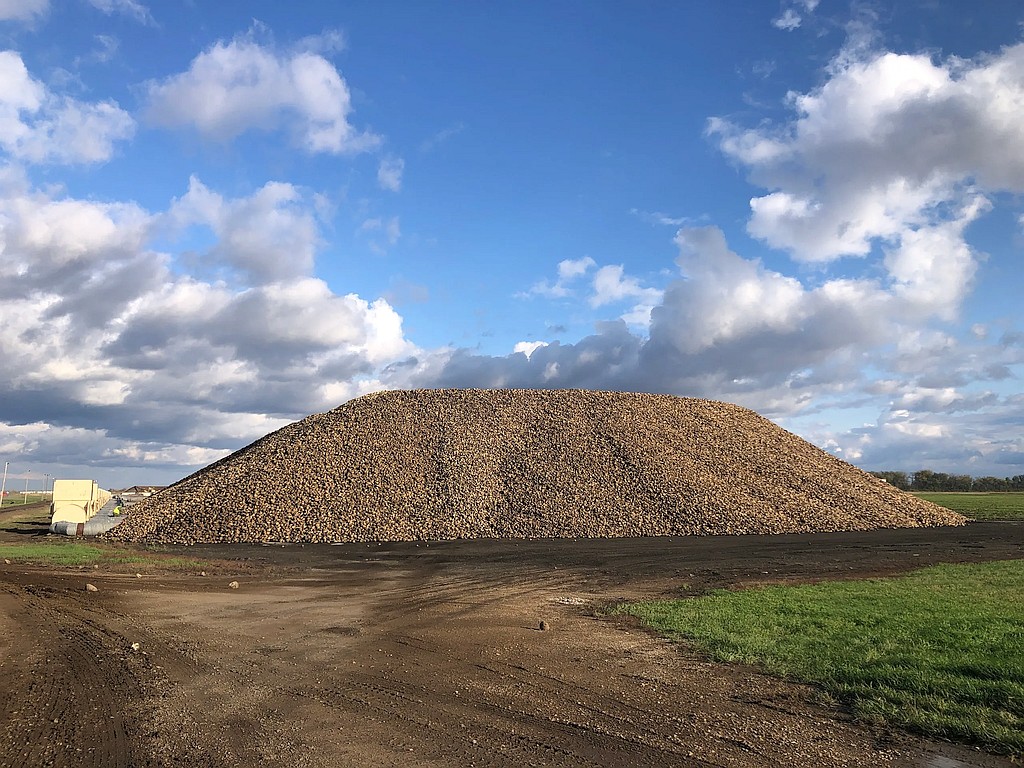
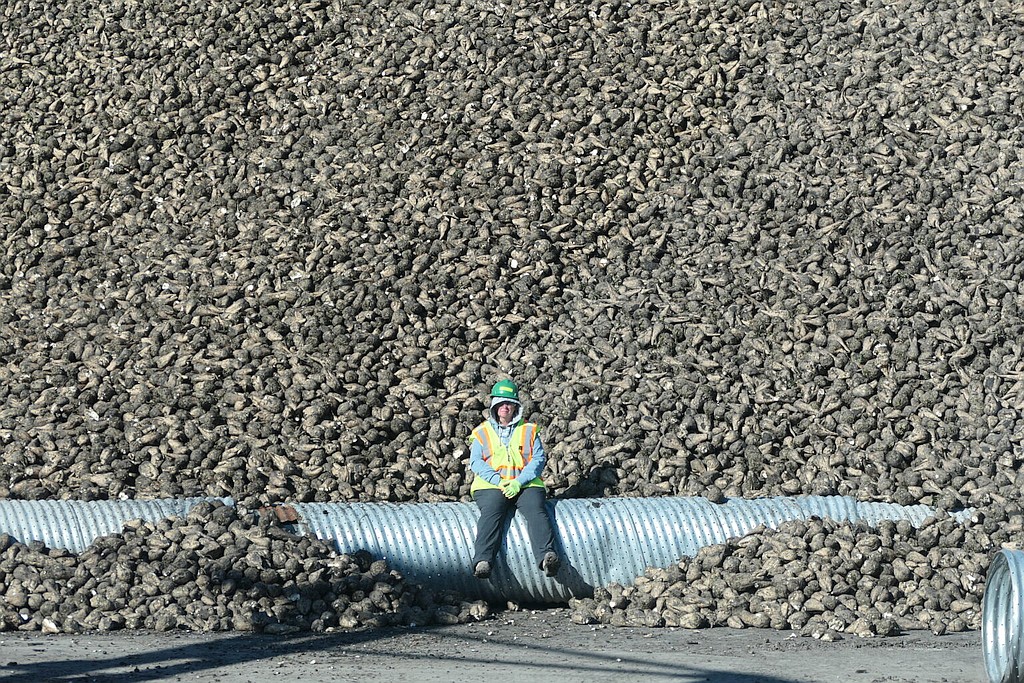
The piling locations are where trucks bring truckloads of beets and dump them in piles that are about 30 ft tall by, I don’t know, a quarter of a mile long. These sites are located all the way from as far west as Idaho to as far east as Michigan. The site we’re going to is located in Draton, North Dakota.
The shifts at my particular site in North Dakota are 12-hour shifts and there are four different jobs you can get, although technically they only hire for one, and that is the ground crew. However, you can try out to be a piler operator or a skid steer operator and then of course they have the foreman and assistant foreman, but those jobs are usually hired from within.
The beet harvest starts October 1st and you are contracted through the entire month of October, although it really only takes 2 weeks to 15 days to finish the harvest at the piling sites.
But we do need to come end of September, that’s usually when everyone’s asked to come for orientation and then you wait until the harvest starts. You’re kind of – there – and ready to go.
How Much Can You Make? Let’s get into the numbers because that’s probably what you’re most interested in. How much can you actually make at the beet harvest? Last year Joseph, being ground crew, got $18.25 an hour and you were paid hourly for the first eight hours and then, because they’re 12-hour shifts, the 4 hours after that are technically treated as overtime so you get time and a half. Plus every Saturday is time and a half, and every Sunday worked is double time.
If you don’t work because of the weather – it’s too hot or too cold to harvest the beets – then you have to stay home, but you still get 4 hours of stay pay.
The total for all of that was $3,969.42, and then you get an end of season bonus your first year of [5%] which, worked out to $677 so for a grand total of 15 days of work: $4,646.42.
Now this year the ground crew in 2023 the ground crew is getting paid $18.88 an hour. Skilled positions like the piler operator or the skid Seer operator they get paid at least an hour above that range.
Last year I was a what they call a helper sampler which is the ground crew and basically all we do is we bring the trucks in and guide them in onto the machinery that lets them dump their beets. We keep the area clean, put dirt back into the trucks and let them go. It’s really not all that hard if you don’t mind being on your feet for 12 hours a day.
The thing is, even though this is my second year, you still don’t know exactly what to expect because it’s agriculture, so the schedule can be different. Last year we started October 1st and we had a couple days working couple days off couple days working and then all of a sudden the weather changed and we worked 12 12-hour shifts in a row.
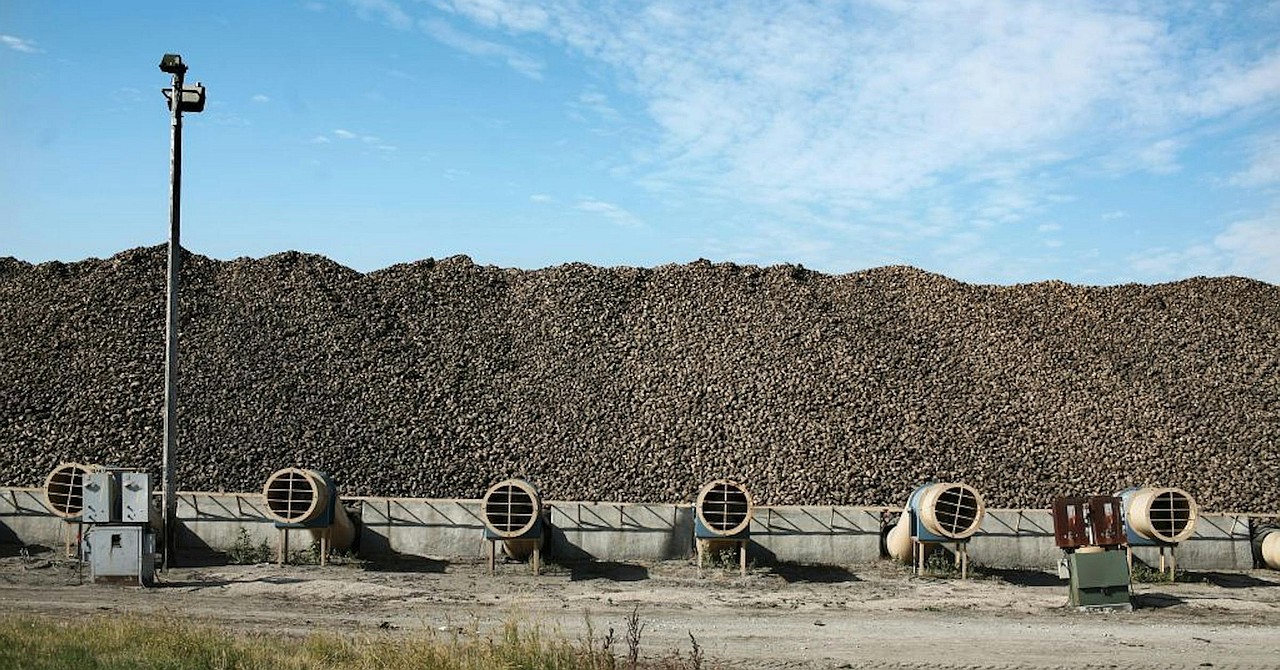
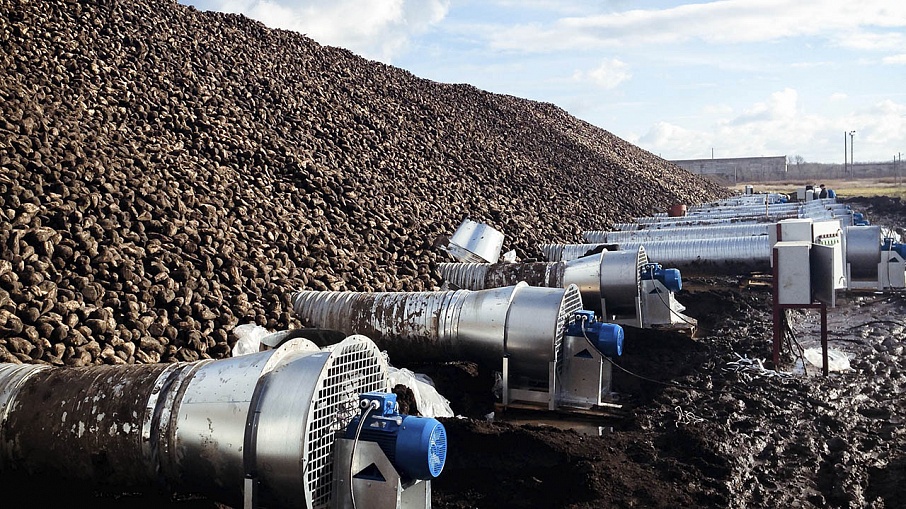
Since it often takes many months to process the mountain of sugar beets, it is necessary to ventilate the tubers to prevent spoilage. But how much air?
Interesting article on how to ventilate enormous piles of sugar beets, to prevent spoilage during the winter storage.
Airflow resistance of sugar beets … As a tool for defining ventilation requirements, this research helped to study changes in pressure and airflow characteristics in ventilated piles of sugar beets. Airflow resistance is necessary for forecasting airflow distribution in a ventilated pile and for defining the requirements for fan power….
Sugar beet is the main crop plant in the southern part of Alberta, Canada. In 1999 and 2000, 839 773 tons and 920 252 tons of beets were collected, respectively. It is necessary to store beets before their cultivation because of the short period of collecting crops and limited prospects for cultivation. Crops are usually put into storage at the end of September and this continues in October. Crop cultivation begins right away and continues until February or March, or until all crops are cultivated. Crops are kept for 120 days or more, depending on the speed of cultivation and the size of the crop.
The loss of beets during storage depends on many factors, including the time of storage, temperature of root crops, environmental temperature and the extent of mechanical and frost damage. Peterson and others (1987) calculated that beets lose from 0.15 to 0.25 kilograms of sugar per ton a day during storage. Forced air ventilation of piles is effective against the temperature rise caused by crop respiration in piles. Ventilation reduces temperature and, as a result, significantly decreases losses during storage. It was shown (1952) that sugar loss was reduced by 50% when piles were ventilated at approximately 0.005 m3/sec/ton (10 lb3/min/ton). Nevertheless, the installation of ventilation systems in Alberta was limited. Company expenses associated with the installation and use of a ventilation system should be offset by the reduction of storage losses.
It began at the Annual WLBOTT Root Vegetable Symposium, held inside a disused silo in North Dakota. UC#2, hopped up on fermented horseradish, gave a rousing speech titled: “The Future is Tuberlar: A Case for Rhizomatic Currency.”
Inspired, the Elders unveiled Beetcoin – a blockchain-based currency backed by the global beet surplus.
The Collapse
The dream decomposed quickly:
1. Counterfeit Beets flooded the market—primarily parsnips in disguise.
2. A rogue WLBOTT Elder (known only as “The Mulcher”) began a beet-hoarding scheme, driving up prices and causing panic in the Root Exchange.
3. Several “crypto-agriculturists” vanished into the Carpathians with a briefcase full of pickled currency.
Failed Marketing Attempts
Las Vegas Showgirls!
The Fashion Catwalk
Olympic Sponsorship
Retro Advertising
We bought air time on I Dream of Jeannie reruns.
One reply on “Sugar Beets and BeetCoin”
So, overall, aprox $25/hr for 15 days of 12 hour shifts. Sweet!































One reply on “Sugar Beets and BeetCoin”
So, overall, aprox $25/hr for 15 days of 12 hour shifts. Sweet!