Elder G and I flew into Kolkata on our next refueling stop, as we journey from Edmonton to Perth.
During our final approach, we see the bustling city and the Hooghly River curling beneath us.
The arrival gate is a busy cacophony, and we hear a dozen languages in our short trip to customs.
Kolkata
Kolkata is a huge metropolis, facing many challenges, including infrastructure, weather, and deep poverty.
Kolkata, also known as Calcutta (its official name until 2001), is the capital and largest city of the Indian state of West Bengal. It lies on the eastern bank of the Hooghly River, 80 km (50 mi) west of the border with Bangladesh. It is the primary financial and commercial centre of eastern and one of the gateways to northeastern India. Kolkata is the seventh most populous city in India with an estimated city proper population of 4.5 million while its metropolitan region Kolkata Metropolitan Area is the third most populous metropolitan region of India with a metro population of over 15 million. Kolkata is regarded by many sources as the cultural capital of India and a historically and culturally significant city in the historic region of Bengal.
Kolkata sits within the lower Ganges Delta of eastern India. […] [T]he city’s elevation is 1.5–9 m (5–30 ft). Much of the city was originally a wetland that was reclaimed over the decades to accommodate a burgeoning population.
Rainfall Rains brought by the Bay of Bengal branch of the south-west summer monsoon[88] lash Kolkata between June and September, supplying it with most of its annual rainfall of about 1,850 mm (73 in). The highest monthly rainfall total occurs in July and August. In these months often incessant rain for days brings life to a stall for the city dwellers.
Economy Flexible production has been the norm in Kolkata, which has an informal sector that employs more than 40% of the labour force.[30] One unorganised group, roadside hawkers, generated business worth ₹87.72 billion (equivalent to ₹300 billion or US$3.5 billion in 2023) in 2005.
As of 2003, the majority of households in slums were engaged in occupations belonging to the informal sector; 36.5% were involved in servicing the urban middle class (as maids, drivers, etc.) and 22.2% were casual labourers. About 34% of the available labour force in Kolkata slums were unemployed. According to one estimate, almost a quarter of the population live on less than ₹27 (32¢ US) per day.
Mother Teresa was awarded the Nobel Peace Prize for founding and working with the Missionaries of Charity in Kolkata—an organisation “whose primary task was to love and care for those persons nobody was prepared to look after”.
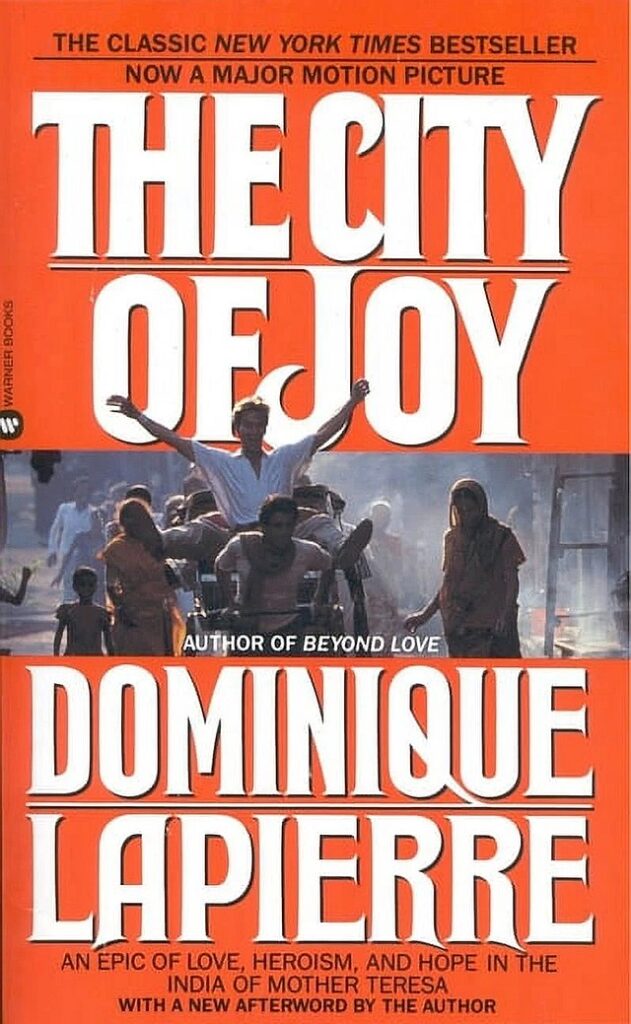
City of Joy (1985) by Dominique Lapierre is set in the 1980s within the Pilkhana slum of Howrah, an industrial town adjacent to Calcutta (now Kolkata), India. The narrative focuses on the fictional slum area known as Anand Nagar (“City of Joy”), depicting the extreme poverty, resilience, and daily struggles of its residents. This is a wonderful book; we’ve read it several times.
The most poignant scene, as I recall, is a desperately poor man who scrapes out a living by picking through the trash at a local dump, looking for anything of value. He’s ill with TB, and concerned that he has no dowry for his daughter. Providing for his family and his daughter drives him, day after day. One day, he comes across a discarded wristwatch, and this brings him great joy, knowing that this will provide for his daughter’s dowry.
City of Joy (French: La Cité de la joie) is a 1985 novel by Dominique Lapierre. It was adapted as a film by Roland Joffé in 1992. Calcutta is nicknamed “the City of Joy” after this novel, although the slum was based on an area in its twin city of Howrah.
Plot The story revolves around the trials and tribulations of a young Polish priest, Father Stephan Kovalski (a French priest named Paul Lambert in the original French version), the hardships endured by a rickshaw puller, Hasari Pal in Calcutta (Kolkata), India, and in the second half of the book, also the experiences of a young American doctor, Max Loeb.
[…]
The author has stated that the stories of the characters in the book are true and he uses many real names in his book. However, the book is considered fictional since many conversations and actions are assumed or created.
The author and his wife traveled to India many times and sometimes stay with friends in the “City of Joy”. Half of the royalties from the sale of the book go towards the City of Joy Foundation, which looks after slum children in Calcutta.
Inspiration from real life The book is set in the slum of Anand Nagar, which is based on the area of Pilkhana in Howrah, West Bengal, India. The character of Stephan Kovalski is based on the life of Gaston Dayanand, a Swiss national and nurse by profession, who moved to India in 1972 and has devoted his life to improving the welfare of slum dwellers. The book also refers to Mother Teresa and the Missionaries of Charity.
The book chronicles not only the separation of the wealthy from the poor but also the separation of the different levels of poverty, caste divisions, and the differences of the many religions living side by side in the slums. …] [A]n overall feeling of peace and well being is achieved by the story’s end. Despite facing hunger, deplorable living conditions, illness, bone-breaking work (or no work at all) and death, the people still hold on to the belief that life is precious and worth living, so much that they have named their slum Anand Nagar, which means “City of Joy“.
GOHALOPATA (India), May 26 — Decades after inspiring a best-selling novel that brought readers into slums near Kolkata, 86-year-old ascetic Gaston Dayanand is still working for India’s poorest.
His life helping people in the mega-slums of Pilkhana formed the plot of Dominique Lapierre’s 1985 book The City of Joy, which was later turned into a Patrick Swayze movie.
Born in 1937 to a Swiss working-class family in Geneva, Brother Gaston said he remembered deciding at six years of age to dedicate his life “to Christ and the poor”.
“I never wanted to be a priest,” the brother of the Prado congregation told AFP at the Inter-Religious Center of Development (ICOD), an NGO he co-founded in Gohalopata, a village 75 kilometres (45 miles) southwest of Kolkata.
“The church would never have let me live in a slum with the poor, but my life was about sharing with the poorest.”
A trained nurse, Brother Gaston arrived in India in 1972 to work with a French priest in a small self-help centre in Pilkhana.
“I will earn my bread until the last day of my life,” he said.
To the western audience, probably the most famous Kolkata / Calcutta resident was Mother Teresa. Although credited with many good works, she is not without controversy.
For those interested, there are a couple of resources dig deeper into the dark side of her type of altruism.
This isn’t really the forum to dig into the controversy, but my take-away is that it is so easy to be blinded by ideology (religious, political, etc.). Fanaticism leads us to lose our connection to humanity. We must always be learning, always be open to suggestion, even criticism, and always be willing to accept our own limits.