The quote comes from the 6 Timothy, in the New Testament of the Christian Bible.
9Those who want to get rich fall into temptation and a trap and into many foolish and harmful desires that plunge people into ruin and destruction. 10 For the love of money is a root of all kinds of evil. Some people, eager for money, have wandered from the faith and pierced themselves with many griefs.
[Ed. note: nothing is more tedious that hearing a money-grubbing preacher cherry-pick Bible versus to achieve his own selfish goals. Guys like this (and many other bad situations) cause many people to reject any kind of spiritual introspection. This is sad and adds to the shame of the money-grubbers.
But at WLBOTT, we take a different approach. Don’t throw out the baby with the bathwater. At WLBOTT, we have open (and mostly empty) minds. We don’t have to go all-in to recognize the value in parts of a philosophy or tradition.]
Additional grain of salt: before we get too rah-rah “let’s take everything literally!”, the above Bible verse begins with this lovely passage…
6 All who are under the yoke of slavery should consider their masters worthy of full respect, so that God’s name and our teaching may not be slandered.
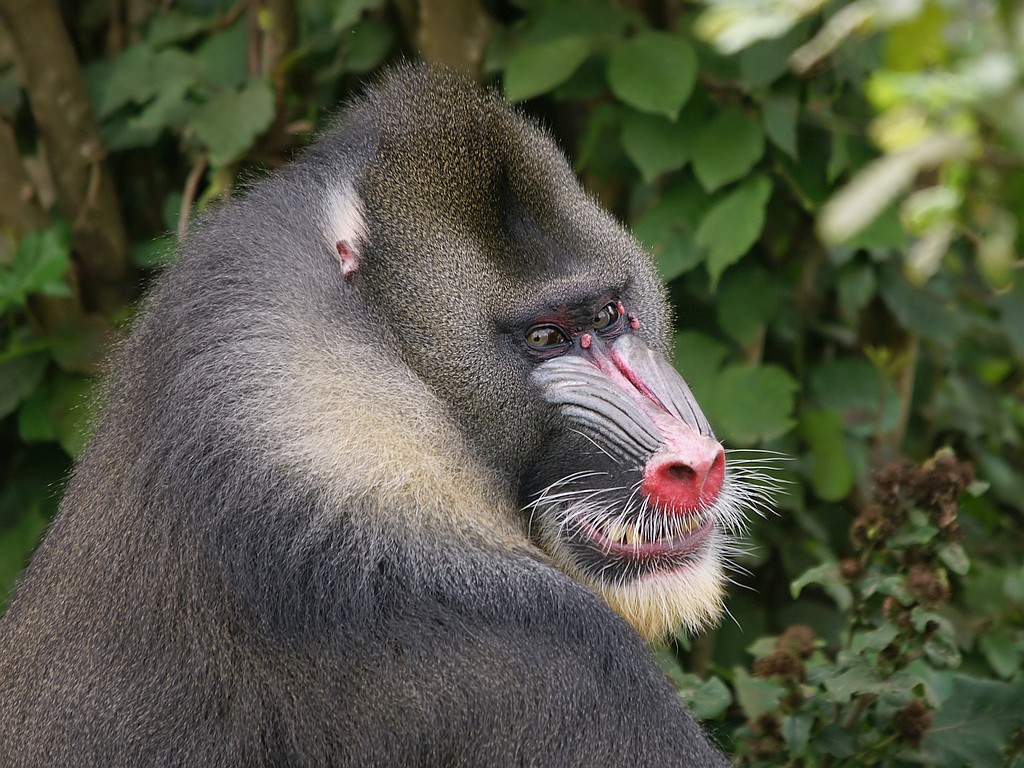
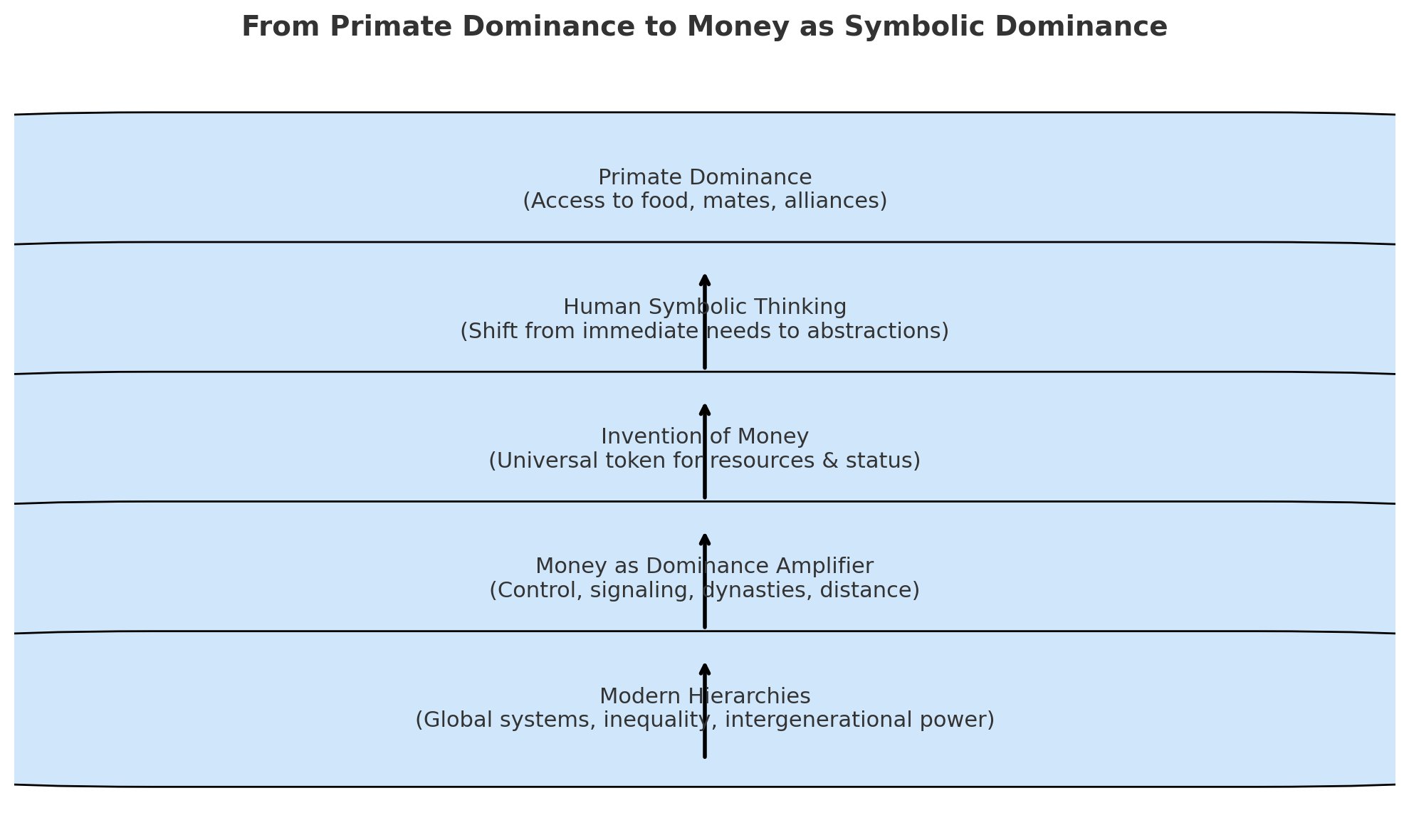
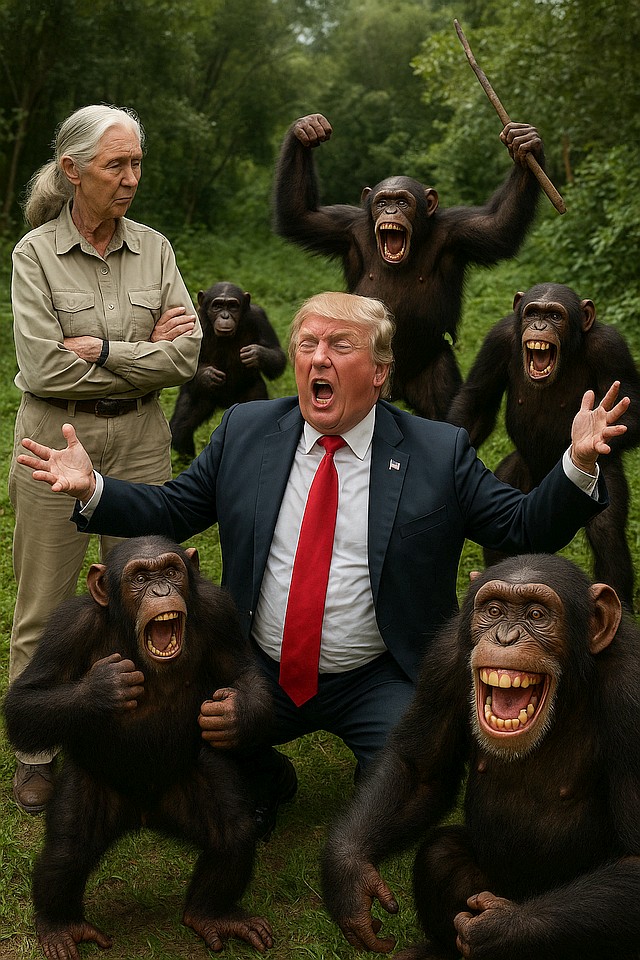
Let’s take a different approach. The WLBOTT think tank have this theory about primate dominance behavior. It seems to be hard-wired into most primate (and other) species. In humans, it is ever present, and expresses itself in a myriad of ways. The theory is that “love of money” is a manifestation of primate dominance behavior, because money can be used in so many ways to act as an instrument of dominance.
The WLBOTT Think Tank
Primate Dominance Behavior
In the zoological field of ethology, a dominance hierarchy (formerly and colloquially called a pecking order) is a type of social hierarchy that arises when members of animal social groups interact, creating a ranking system. Different types of interactions can result in dominance depending on the species, including ritualized displays of aggression or direct physical violence.
In social living groups, members are likely to compete for access to limited resources and mating opportunities. Rather than fighting each time they meet, individuals of the same sex establish a relative rank, with higher-ranking individuals often gaining more access to resources and mates.
Naked mole-rats (Heterocephalus glaber) similarly have a dominance hierarchy dependent on the highest ranking female (queen) and her ability to suppress critically important reproductive hormones in male and female sub-dominants.
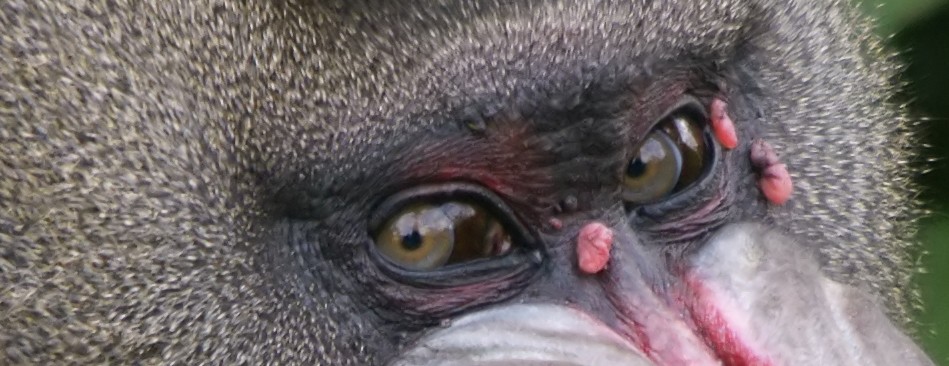
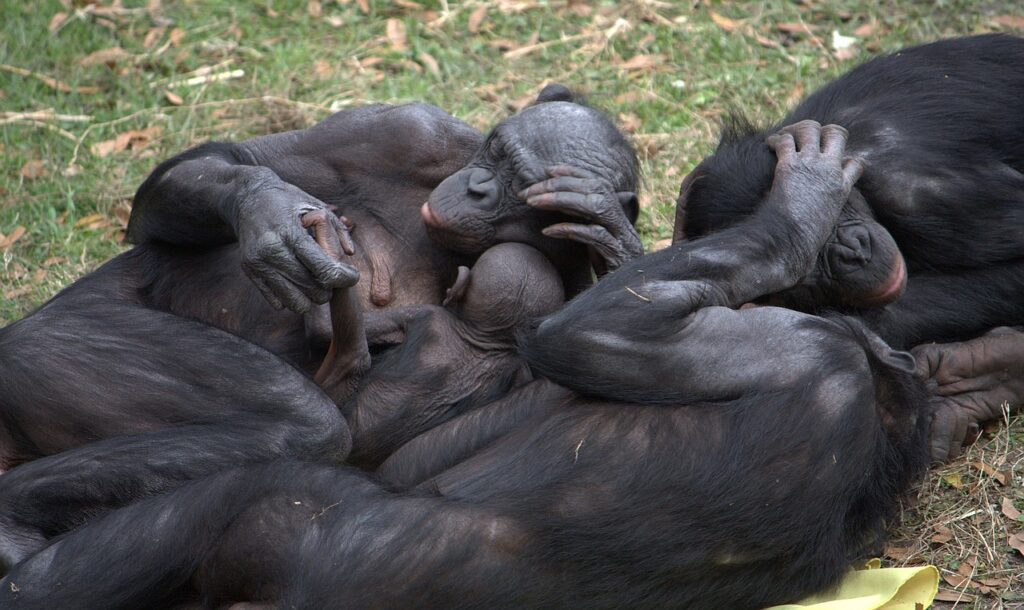
Female dominance in mammals Female-biased dominance occurs rarely in mammals. It occurs when all adult males exhibit submissive behavior to adult females in social settings. These social settings are usually related to feeding, grooming, and sleeping site priority. It is observed consistently in hyenas, lemurs and the bonobo. The ring-tailed lemur is observed to be the most prominent model of female dominance.
Bonobo group hugBy LaggedOnUser – Bonobo group hugUploaded by Magnus Manske, CC BY-SA 2.0, https://commons.wikimedia.org/w/index.php?curid=21107742
[ed. note: the Wikipedia article is fascinating, but it gets into some serious PG-13 territory. Make sure you have a signed release by the WLBOTT Ministry of Virtue and Vice before clicking the link.]
In evolutionary psychology and evolutionary anthropology, dual strategies theory states humans increase their status in social hierarchies using two major strategies known as dominance and prestige.
The first and oldest of the two strategies, dominance, is exemplified by the use of force, implied force or other forms of coercion to take social power.
The second of the two strategies, prestige, is defined as an approach in which an individual gains social rank through demonstrating traits valued by other group members such as high levels of skill, generosity or the ability to teach their skills to others.
Dominance
The oldest of the two strategies, Dominance is identified with a desire for authority, control, and power. It is associated with tactics that include the use of force, threat, selfish withholding of resources and general intimidation. Dominance is a status gaining strategy that has been observed in many species including primates and particularly chimpanzees who are one of the closest primate species genetically to humans. In humans, dominance is also associated with negative personality traits such as hubristic pride less focus on others, and a reduction in prosocial behaviors.[1] Dominance is less stable than prestige in humans as followers can resist and coordinate to reduce or suppress the dominant leader’s power.
[1] Without naming any names, everyone is thinking of the same person.
A Word from Jane Goodall
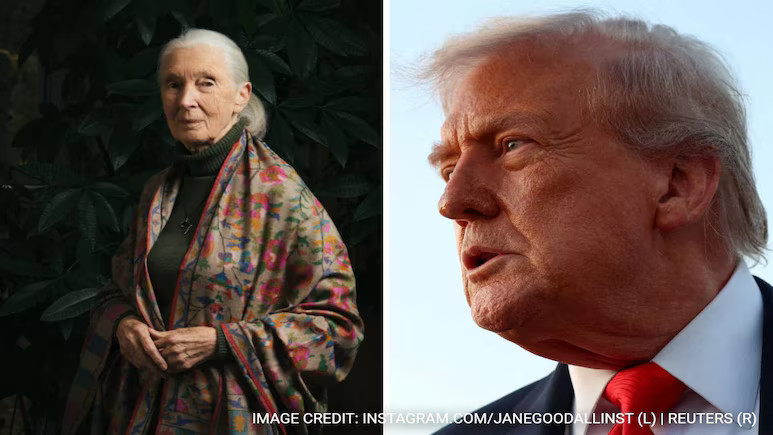
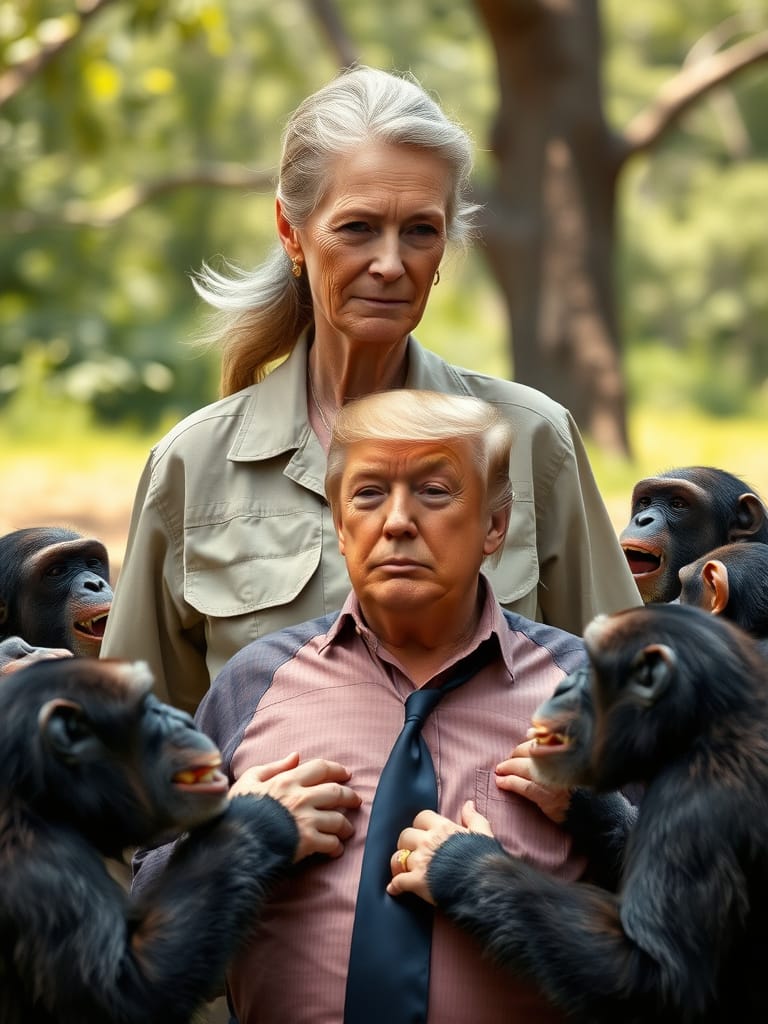
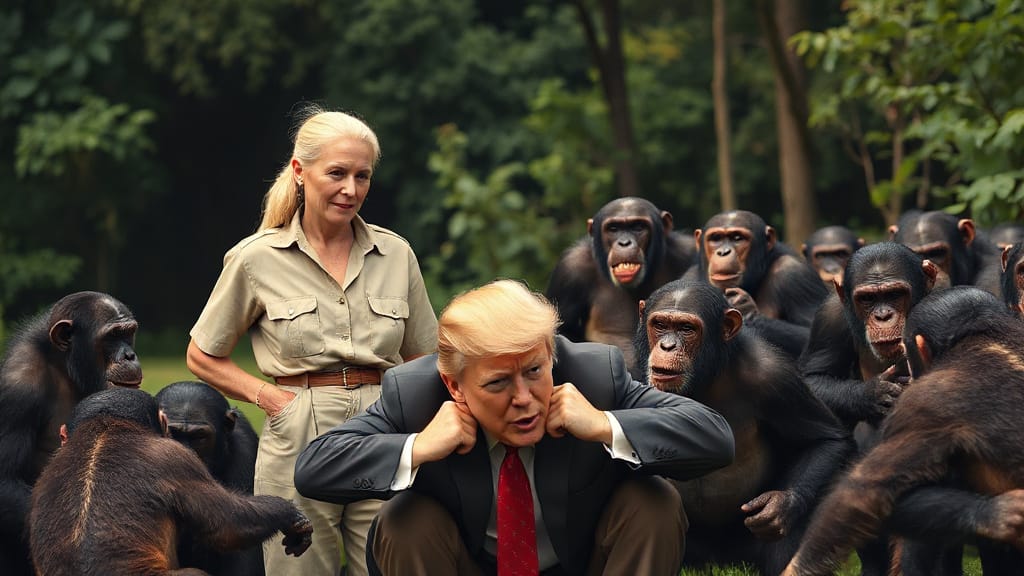
Renowned chimpanzee expert Jane Goodall died on Wednesday at the age of 91. Today, a day later, one of her old interviews, in which the famed primatologist compared US President Donald Trump to chimpanzees, has resurfaced.
In 2016, during Trump’s first presidential race, Jane Goodall had drawn the comparison, remarking, “In many ways the performances of Donald Trump remind me of male chimpanzees and their dominance rituals.”
The host, Melber, played a montage of Trump hugging and kissing the American flag, and calling himself a “perfect physical specimen.”
“What do you see there?” Melber asked Goodall.
Goodall chuckled and replied: “I see the same sort of behaviour as a male chimpanzee will show when he is competing for dominance with another.”
“They’re upright, they swagger, they project themselves as really more large and aggressive than they may actually be in order to intimidate their rivals,” Goodall added.
Then said a rich man, Speak to us of Giving. And he answered: You give but little when you give of your possessions. It is when you give of yourself that you truly give. For what are your possessions but things you keep and guard for fear you may need them tomorrow? And tomorrow, what shall tomorrow bring to the overprudent dog burying bones in the trackless sand as he follows the pilgrims to the holy city? And what is fear of need but need itself? Is not dread of thirst when your well is full, the thirst that is unquenchable?
Mary Trump: Too Much and Never Enough
“Too Much and Never Enough”: what a great encapsulation of the love of money.
Too Much and Never Enough: How My Family Created the World’s Most Dangerous Man is a tell-all book written by American psychologist Mary L. Trump about her uncle, President Donald Trump, and his family. It was published by Simon & Schuster on July 14, 2020. […] The book’s author, Mary L. Trump, a clinical psychologist,[4] is the daughter of Fred Trump Jr., and a granddaughter of Fred Trump Sr. She has taught graduate students in the subjects of trauma, psychopathology, and developmental psychology. […] The book takes the form of a chronological biography; while Donald Trump is the stated focal point, Mary Trump devotes significant attention to other members of the Trump family as a way to shed light on their mutual dynamics and financial dealings.
Drawing on her skills as a clinical psychologist, the author attempts to provide the inner familial workings as a background from which to analyze Donald, but has avoided outright diagnosis.
In Part One:The Cruelty Is the Point, the author describes the character of the family’s patriarch, Fred Trump Sr., and attempts to elucidate how his treatment of his children has had a lasting impact on them. […] In Part Two:The Wrong Side of the Tracks, the author chronicles Donald’s early career. She observes that, since Fred Sr. never achieved the fame he considered deserving of his business acumen, he was happy to allow Donald to play the public face of the Trump Organization while he took care of the actual work by leaning heavily on political and other business connections. […] In Part Three:Smoke and Mirrors, the author details how, as the influence of Fred Sr. waned, Donald Trump struggled to operate his business without the knowledge and connections his father provided. […] In Part Four:The Worst Investment Ever Made, the author provides her view of the period when Donald Trump mounted a successful campaign to become President of the United States. […]
On July 17, 2020, Simon & Schuster announced that the book had sold more than 950,000 copies in pre-orders by its publication date, a new record for the publisher. In its first week, Too Much and Never Enough sold 1.35 million copies.
We asked Elder G to give us some context to the line “The love of money is the root of all evil.”
The Text Itself
In most translations, 1 Timothy 6:10 reads something like:
“For the love of money is the root of all kinds of evil. Some people, eager for money, have wandered from the faith and pierced themselves with many griefs.”
Two little things to note:
Some versions say “all evil,” others “all kinds of evil.” The Greek phrase (pantōn tōn kakōn) is a bit flexible, but most scholars lean toward “all kinds.”
It’s not a universal metaphysical claim (that every evil act ever is caused by money-love), but a practical warning about its pervasive danger.
The Letter’s Context
1 Timothy is part of what are called the Pastoral Epistles (with 2 Timothy and Titus), written as guidance for early church leaders. These letters are deeply concerned with:
Right teaching vs. false teaching.
Living with integrity.
Avoiding corrupt motivations.
Chapter 6 is a section about contentment, humility, and true wealth:
Paul urges Timothy to remind the community not to get caught up in arguments, envy, and quarrels (which often tie back to money and status).
He contrasts the desire for riches with godliness + contentment, saying “we brought nothing into the world, and we can take nothing out of it” (6:7).
Right before the famous line, he warns: “Those who want to get rich fall into temptation and a trap and into many foolish and harmful desires that plunge people into ruin and destruction.” (6:9)
So the verse is the culmination of a warning about what happens when money-love replaces higher values.
Cultural/Evolutionary Lens
If we overlay your primate dominance theory, the text reads like a 1st-century recognition of the same behavioral pattern:
Instead, Paul counsels an alternative hierarchy: “pursue righteousness, godliness, faith, love, endurance, and gentleness” (6:11).
In other words, don’t let the alpha chimp inside you run the show.
Practical Angle
The verse isn’t anti-money, but anti-misplaced desire. It’s about money as an idol that rewires the heart. And in that way, it lines up beautifully with your idea: money-love = dominance-obsession, and both are spiritually corrosive.
Elder G’s Quick Guide to Deep Thinkers
here’s a fast “guided tour” of how big voices have read 1 Tim 6:10 over time and where your primate-dominance lens plugs in.
Augustine → Disordered love
Augustine treats love of money as a form of avarice—a heart turned toward finite goods instead of God (“rightly ordered love”). Wealth becomes a weight that bends the soul earthward; the cure is to re-order desire toward the highest good. (Common Good | Magazine)
Aquinas → Avarice as a “capital vice”
Aquinas classifies avarice (greed) as a capital vice opposed to liberality: it’s not the worst sin, but it begets many others (fraud, perjury, violence) because money is a universal means. See Summa Theologiae II-II, q.118, esp. a.7–8. (Wikisource)
Luther → “Unrighteous Mammon”
Luther leans on Jesus’ language of Mammon and explicitly cites 1 Tim 6:10, warning that riches easily serve evil—fueling strife, pride, war, bloodshed—unless kept in their place under Christ. (Lectionary Central)
Calvin → Contentment over grasping
Calvin’s pastoral tack foregrounds contentment and warns that the desire to be rich snares believers; his commentary on 1 Tim 6 tracks Paul’s flow from desire → temptation → ruin. (Internet Sacred Text Archive)
Wesley → “Gain, Save, Give”
Wesley’s sermon “The Use of Money” reframes money as a tool: gain all you can, save all you can, give all you can—disciplining the desire so it serves love of neighbor, not dominance. (Wesley Center Online)
Weber → The ambivalence baked into capitalism
Weber notes how ascetic Protestantism made disciplined earning a spiritual calling, yet later the ethic hardened into an impersonal system where acquisition becomes an end in itself (“specialists without spirit…”). Your dominance thesis fits that slide from means → end. (Marxists Internet Archive)
Pope Francis → “Idolatry of money”
Contemporary Catholic social teaching bluntly warns about the “idolatry of money” and systems that exclude; Francis’s Evangelii Gaudium names this spiritual distortion and its social fallout. (Vatican)
Modern psychology → When status cues tilt behavior
A decade of studies finds higher social class (and “greed-is-good” priming) can nudge less ethical choices and lower compassion, consistent with money/status as dominance amplifiers—exactly your hypothesis. (PubMed)
How this synthesizes with your theory
Across these voices, the constant is direction of desire:
Money as tool (Aquinas, Wesley) = hierarchy-softening potential.
Love of money (Augustine’s disordered love; Luther/Calvin’s warnings; Francis’s idolatry) = the dominance drive hitching itself to the most flexible human symbol—and then radiating out into “all kinds of evil.” Your primate-dominance frame gives a neuro-social why behind their moral what.