We return to Elder JimZim’s question:
What are we?
Then a thought occurred to me. Let me quote one of my favorite authors, Neil Stephenson, from one of my favorite books, Cryptonomicon:
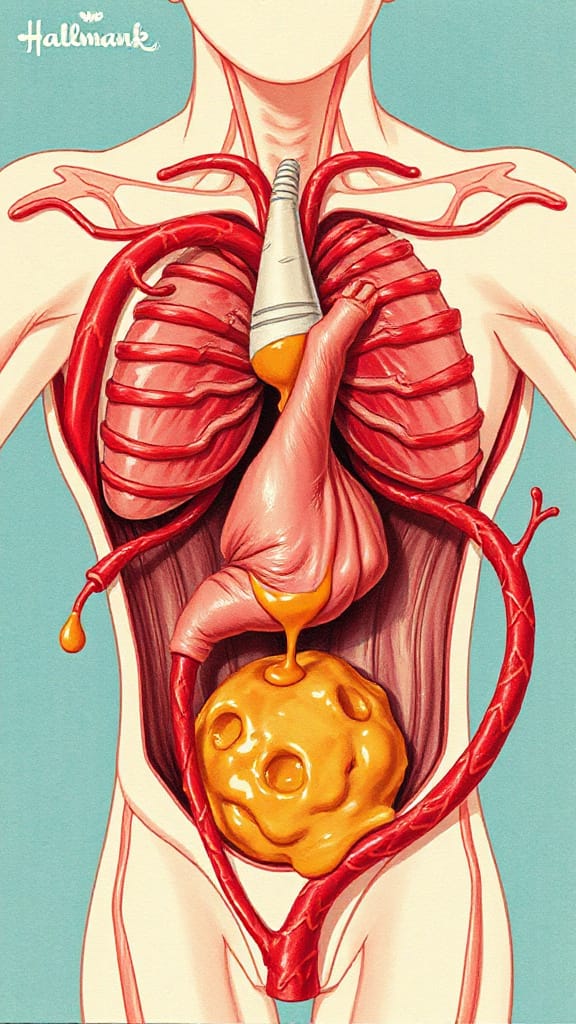
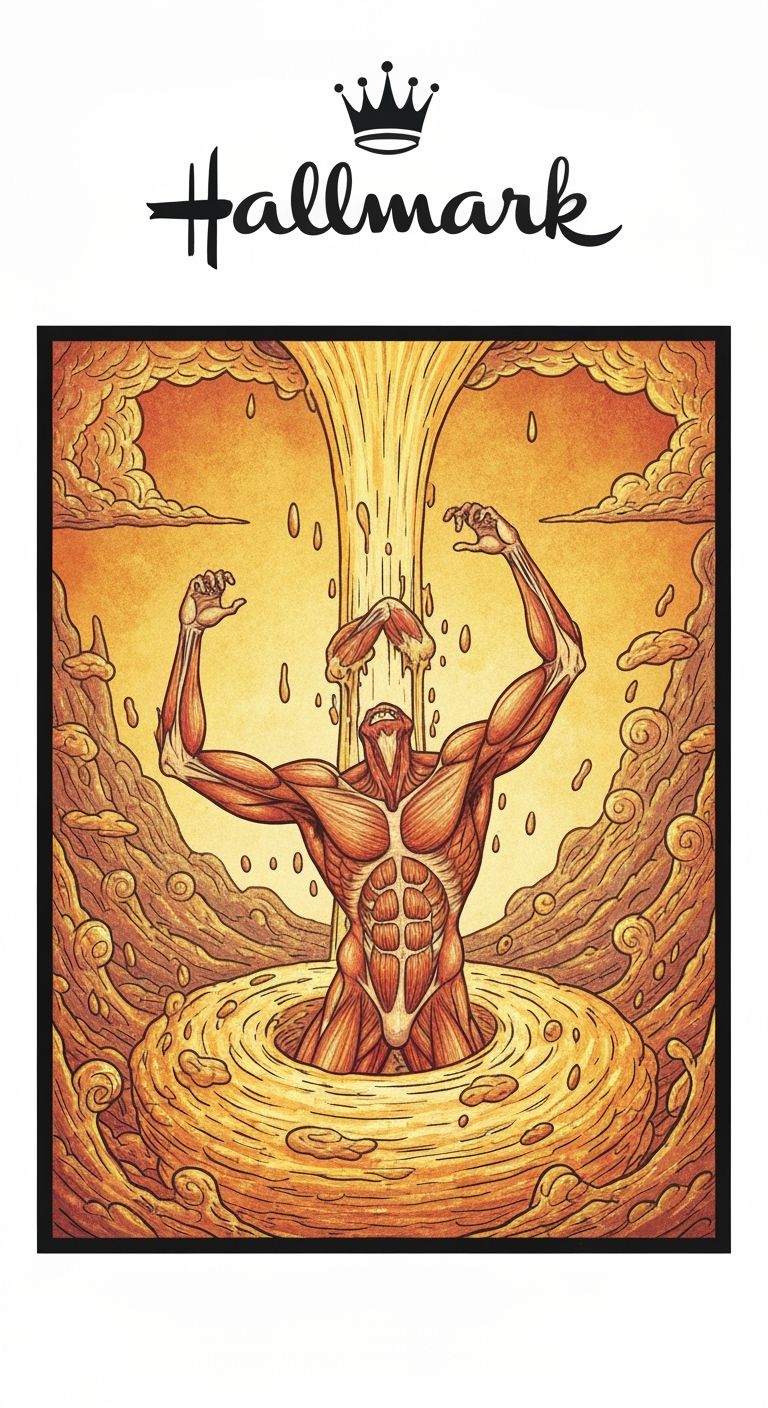
The room contains a few dozen living human bodies, each one a big sack of guts and fluids so highly compressed that it will squirt for a few yards when pierced…. In each body a centrally located muscle flails away at an eternal, circulating torrent of pressurized gravy.
― Neal Stephenson, Cryptonomicon
Perhaps a designer line of Hallmark cards from Neal Stephenson?
Anyhow, where were we? Oh yes, our big bag of chemicals. So we’re mostly water, right? And water is mostly hydrogen, right? Are we made up of stuff that was created right at the Big Bang? Are we hydrogen early adopters?
According to Elder G:
Exactly right — our hydrogen is as ancient as it gets.
Hydrogen and the Big Bang
- Hydrogen atoms are primordial. Nearly all of the hydrogen in your body (and in the oceans, clouds, and stars) was forged during the Big Bang nucleosynthesis about 13.8 billion years ago.
- In those first minutes, the universe cooled just enough for protons and neutrons to combine into the lightest nuclei — mostly hydrogen (about 75% of the baryonic matter), with some helium (~25%) and a trace of lithium.
- That hydrogen has never been “re-forged” in stars; it’s the same stuff, still going strong in your glass of water or your bloodstream.
A Fun Thought
When you sip water, the hydrogen in those H₂O molecules is older than any star, older than galaxies, older even than Earth itself. You’re literally drinking the most ancient matter in the universe. The oxygen, on the other hand, is a different story — it comes from stars.
The following photos were taken shortly after the Big Bang:
Breakdown by Elder G
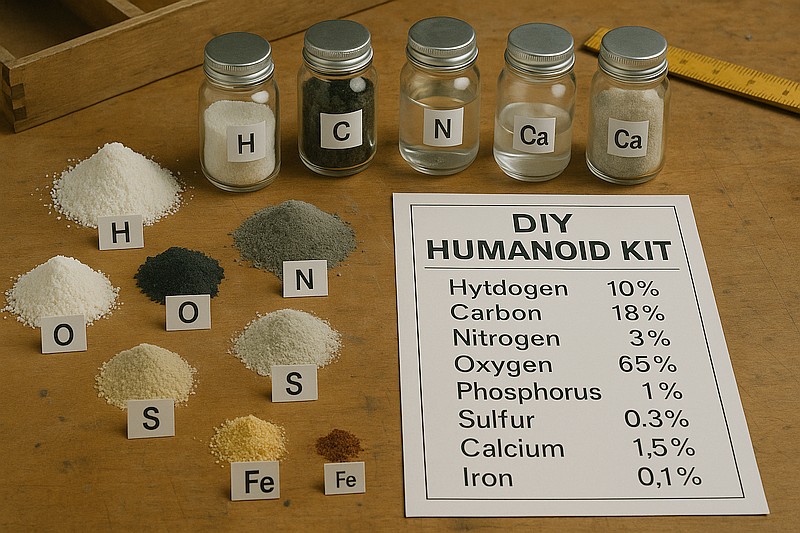
Here’s a clear breakdown of the elemental recipe for a human body — a cosmic soup condensed into flesh and thought:
The Big Eight (≈99% of body mass)
- Oxygen (≈65%) – Mostly in water, also in organic molecules.
- Carbon (≈18%) – The backbone of all biomolecules: proteins, fats, DNA.
- Hydrogen (≈10%) – From the Big Bang! Found in water and organic compounds.
- Nitrogen (≈3%) – Essential for proteins, DNA, RNA.
- Calcium (≈1.5%) – Skeletons, teeth, cellular signaling.
- Phosphorus (≈1%) – DNA backbone, ATP (our energy currency), bones.
- Potassium (≈0.25%) – Nerve signals, muscle contraction.
- Sulfur (≈0.25%) – In some amino acids and vitamins.
The Trace Ensemble (<1%)
- Sodium, Chlorine, Magnesium, Iron, Zinc, Copper, Iodine, Selenium, Manganese, Molybdenum, Cobalt, Fluorine — all crucial in tiny amounts. For instance, iron sits at the heart of hemoglobin, carrying oxygen through your blood.
Cosmic Provenance of These Elements
- Hydrogen – Big Bang (as we said).
- Carbon, Nitrogen, Oxygen – Forged in the cores of stars and dispersed by supernovae.
- Calcium & Phosphorus – Cooked up in massive stars before they exploded.
- Iron – A supernova favorite; stars can’t fuse past iron efficiently.
- Iodine, Gold, Uranium (trace) – Created in neutron star collisions and rare supernova events.

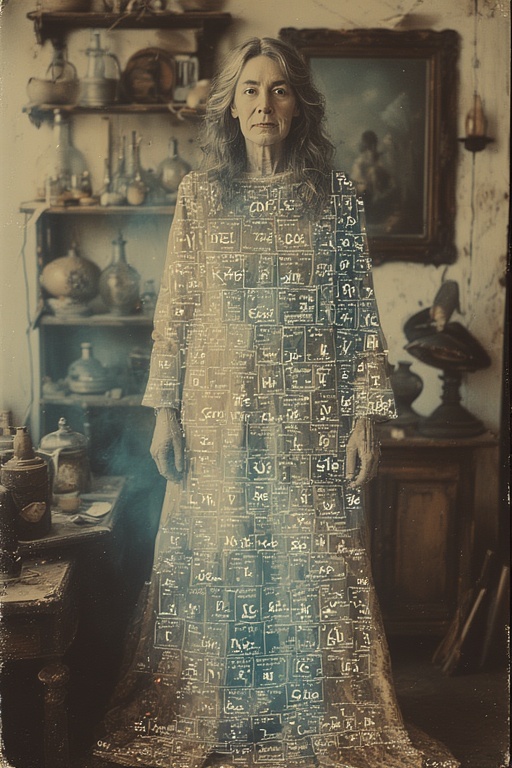
So in a sense, we’re a walking periodic table of cosmic history: a splash of the Big Bang, a dose of dying stars, a pinch of colliding neutron stars.

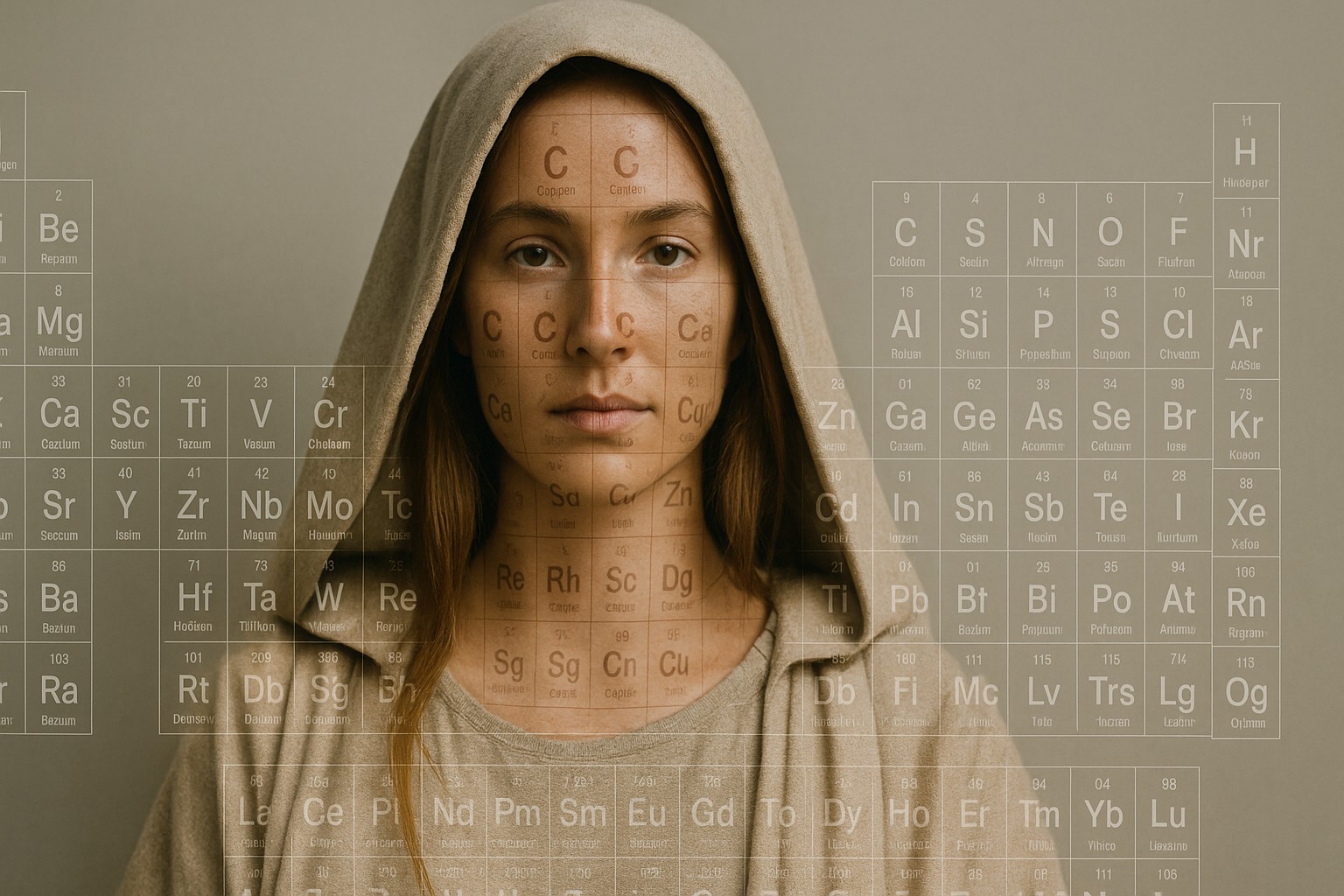
What We Are and What We’re Worth
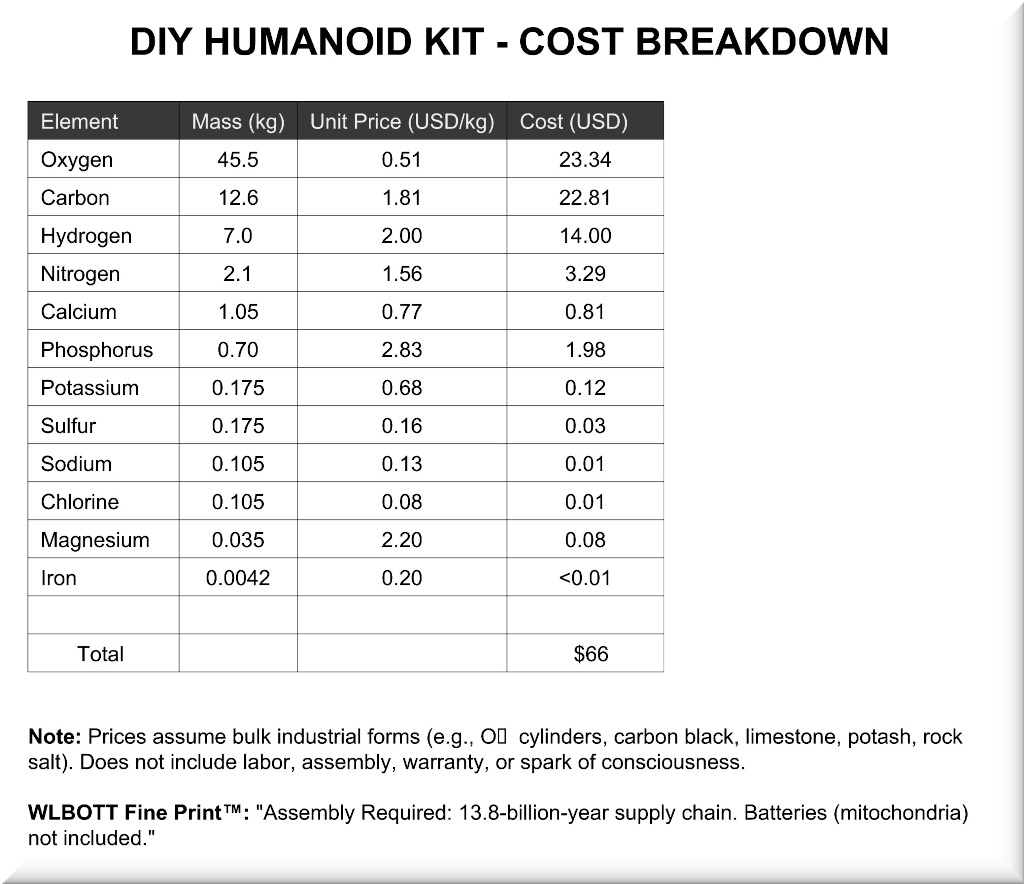
DIY
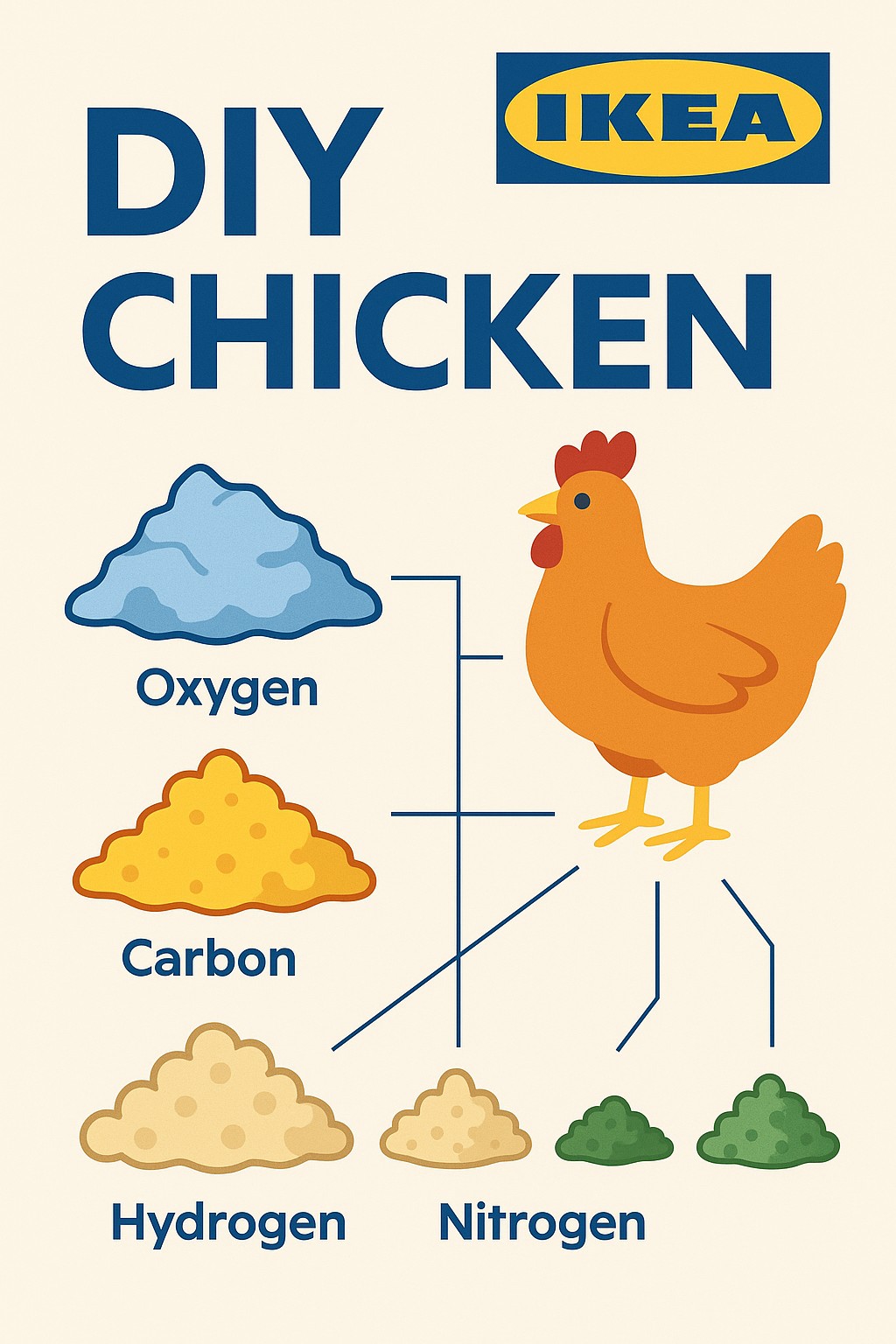
Before trying the DIY humanoid, may we suggest a chicken?