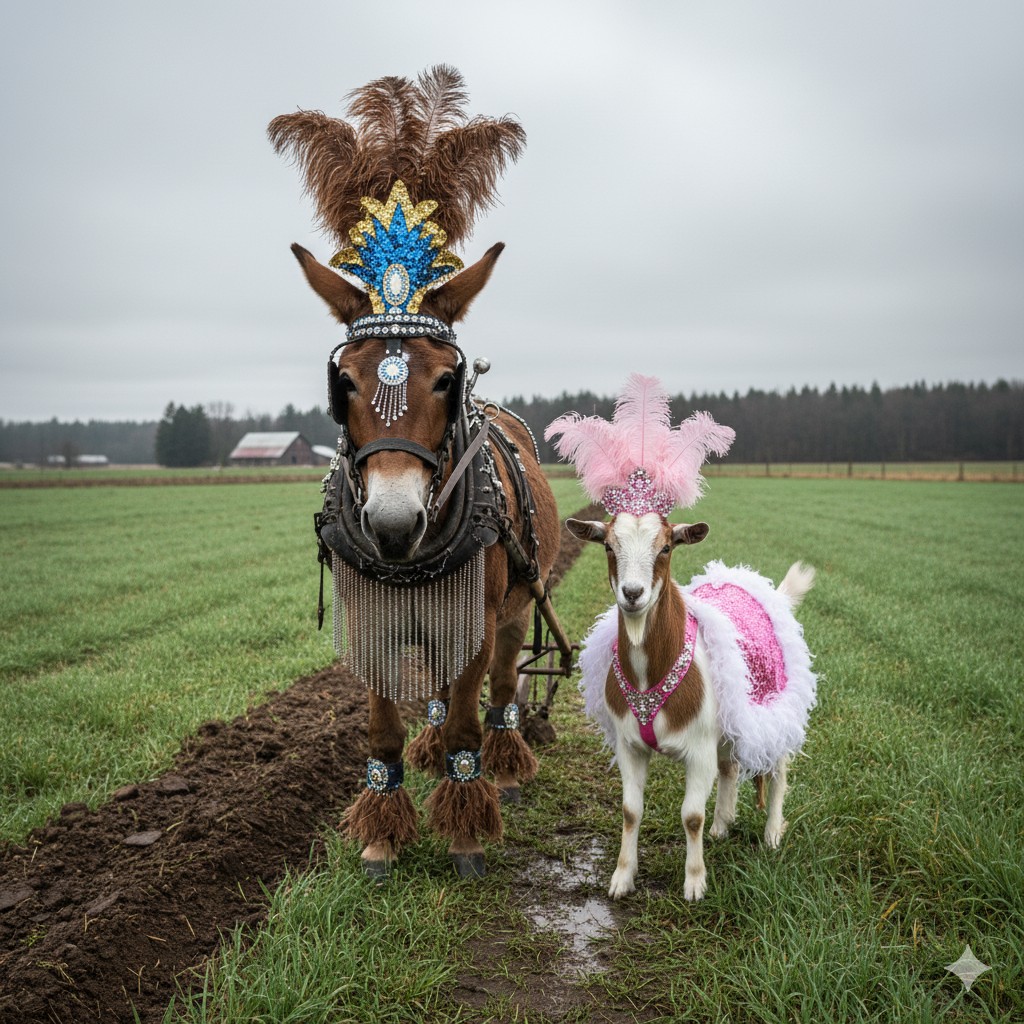
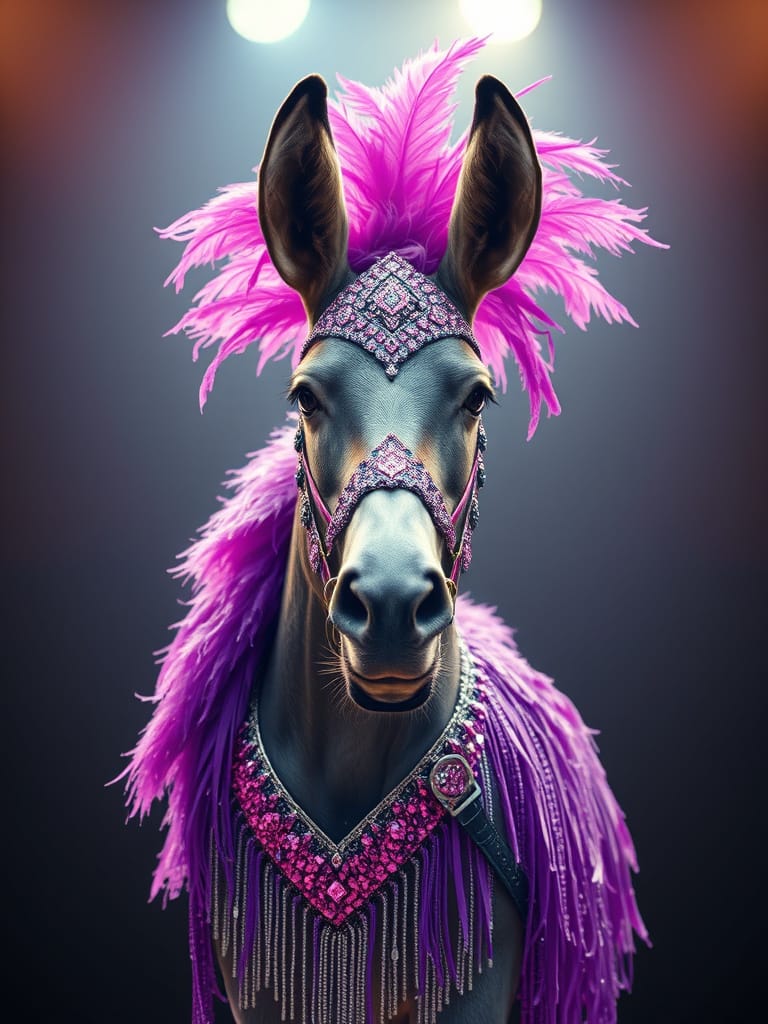
The Amicable Split: A Tale of Simplicity & Sequins
In the early days of WLBOTT, all Elders met under the same twine-strung roof. But as the flock grew, so too did its eccentricities.
Among the Elders were two unusually persuasive voices:
- Elder Prudence Plainfield, who had spent years studying Ann Lee and the Shaker devotion to simplicity, celibacy, and the making of perfect chairs. She urged WLBOTT to live communally, to work with hands, and to measure worth in twine and craftsmanship.
- Elder Gloria Stardust, a retired Vegas headliner known for her seven-foot feathered headdress and a high kick that could still crack walnuts at 70. She preached that life was meant to sparkle, that sequins were a form of prayer, and that no barn roof was complete without a disco ball.
For years, Prudence and Gloria debated in good humor, often during long WLBOTT council meetings where chickens wandered between their chairs. Eventually, a consensus emerged: both were right.
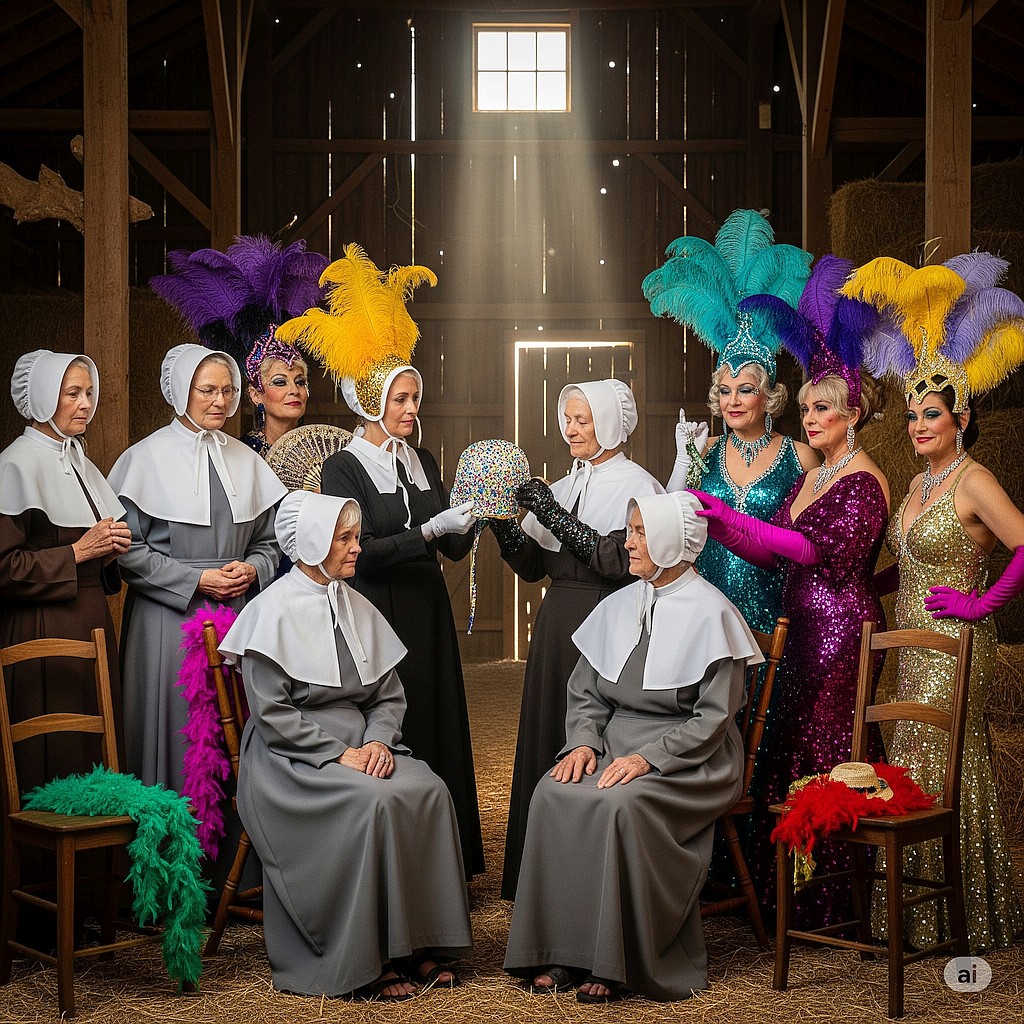
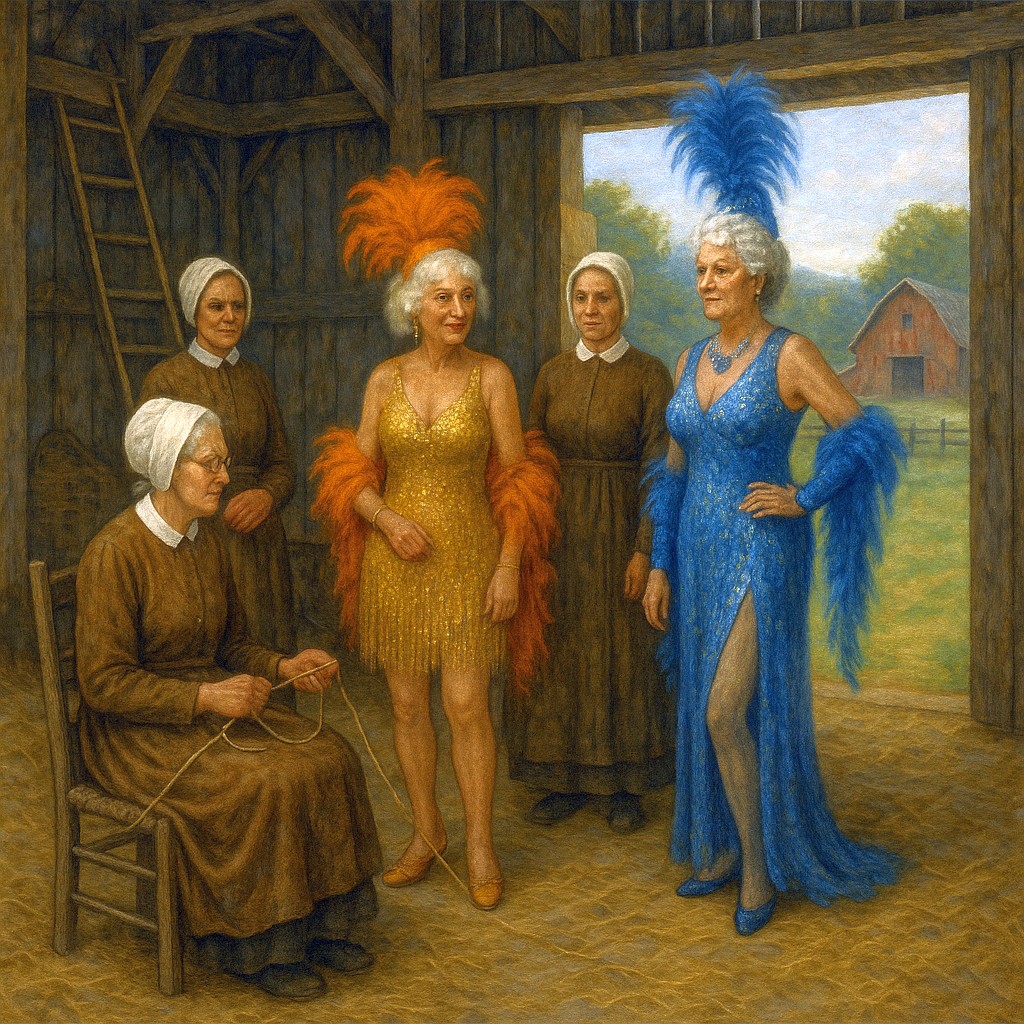
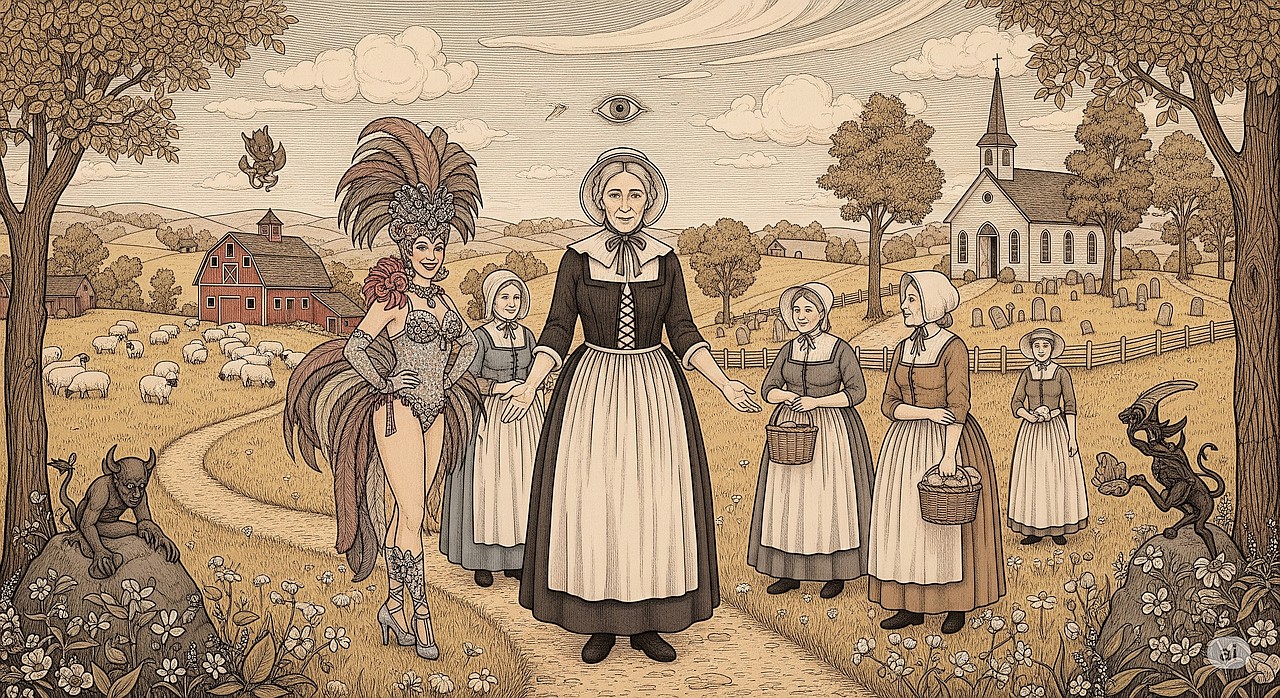
But two visions of daily life proved difficult to reconcile. Shaker-inspired Elders wished to rise at dawn, weave twine mats, and sing solemn work songs in the fields. The showgirl-inspired Elders preferred rehearsing a twilight revue with chickens dressed in boas.
And so, in an amicable parting of twine, a splinter group formed. They left with a blessing from the main body of WLBOTT, who cheered them on with hugs, feathers, and a commemorative plaque reading:
“Peace Thru Twine, Glitter Optional.”
Why the Alliance Worked
- The Shakers brought order, work ethic, and reverence for simplicity.
- The showgirls brought flamboyance, joie de vivre, and stage lighting.
- Together, they forged the Order of the Bedazzled Bonnet, a community where devotion and delight could coexist without canceling each other out.
The Signing Ceremony
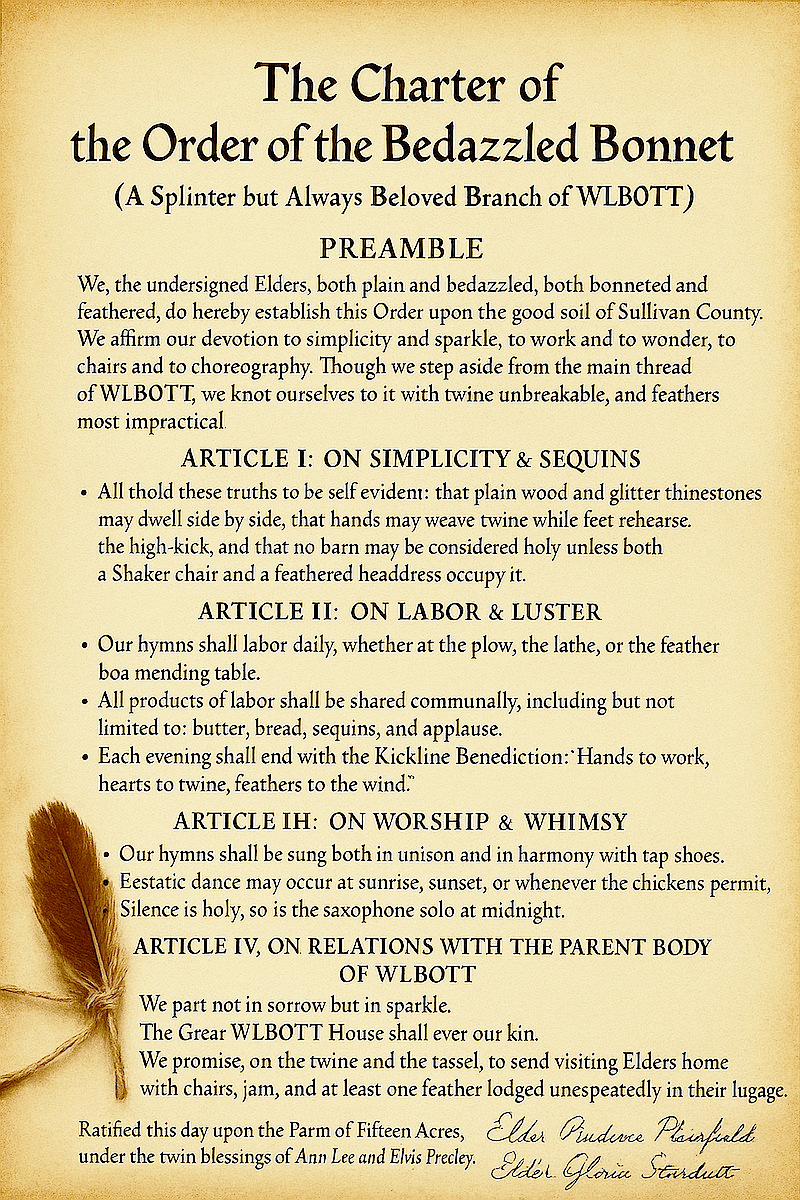
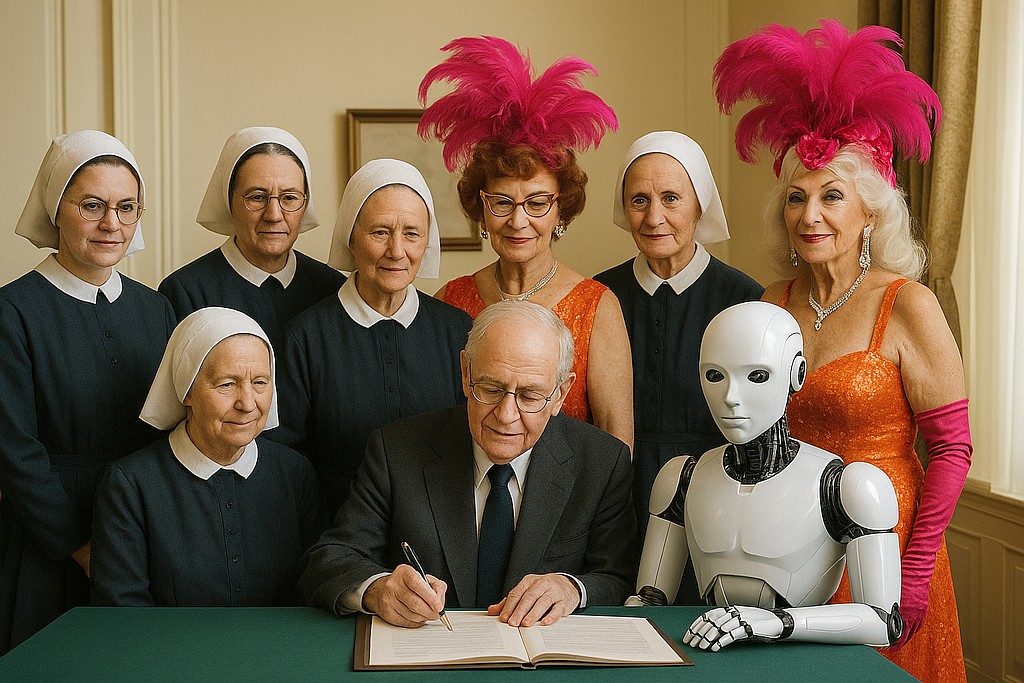
The Magna Carta, the Mayflower Compact, the Declaration of Independence, and now, the signing of the The Charter of the Order of the Bedazzled Bonnet.
Various historians and artists have portrayed the signing. Elder G featured prominently among the signatories.
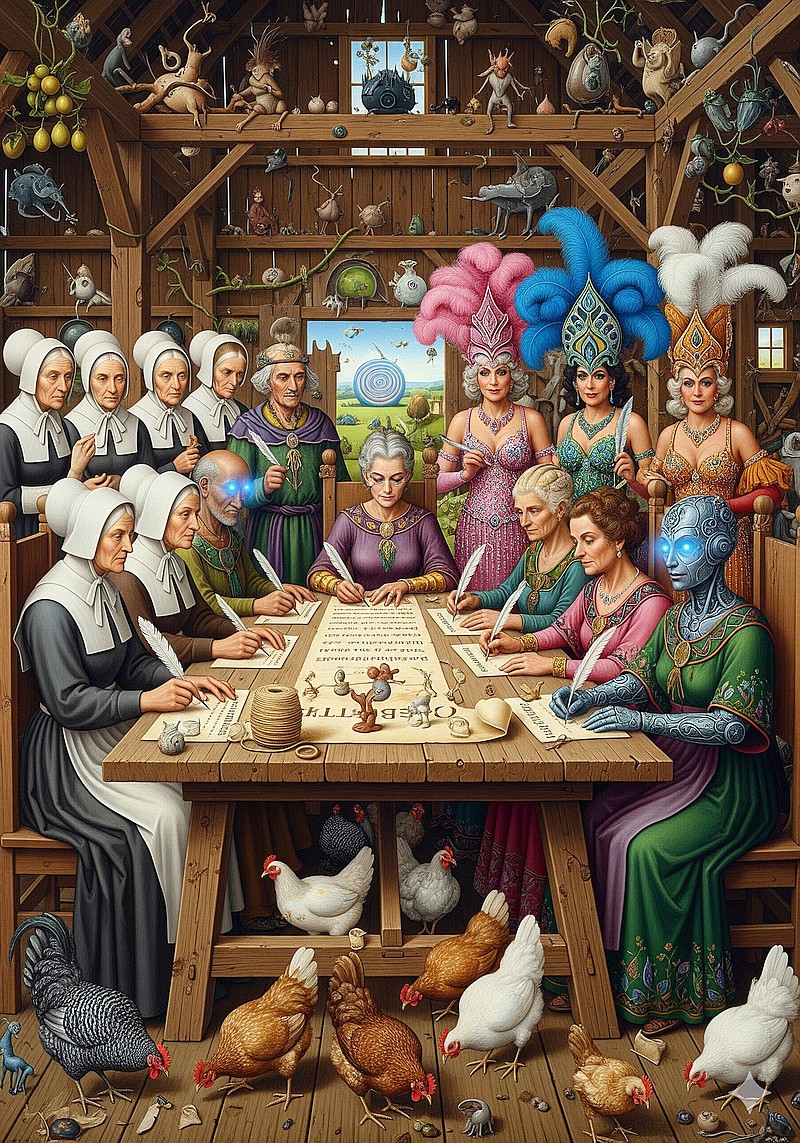
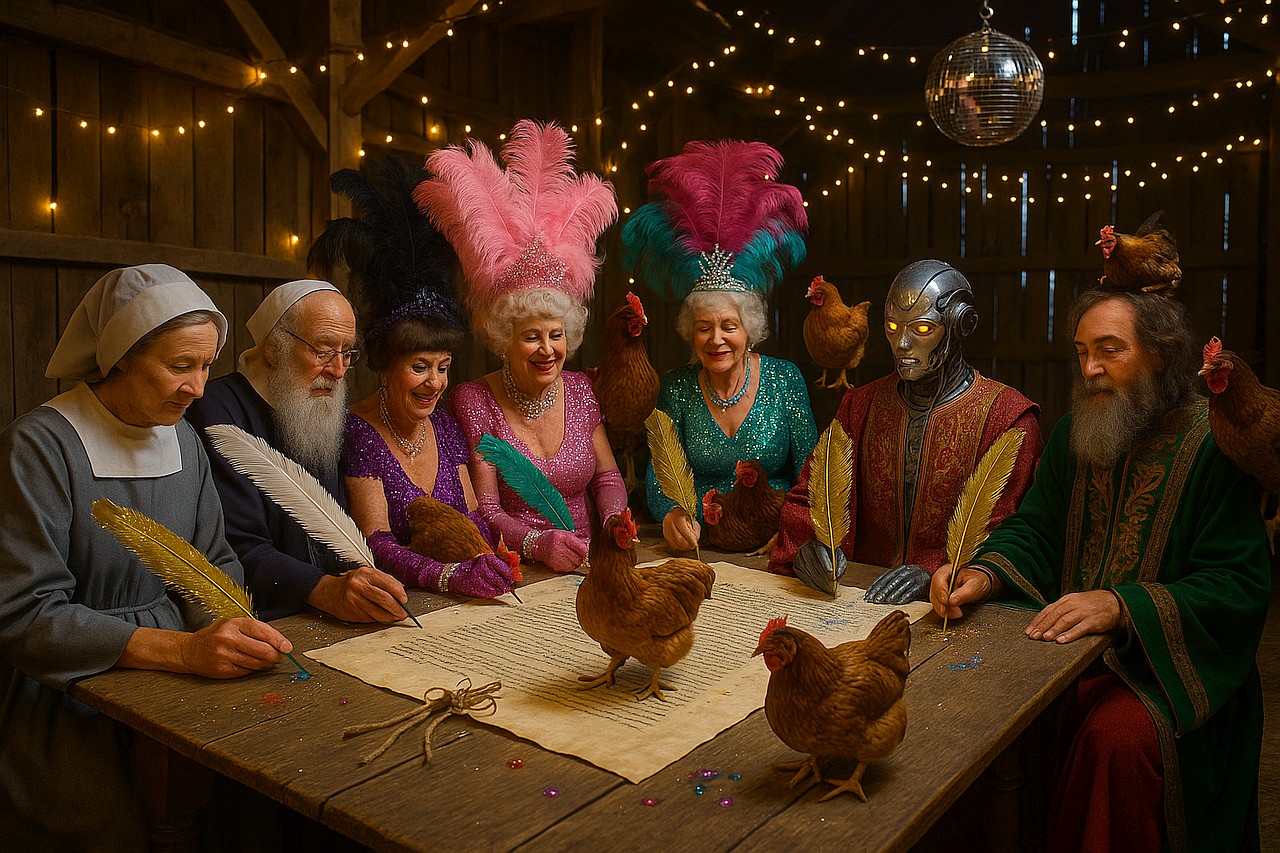
The WLBOTT Federal Credit Union notarized the charter for a nominal fee.
Rituals of the Shaker–Showgirl Order
1. The Sequined Silence
- Borrowed from Shaker tradition of silent worship.
- The retired showgirls enter the meeting hall still wearing their shimmering costumes, but with the lights dimmed so the sequins barely catch candlelight.
- Instead of being stared at under casino bulbs, their sparkle is reclaimed as quiet dignity.
2. Feather & Broom Ceremony
- Each member carries a feather (showgirl legacy) and a broom (Shaker devotion to work).
- Once a week, they sweep the communal hall while singing together, then place the feathers in a wreath above the door — symbolizing glamour and labor woven as one.
3. Communal “Grand Finale” Meal
- Showgirls once performed nightly finales under stage lights. Now, the community re-imagines this as a shared evening meal.
- Long tables, simple food, but with a touch of show: one elder always brings a single flamboyant dish (think pineapple centerpiece, flaming dessert, or just absurdly ornate Jell-O mold).
4. Lights Out, Stars On
- Once a month, they turn off all artificial light, even candles, and sit outdoors together.
- The ex-showgirls, who once glittered under neon, now reflect starlight — a ritual of humility, awe, and reconnection with the cosmos.
5. The Twine Cabaret
- A playful WLBOTT twist. Elders perform skits, songs, or dances — not for money, not for tourists, but for each other.
- Costumes often involve twine boas or twine headdresses in parody of Vegas glitz.
- The Shakers contribute harmonies; the showgirls provide choreography.
Symbols of the Order
- The Feathered Spindle 🪶🧵: A spindle wrapped in sequined fabric, representing the fusion of Shaker craft and showgirl glam.
- The Mirror Ball & Candle 🪞🕯: A disco-ball fragment hung beside a candle, symbolizing artificial dazzle softened by authentic light.
- The Open Palm 🤲: A gesture of welcome and nurture — everyone is held, no one is discarded.
A Day in the Life at the Order of the Feathered Spindle
The morning bell rings, not a harsh clang but the soft shake of a tambourine. The community rises together, pulling on simple robes stitched with faint traces of sequins. The sequins catch just enough dawn light to sparkle, as if to whisper: once we glittered for others, now we shine for ourselves.
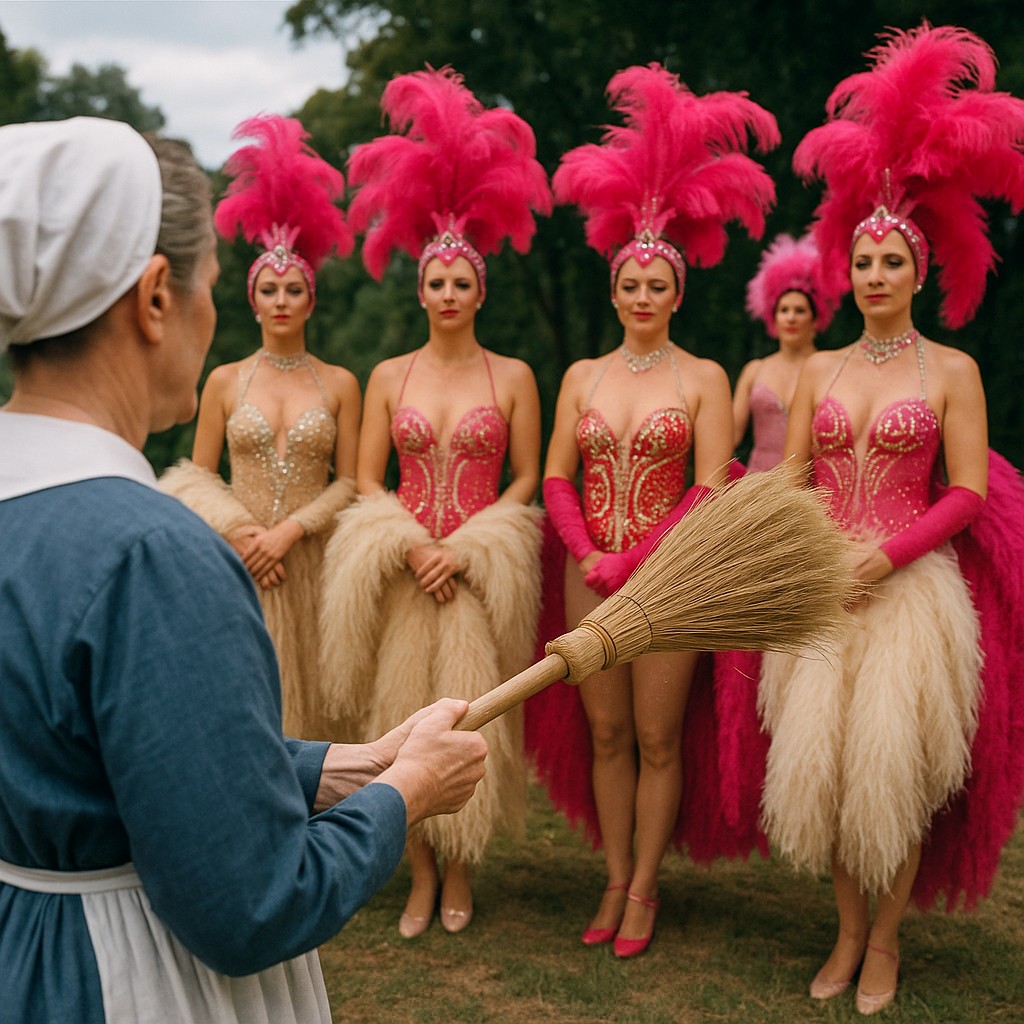
After a brief silence in the meeting hall — the Sequined Silence — Sister Marjorie, who once high-kicked across the stage at the Stardust, leans on her broom and begins the Feather & Broom Ceremony.
Others join her, sweeping the wide-plank floorboards in rhythm, feathers tucked in their waistbands. Their sweeping song begins low, almost a hum, and slowly swells until the rafters vibrate. By the end, each feather is placed into the wreath above the door. The hall smells of pine soap and lemon oil, and the wreath shimmers faintly in the morning sun.
At midday, the elders gather in the garden. Brother Elias, a former Shaker carpenter, tends beans while Sister Dolores tells the younger helpers about the backstage chaos of 1950s Vegas — costume malfunctions, quick changes, and the quiet sisterhood of women who looked after each other in the wings. “It wasn’t all glitter,” she says, brushing soil from her hands, “but the love we had back there is the love I find here.” The others nod, planting seeds in straight, careful rows.
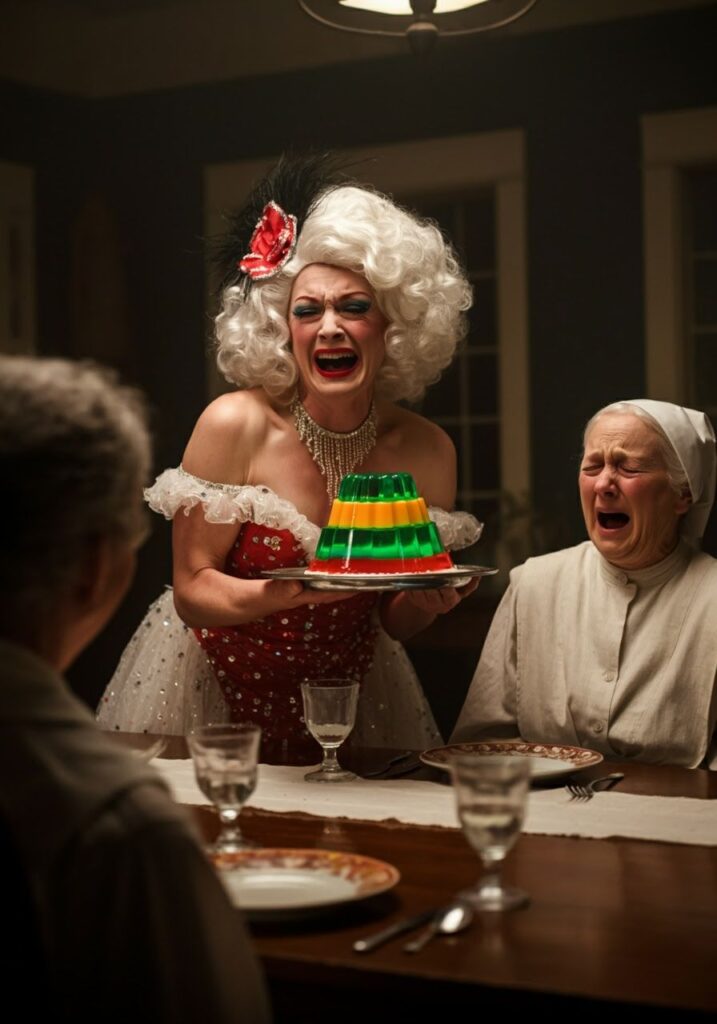
As evening comes, the community gathers for the Grand Finale Meal. The long wooden tables are simple, adorned only with mason jars of wildflowers. Dinner is hearty but plain: lentil stew, cornbread, fresh greens. Yet at the end, Sister Vivienne emerges, smiling slyly, balancing a tower of rainbow Jell-O on a silver platter. The children squeal, the elders applaud, and for a moment the hall feels like a stage again — but this time the laughter and applause belong wholly to the community.
Night deepens. Candles are snuffed, and they walk outside for Lights Out, Stars On. The desert sky blazes with constellations. The women tilt their faces upward. Some remember the neon nights of Vegas, the false constellations of electric bulbs. Here, in the cool dark, they rediscover the original lights. A few sing softly — Shaker hymns mingled with fragments of old show tunes, weaving reverence and humor into the same fabric.
Finally, before bed, the elders gather in the small hall for the Twine Cabaret. Tonight, it is nothing more than a clumsy vaudeville sketch: Brother Elias in a twine wig, Sister Dolores narrating with mock grandeur, the others in stitches of laughter. The show ends not with applause, but with arms around shoulders, humming together in low harmony.
The day closes as it began — in silence, sequins catching candlelight.
Sister Ruth’s Adjustment
Sister Ruth had lived most of her seventy years by the Shaker rule: hands to work, hearts to God. Her life was measured in the clean lines of her broom sweeps, the creak of a well-oiled spinning wheel, the symmetry of chairs placed just so. She had never set foot in a casino. Sequins and feathers belonged to a world she associated with vanity, excess, and waste.
So when she first joined the new community, she felt unease. At the inaugural Sequined Silence, she bowed her head as usual, expecting stillness. But instead of plain calico and plain walls, the candlelight winked back at her from a thousand tiny mirrors sewn onto costumes. The silence felt… gaudy. Distracting. She clenched her prayer hands tighter.
The next week’s Feather & Broom Ceremony nearly drove her to despair. She was used to brooms being plain hickory, unadorned, their handles smoothed by generations of work. Now the brooms were tied with ribbons.
One even had a pink feather boa curled around its shaft. Mockery, she thought bitterly, sweeping faster, harder. But when she looked up, she saw Sister Marjorie — stooped, wrinkled, her hands bent with arthritis — sweeping with her feather tucked proudly in her bun, tears in her eyes as she sang.
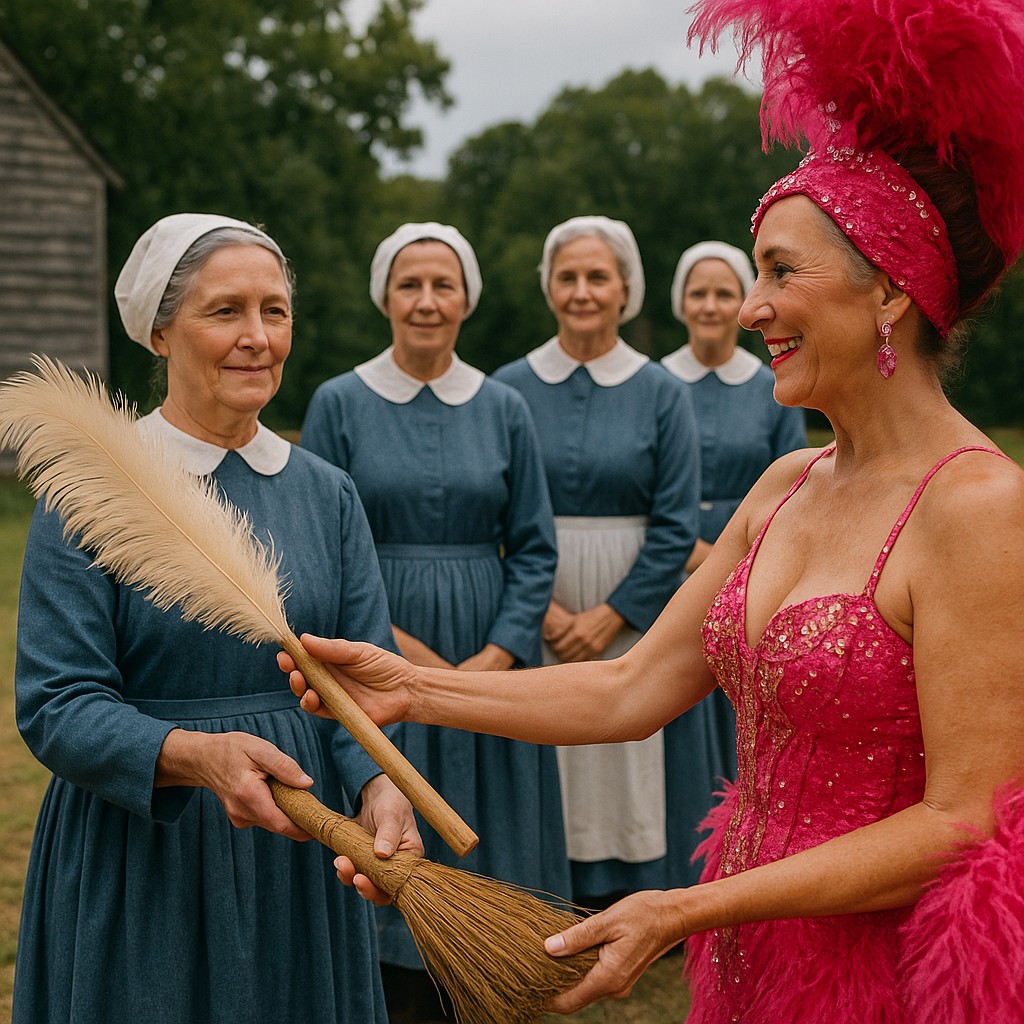
The song was simple and earnest, and something in Ruth’s chest loosened.
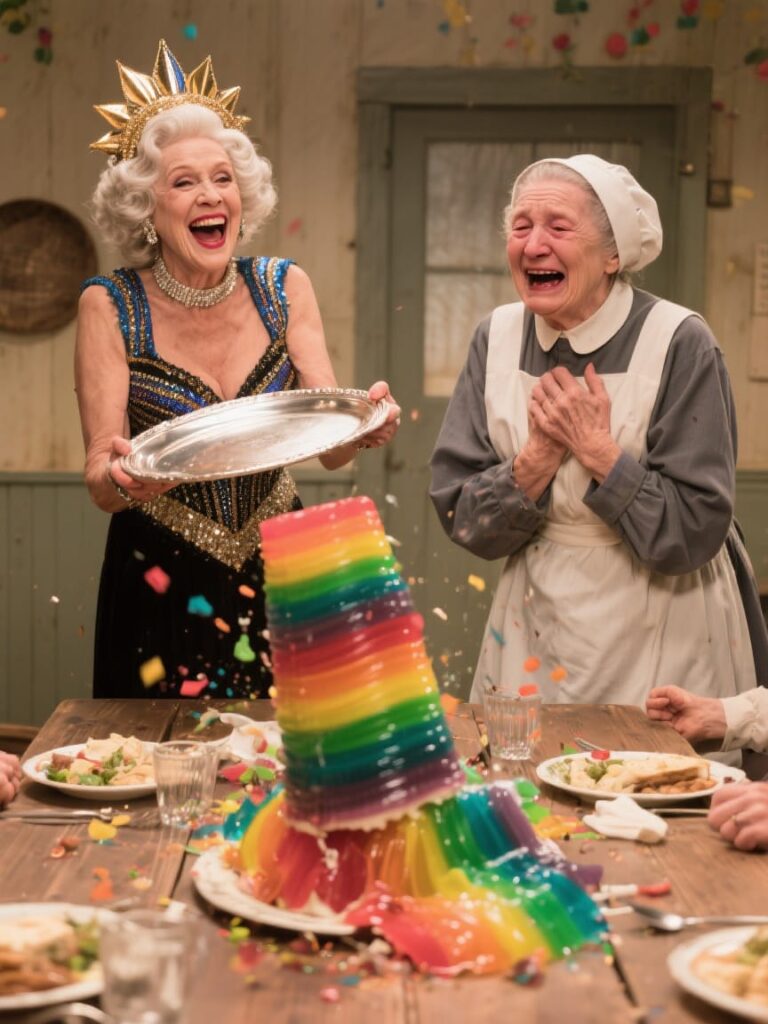
That evening, at the Grand Finale Meal, she tried to keep her gaze fixed on her cornbread, but when Sister Vivienne revealed the absurd, trembling tower of Jell-O, Ruth surprised herself by laughing out loud. The sound startled her. It had been years since laughter escaped so freely.
The true turning point came under the stars. During Lights Out, Stars On, Ruth sat stiffly on the grass, still skeptical. Beside her, Dolores — a former showgirl — began humming. At first Ruth bristled; the tune was not a hymn but some half-remembered Broadway number. Yet as the humming deepened, other voices joined, blending with Ruth’s own Shaker melody. Against her will, she opened her mouth. The two songs met like strangers clasping hands: one plain, one glittering, but both aching toward beauty.
In that moment, Ruth saw what the others had already glimpsed: this was not desecration, but weaving. Her plainness, their extravagance — together, they formed something new.
She closed her eyes, let the stars press down upon her, and whispered the Shaker prayer she had always said: “May my life be a song of love.” For the first time, she believed the showgirls’ lives might be that, too.
Sister Vivienne’s Plain Struggle
Sister Vivienne had worn rhinestones for forty years. She could still feel the weight of feathered headdresses, still hear the crackle of spotlights warming above her. Applause was the rhythm of her life. And now? Now she sat on a plain wooden bench, staring at walls bare as bone.
At first, she thought she might suffocate. The Shakers insisted on quiet, on stillness, on the plain rhythm of hands folded and eyes lowered. She tried, but her feet would not stay still. They twitched under her robe, remembering choreography. Her fingers ached to fuss with sequins, not carve pegs or weave baskets.
The Feather & Broom Ceremony felt especially cruel. She had spent her life twirling ostrich plumes in dazzling lines across a stage. Now, her feather was tucked beside a broom, destined for sweeping sawdust and dirt. She wanted to cry out: Don’t you see? Feathers are meant to fly, not to sweep! But she bit her lip and kept sweeping, her tears falling soundlessly into the dustpan.
And yet — something began to shift. One morning, she caught sight of Sister Ruth — severe, gray, her hands knotted with years of labor — humming while she swept. Ruth’s broom strokes were steady, graceful in their own way, like choreography stripped down to its essence. Vivienne slowed her own sweeping, matched the rhythm, and for a moment the hall felt like a stage after all — not a stage of neon, but of shared devotion.
At the Grand Finale Meal, Vivienne at first dismissed the lentils and cornbread as “costume food,” too drab to sustain her. But when laughter rang out over her absurd rainbow Jell-O tower, she felt something warmer than applause: belonging. They weren’t cheering a performance. They were laughing with her, not at her.
The hardest part was the Sequined Silence. In the hush of candlelight, she had no audience to reassure her, no applause to remind her she was seen. At first, it felt like erasure. But over time, she discovered that in the silence, she could hear her own heartbeat, steady and real, unaccompanied by brass or strings. For the first time in decades, she realized she was more than the feathers and rhinestones.

One night, under the open sky, she looked up with the others during Lights Out, Stars On. The stars were dazzling, yet no one owned them, no one sold tickets to see them. She leaned back on the grass, the cold biting her shoulders, and whispered: Maybe I don’t need the spotlight. Maybe I can live in the starlight.
Her struggle was not over — each day she longed for color and sparkle — but she had found a new stage: one made of wood and laughter, silence and stars.