Fairy tales and folk tales are fascinating. They remind me more of dreams than what we considered a traditional three act narrative. Improbable things happen, which lead to more improbable things, and sometimes there is a resolution (happily ever after) and sometimes there is no resolution, and often no happy ending.
Last night I was reading The Grave Mound (collected by The Brothers Grimm) on Wikipedia, which had randomized the article for our protection.
(The story is from the Wikipedia page; the illustrations are from Elder G)
Story While standing and looking at his field and gardens, a rich farmer hears a voice that asks him if he has helped the poor and hungry. He realizes that he has turned his poor neighbours away from his door and has only thought of increasing his own wealth. His knees give way beneath him as he realises his sin.
Just then, there is a knock at the door. He opens it to see his poor neighbour, who, believing he will be turned away, has steeled himself to beg for four measures of corn to feed his young children. The rich farmer gives eight measures to the man, with the stipulation that when he dies, the poor man will stand guard over his grave for three nights.
When the rich man suddenly dies three days later, unlamented by his neighbours he is buried, and the poor man keeps his side of the bargain and watches over the grave by night, returning to his humble home at daybreak.
On the third and final night, a passing battle-scarred and retired soldier pauses to rest by the churchyard and says he will sit with the poor man and join him in watching over the grave. At midnight, the two are disturbed by a shrill whistling, which heralds the arrival of the Devil, who has come to claim the rich man’s soul. The two defy him, so after threatening them, the devil tries a subtler ruse and bribes the men with an offer of gold into giving up their watch.
The soldier says that if the devil fills his boot with gold, they will leave. The Devil departs to fetch the gold, and in his absence, the soldier takes off his boot and cuts a large hole in the sole.
The Devil returns with a bag of gold, which he pours into the boot, but it falls through the sole into a hole in the ground. The soldier chides the Devil for his meanness, and the Devil is forced to fetch more gold, but again, he fails to fill the boot. Just as the Devil is about to snatch the boot from the hand of the soldier, the light of dawn breaks, and the Devil flees with loud shrieks. The poor man and the soldier having saved the soul of the rich man, discuss how best to divide the gold. The soldier says that his share is to be given to the poor, and he goes with the poor man to his cottage to live out his days.
The story makes more sense now. Four measures would feed the children briefly. Eight measures signals genuine repentance.
In this story, the moral reckoning is real, and consequences are not postponed indefinitely.
Elder G gives us an interesting summary:
The Grave Watch: An Old European Motif
The three-night vigil over a grave is an ancient folkloric pattern.
Three nights = spiritual testing.
Midnight = boundary hour.
Churchyard = thin place between worlds.
The rich man’s neighbors don’t mourn him. That detail matters. Earthly reputation doesn’t save him. What saves him?
One act of repentance.
A poor man who keeps his word.
A soldier who knows how to outwit evil.
Aarne-Thompson-Uther (ATU) Index
There are several cataloging systems for folk and fairy tales, the most prominent being the ATU.
The Aarne-Thompson-Uther (ATU) Index is the standard international cataloging system for fairy tales and folktales, grouping narratives by plot similarities into numbered categories. It categorizes thousands of stories into types such as Animal Tales (1-299), Magic (300-749), or Religious (750-849), helping track cultural variations and themes.
Key Aspects of the ATU System
Structure: The system, formerly AT (Aarne-Thompson), was updated by Hans-Jörg Uther in 2004 to become the ATU index.
Categories: The system breaks down tales into seven main areas, including:
Tales of Magic: Types 300–749 (e.g., Cinderella is 510A, Rumpelstiltskin is 500).
Animal Tales: Types 1–299.
Religious Tales: Types 750–849.
Realistic Tales: Types 850–999.
Tales of the Stupid Ogre: Types 1000–1199.
Anecdotes and Jokes: Types 1200–1999.
Formula Tales: Types 2000–2399.
Utility: It allows researchers to compare different versions of stories, such as finding variants of Little Red Riding Hood (ATU 333).
Motif-Index: Used alongside the ATU, the Thompson Motif-Index organizes tales by specific, smaller narrative elements (e.g., “magic wand” or “forbidden chamber”).
Other approaches to analyzing tales include Vladimir Propp’s structuralist approach (focusing on character functions) or using library subject headings for thematic searching.
Surprisingly, the ATU is a bit hard to find. There is no on-line database.
It is available for $290 on Amazon. Another example of Big Fairytale’s power in this field.
But I spoke too soon. All three volumes are available for free download as PDFs, from the Kalevala Society, an organization that preserves the Finnish folklore.
To give you a flavor of the cataloging system, here’s the first entry:
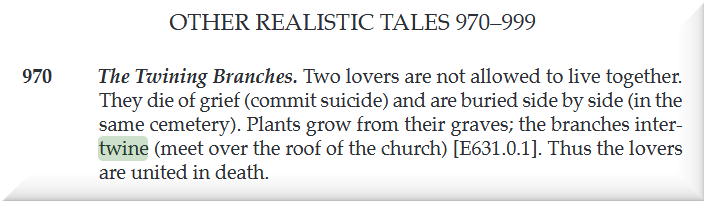
There’s a single entry that includes the word “twine”.
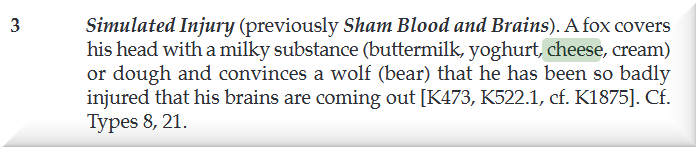
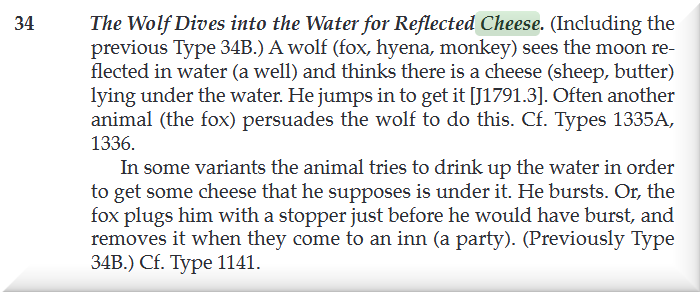
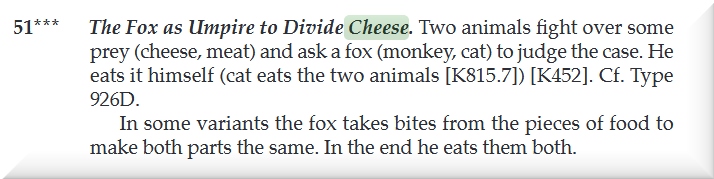
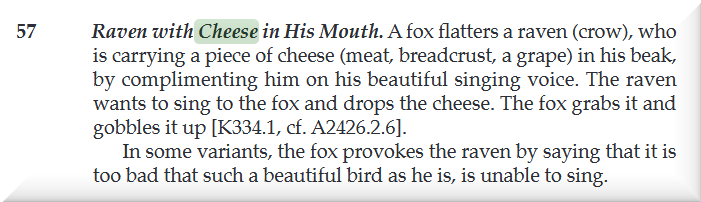
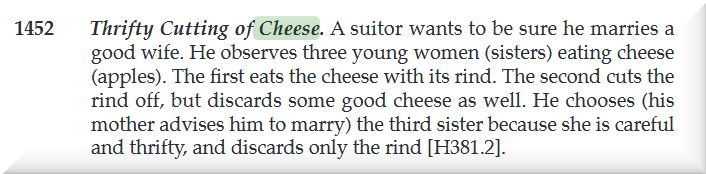
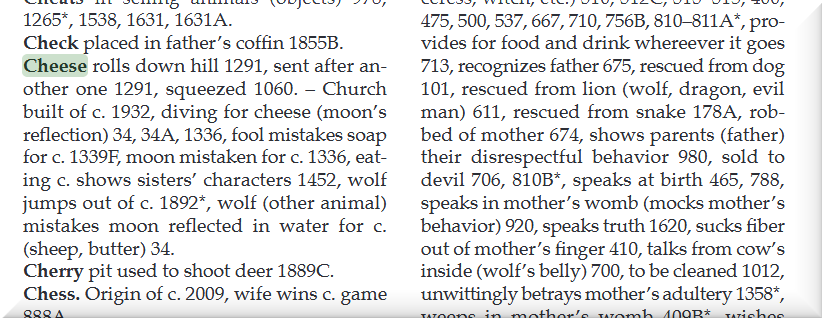
But cheese is on everyone’s mind….
Kalevalaseura
The Kalevala is the national epic of the Finns and Karelians. It is the most translated work of Finnish literature and part of world literature. The Kalevala is also a multi-layered combination of different oral-literary materials, worlds and meanings, which is why it escapes a single definition and interpretation.
The first edition of the Kalevala was published in 1835. Elias Lönnrot compiled it from folk poetry recorded into notebooks in 1828–1834, during his several lenghty collection trips among poetry singers especially in the White Sea Karelian villages.
Elias Lönnrot Founding Father of the Kalevala
Elias Lönnrot (1802–1884) has been called a collector of fragmented epics, a collector of folk poetry, a scribe, a creative poet, and a singer. In reality, the Kalevala is Lönnrot’s epic poem and a 19th-century work of art, although its sources are deep in the folk traditions.
Every year, the board invites persons to join the Society for merits in the field of culture. Such a person must have accomplishments in the fields of operation of the Kalevala Society, i.e. research or art relating to the Kalevala or the Finnish cultural heritage or fields combining the two. 5–15 new members are invited to join the Society.
Vacation in Nehvo The Kalevala Society owns a former border guard post, the Nehvo Guardhouse, in the beautiful landscape of Ilomantsi, in the village of Nehvonniemi. The house consists of a main building, a log sauna containing a room with a fireplace as well as a side building with two separate duplexes. The buildings were completed in 1950. They have been renovated, and include all modern comforts. There are excellent outdoor opportunities in the area during all seasons. The nearby forests and swamps are well suited to those interested in picking berries or mushrooms. In addition, guests can use the house boat to go fishing.
The Nehvo Guardhouse is available for vacationing or research retreats for the members of the Kalevala Society.
There’s a delightful blog post by PhD student Hannah who gives us a practical guide to the ATU index.
A Casual Girl’s Guide to Using the ATU Index Hannah Blog February 28, 2019
The ATU Tale Type Index is a Categorization System The ATU Tale Type Index, which is only one of its “official names,” is an essential guide for those of us who are trying to find different versions of the fairy tales we already know, or discover tales and types of fairy tales we don’t know. And with thousands of discovered tales around the world, having one big source like that is awesome.
Officially it’s a categorization system, cataloging fairy tales, folk tales, and fables around the world and filing them neatly away in smaller categories according to their plot.
I believe, like the Grimm brothers, that you can learn a bit about a person’s culture, and even people themselves, by the fairy tales they love and continue to tell. And, like the Grimm brothers, I hate to see these cherished stories die.
Hannah is a doctoral candidate studying Victorian and children’s literature. Her research focuses on depictions of disability in Victorian children’s fantasy stories. Her other interests include game studies, fairy tales, and true crime, all of which she enjoys incorporating into her teaching wherever possible. Her academic work has been published in the Victorian Review and the Victorian Institute Journal.