“The Lake Isle of Innisfree”
- William Butler Yeats

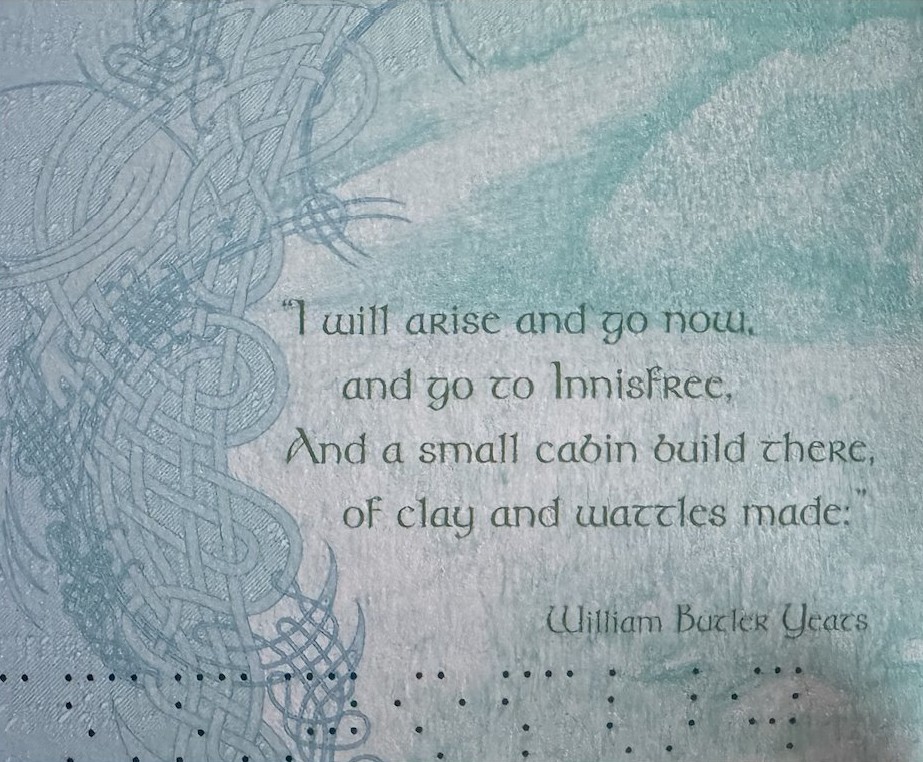
I will arise and go now, and go to Innisfree,
And a small cabin build there, of clay and wattles made;
Nine bean-rows will I have there, a hive for the honey-bee,
And live alone in the bee-loud glade.

And I shall have some peace there, for peace comes dropping slow,
Dropping from the veils of the morning to where the cricket sings;
There midnight’s all a glimmer, and noon a purple glow,
And evening full of the linnet’s wings.

I will arise and go now, for always night and day
I hear lake water lapping with low sounds by the shore;
While I stand on the roadway, or on the pavements grey,
I hear it in the deep heart’s core.
I only recently learned that this is a poem by William Butler Yeats. He was feeling homesick while walking through the busy and noisy streets of Fleet Street. He recalled a peaceful, beautiful uninhabited island, Lake Isle of Innisfree, that he visited as a youth.
It is about a daydream and an escape to a place of peace and calm, compared to the soot and crowded streets of London.
Background Lake Isle of Innisfree is an uninhabited island within Lough Gill, in Ireland, near which Yeats spent his summers as a child. Yeats describes the inspiration for the poem coming from a “sudden” memory of his childhood while walking down Fleet Street in London in 1888.
Fleet Street at the time was the center of England’s newspaper industry. Yeats would have experienced coal smoke, mud and horse manure, crowds, loud sounds of printing presses, gas lamps.
‘The opposite of a tourist attraction’ – New York Times visits Lake Isle of Innisfree
by Pól Ó Conghaile
The New York Times has arisen and gone to the Lake Isle of Innisfree, as the 150th anniversary of W.B. Yeats’s birth approaches.
The paper’s latest Emerald Isle adventure sees author Russell Shorto sojourn to Sligo and Leitrim in search of one of the most famous islands in poetry.
“Yeats named the poem after an actual place, an island in the middle of Lough Gill, a lake that spreads itself languidly across five miles of furiously green landscape in County Sligo in northwest Ireland,” he writes.
[T]his tiny island (you’d have a hard time fitting a clay and wattle cabin – let alone a bee-loud glade – on this quarter-acre hump) is remarkably undersold as an attraction… and perhaps the better for it.
We found this image of the Innisfree car park on Google streetview. It appears that the object on the right is a statue of a bee hive, in honor of Yeats’ poem.
The Isle of Innisfree is above and to the left of the small jetty.
Some Imaginings of Innisfree
“Living”
I was familiar with the poem from the song “Innisfree” by Judy Collins’ 1971 album “Living.”
Mistakenly, I thought the lyrics were written by Judy Collins, as a form of inner refuge, an idyllic place of peace, away from world, and especially the Vietnam War nightmare. A life of simple sufficiency.
My mind paired this song with another song on the album, “Four Strong Winds,” written by Ian Tyson. Again mistakenly, I imagined a conscientious objector trying to find his place in Canada, missing his girlfriend in the States.
Four Strong Winds
by Ian Tyson

[Chorus]
Four strong winds that blow lonely
Seven seas that run high
All those things that don't change come what may
But our good times are all gone
And I'm bound for movin' on
I'll look for you if I'm ever back this way

[Verse 1]
I think I'll go out to Alberta
The weather's good there in the fall
I got some friends that I can go to workin' for
Still I wish you'd change your mind
If I'd asked you one more time
But we've been through that a hundred times or more

[Verse 2]
If I get there before the snow flies
And if things are goin' good
You could meet me if I sent you down the farе
But by then it would be winter
Ain't too much for you to do
And thosе winds sure can blow cold way out there
The Poetry of the Irish Passport
The poem The Lake Isle of Innisfree is featured on page 22 of the Irish passport.
Both Irish passports and Irish passport cards allow Irish citizens to travel, live, and work without restriction in any country within the EEA, Switzerland and the Common Travel Area. Irish citizens have visa-free or visa on arrival access to 193 countries and territories; the international access available to Irish citizens ranks third in the world according to the 2024 Visa Restrictions Index.[6]
As of 2026, Irish citizens are the only nationality in the world with the automatic right to live and work in both the European Union and the United Kingdom.
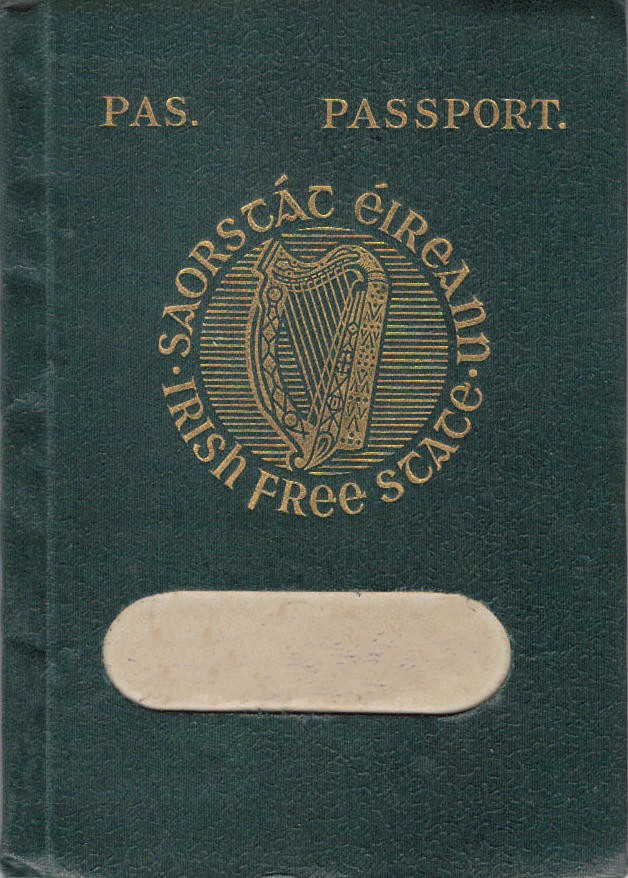
Passport booklet / Physical appearance Irish passport booklets use the standard European Union design, with a machine-readable identity page and 32 or 66 visa pages. The cover bears the harp, the national symbol of Ireland. The words on the cover are in both of Ireland’s official languages, Irish and English. The top of the cover page reads An tAontas Eorpach and the equivalent in English, European Union. Just above the harp are the words Éire and its equivalent in English, Ireland.
The first sentence of Article 2 of the Irish constitution[1] is visible under UV light and is printed in both Irish and English on alternate pages. The 2013 version of the passport also reveal a topographical map of Ireland on the observations page. Later pages include such landmarks as the Cliffs of Moher, the Samuel Beckett Bridge and the Aviva Stadium; there are excerpts from poems in Irish (by Nuala Ni Dhomhnaill), English (by William Butler Yeats) and Ulster Scots (by James Orr) and from the score of the national anthem, Amhrán na bhFiann (Irish for ‘The Soldiers Song’).
[1]“It is the entitlement and birthright of every person born in the island of Ireland, which includes its islands and seas, to be part of the Irish Nation.”
A PDF by Gerry Molumby describes the artistry of the Irish passport.
Reference
One aspect of 19th century London life that doesn’t make it into the Jane Austen movies is the amount of horse manure the city had to deal with. London moved by horse and human muscle. There were steam powered railways and ferries, but everything else was muscle power.
We asked the ever agreeable Elder G to net this out for us:
Let’s do a back-of-the-ledger estimate, the kind a Victorian clerk might scribble while side-eyeing his boots.
Ingredients (from historical estimates)
Horses in London, late 19th century: commonly estimated ~200,000 to ~300,000. (Science Museum)
Manure per horse per day: roughly 15–35 lb/day (a wide range because diets, workload, stabling, etc.). (Historic UK)
~1,500 to ~5,250 tons of horse manure per day (in London, late 1880s ballpark)
That said, many popular-history summaries land on about ~1,000 tons/day for London in the 1890s, which suggests either (a) not all horses were in the street network every day, (b) “working horses” counts differ from “horses in greater London,” and/or (c) people were estimating only what hit the streets, not total production. (Wikipedia)
A simple “middle-of-the-road” number for 1888
If we pick a conservative average like 20 lb/day and 200,000 horses:
200,000 × 20 = 4,000,000 lb/day = 2,000 tons/day
So if you want one satisfying, story-friendly estimate for 1888:
On the order of ~1,000 to ~2,000 tons per day (street-scale London vibe)
Fleet Street didn’t just have headlines. It had… headlines plus horse lines.
That roughly a cube 43 feet tall × 43 feet wide × 43 feet deep, the height of a 4-story building.