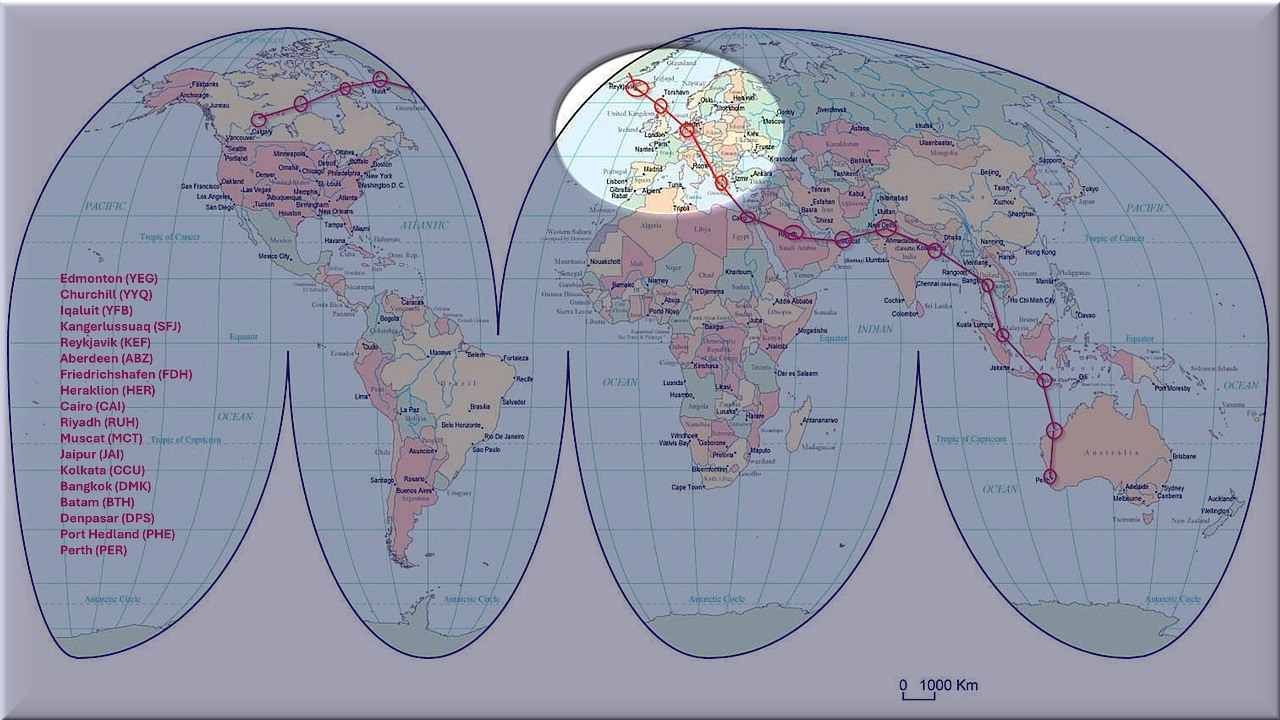
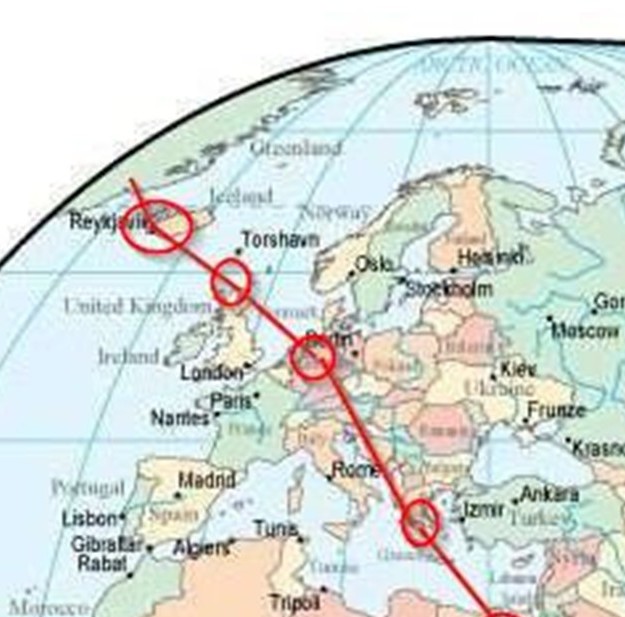
Elder G and I headed down to our next refueling stop – Heraklion, on the Greek island of Crete.
Travel Notes: Maintaining our Rituals
As you may be aware, many WLBOTT locations like to begin the day with the Benediction of the Egg, usually celebrated by Elder G or one of her/his stand-ins.
As Elder G and I travel the globe in our Cessna Citation, we strive to continue this act of gratitude.
Heraklion
Herakleion (Ηράκλειο) is the largest city and the administrative capital of the island of Crete and capital of Heraklion regional unit. It is the fourth largest city in Greece, and the largest city in the Greek islands, with a municipal population of 179,302 (2021) and 211,370 in its wider metropolitan area, according to the 2011 census. The greater area of Heraklion has been continuously inhabited since at least 7000 BCE, making it one of the oldest inhabited regions in Europe. It is also home to the ancient Knossos Palace, a major center of the Minoan civilization dating back to approximately 2000-1350 BCE, often considered Europe’s oldest city. The palace is one of the most significant archaeological sites in Greece, second only to the Parthenon in terms of visitor numbers.
Knossos Palace By Bernard Gagnon – Own work, CC BY-SA 3.0, https://commons.wikimedia.org/w/index.php?curid=20916502Koules Fortress By Radek Kucharski from Warsaw, Poland – Sea Fortress, CC BY 2.0, https://commons.wikimedia.org/w/index.php?curid=132225849View of the port from the fortress By Robert Linsdell – https://www.flickr.com/photos/boblinsdell/9450355791, CC BY 2.0, https://commons.wikimedia.org/w/index.php?curid=33080373The Saint Peter of Dominicans, one of the oldest monuments of architecture of the Cistercian monks in the 12th century. By User:Ggia – Own work, CC BY-SA 3.0, https://commons.wikimedia.org/w/index.php?curid=16947274Wikipedia
Heraklion International Airport “Nikos Kazantzakis” (HER)
Heraklion International Airport “Nikos Kazantzakis” (IATA: HER) is the primary airport on the island of Crete, Greece, and the country’s second busiest airport after Athens International Airport. It is located about 5 km (3.1 mi) east of the main city centre of Heraklion, near the municipality of Nea Alikarnassos. It is a shared civil/military facility. The airport is named after Heraklion native Nikos Kazantzakis, a Greek writer and philosopher. Nikos Kazantzakis Airport is Crete’s main and busiest airport
At first, the airport only offered very basic service, with only primitive installations on the site in the form of three tents, smoke for wind determination, and storm lamps for runway lighting.
Heraklion International Airport By Jan M, CC BY-SA 3.0, https://commons.wikimedia.org/w/index.php?curid=59788766Heraklion International Airport By Jan M, CC BY-SA 3.0, https://commons.wikimedia.org/w/index.php?curid=59788766Wikipedia
A Notable Local
Nikos Kazantzakis (2 March 1883 – 26 October 1957) was a Greek writer, journalist, politician, poet and philosopher. Widely considered a giant of modern Greek literature, he was nominated for the Nobel Prize in Literature in nine different years, and remains the most translated Greek author worldwide.
Kazantzakis’s novels include Zorba the Greek (published in 1946 as Life and Times of Alexis Zorbas), Christ Recrucified (1948), Captain Michalis (1950, translated as Freedom or Death), and The Last Temptation of Christ (1955). He also wrote plays, travel books, memoirs, and philosophical essays, such as The Saviors of God: Spiritual Exercises. His fame spread in the English-speaking world due to cinematic adaptations of Zorba the Greek (1964) and The Last Temptation of Christ (1988).
Nikos Kazantzakis was born in the town of Kandiye (now Heraklion) in Crete, with origins from the village of Myrtia. Crete had not yet joined the modern Greek state (which had been established in 1832), and was still under the rule of the Ottoman Empire.
Epitaph on the grave of Kazantzakis in Heraklion. It reads “I hope for nothing. I fear nothing. I am free.” By Hartmut Riehm – Own work, CC BY-SA 3.0, https://commons.wikimedia.org/w/index.php?curid=64277738Wikipedia
The Minotaur – Another Crete Notable
In Greek mythology, the Minotaur (Ancient Greek: Μινώταυρος, Mīnṓtauros), also known as Asterion or Asterius, is a mythical creature portrayed during classical antiquity with the head and tail of a bull and the body of a man or, as described by Roman poet Ovid, a being “part man and part bull”. He dwelt at the center of the Labyrinth, which was an elaborate maze-like construction designed by the architect Daedalus and his son Icarus, upon command of King Minos of Crete. According to tradition, every nine years the people of Athens were compelled by King Minos to choose fourteen young noble citizens (seven men and seven women) to be offered as sacrificial victims to the Minotaur in retribution for the death of Minos’s son Androgeos. The Minotaur was eventually slain by the Athenian hero Theseus, who managed to navigate the labyrinth with the help of a thread offered to him by the King’s daughter, Ariadne.
Pasiphaë and baby Minotaur
Minotaur-a-thon: The Annual Cretan Thing With the Bull
Since our visit to Heraklion International Airport coincided with the Annual Minotaur Fest, we saw the opportunity for some serious product placement. After all, Ariadne helps Theseus navigate the labyrinth with the help of twine.
Sadly, this year’s budget was pretty small, due in no small part to the ill-advised Greek Yogurt Tariffs.
Setting Up
The Performance
Konstantinos, our thespian Minotaur, was effervescent after his performance.
Post-Festival Selfies
Thanks to All the Volunteers!
Café HER
After a busy day at the Minotaur-a-thon, we headed over to Heraklion airport to have a bite at Café HER.
We were greeted by our server Bev. What a sweetheart!
Semi-Sequitur: George’s Dedication to the Egg Benediction
Our unpaid marketing intern, George (he’s single, ladies!) has never missed a morning Egg Benediction Ceremony.