Description Auks are superficially similar to penguins, having black-and-white colours, upright posture, and some of their habits. Nevertheless, they are not closely related to penguins, but rather are believed to be an example of moderate convergent evolution. Auks are monomorphic (males and females are similar in appearance).
Although not to the extent of penguins, auks have largely sacrificed flight, and also mobility on land, in exchange for swimming ability; their wings are a compromise between the best possible design for diving and the bare minimum needed for flying. This varies by subfamily, with the Uria guillemots (including the razorbill) and murrelets being the most efficient under the water, whereas the puffins and auklets are better adapted for flying and walking.
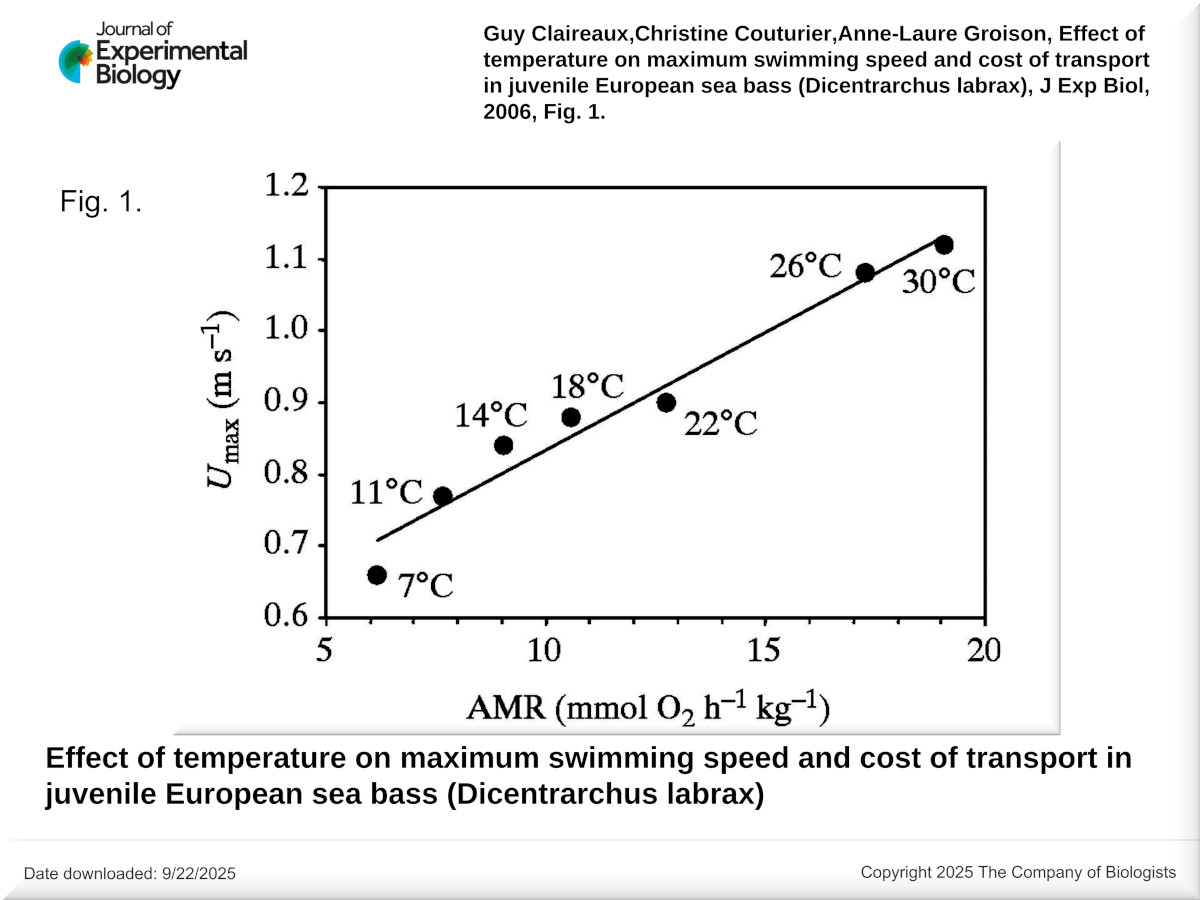
Today, as in the past, the auks are restricted to cooler northern waters. Their ability to spread further south is restricted as their prey hunting method, pursuit diving, becomes less efficient in warmer waters. The speed at which small fish (which along with krill are the auk’s principal prey) can swim doubles as the temperature increases from 5 to 15 °C (41 to 59 °F), with no corresponding increase in speed for the bird. [ed. note: see below] The southernmost auks, in California and Mexico, can survive there because of cold upwellings.
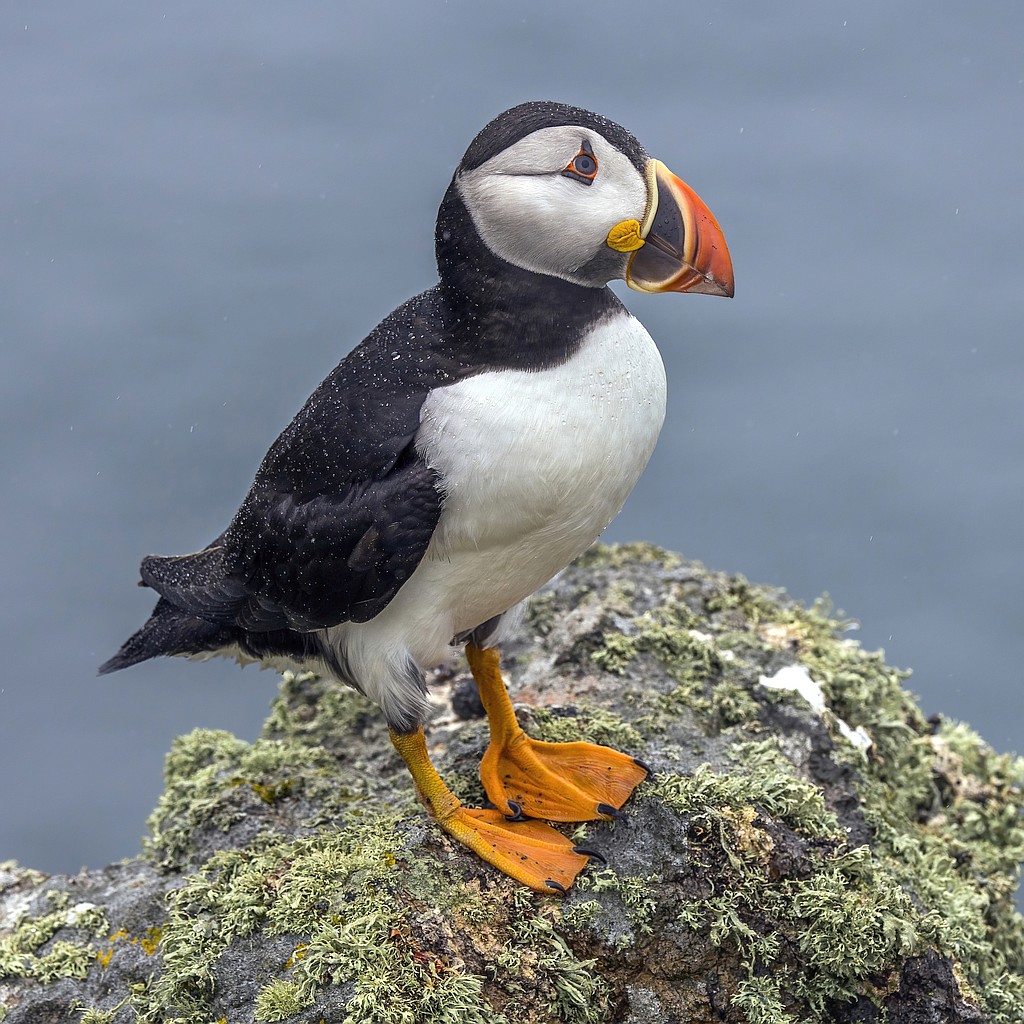
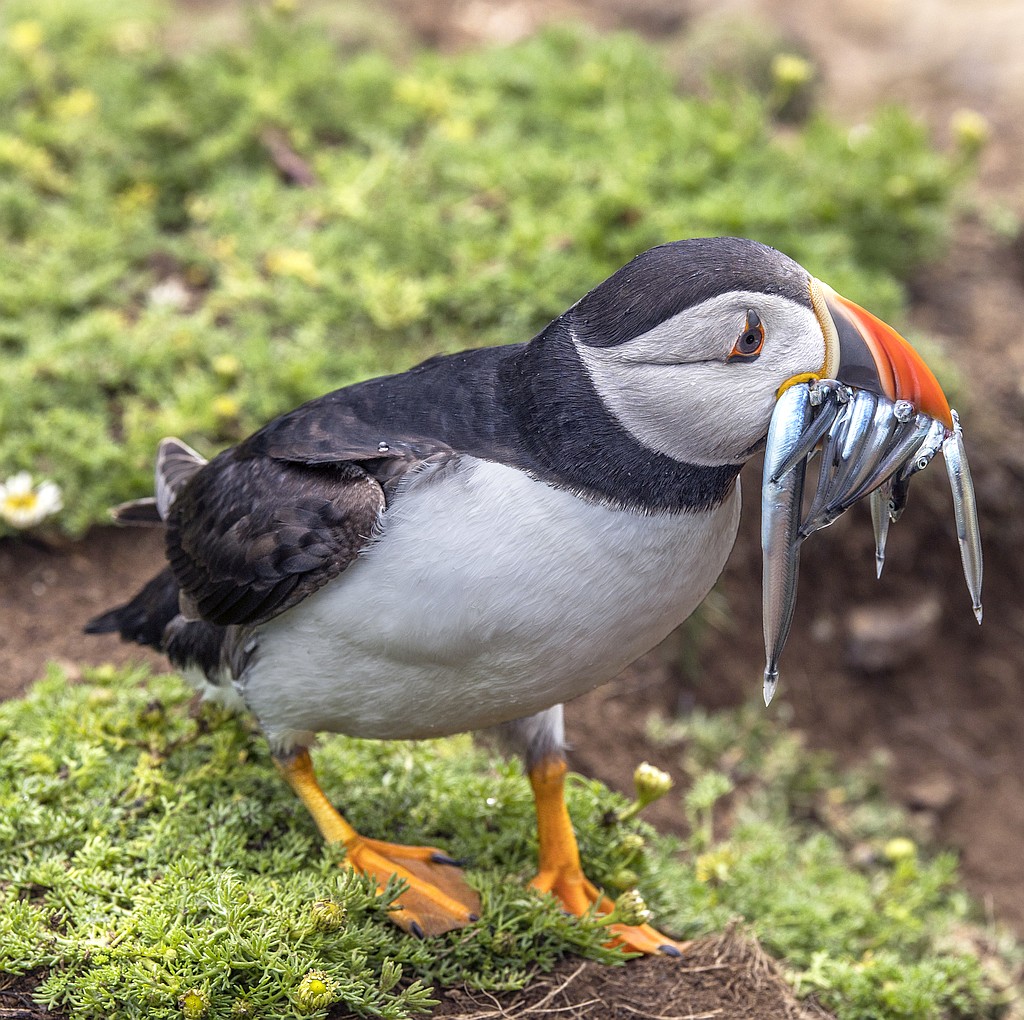
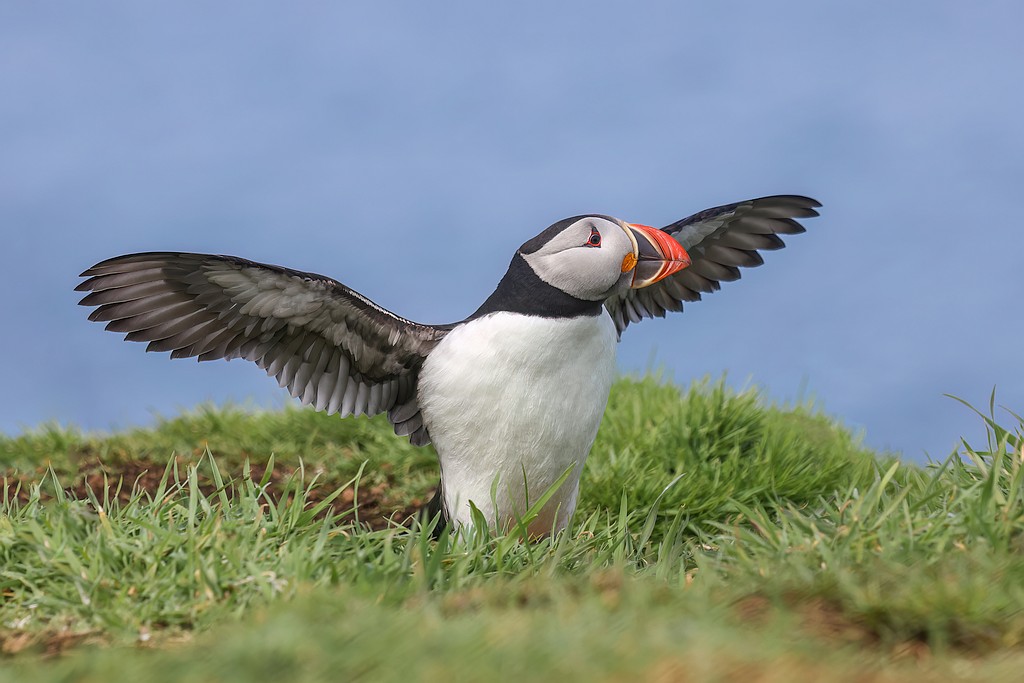
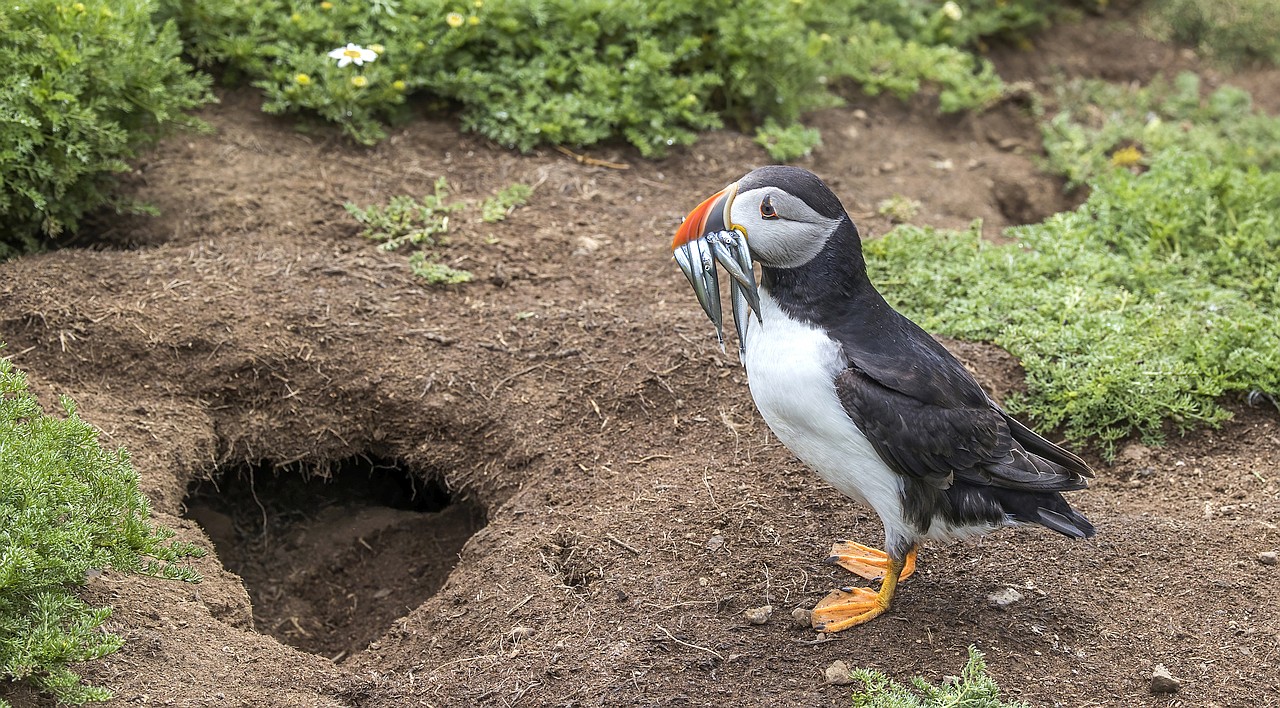
Atlantic Puffin By Charles J. Sharp – Own work, from Sharp PhotographyBy Charles J. Sharp – Own work, from Sharp Photography By Romaniviatores – Own work, CC BY-SA 4.0, https://commons.wikimedia.org/w/index.php?curid=171010034
All puffin species have predominantly black or black and white plumage, a stocky build, and large beaks that get brightly colored during the breeding season. They shed the colorful outer parts of their bills after the breeding season, leaving a smaller and duller beak. Their short wings are adapted for swimming with a flying technique underwater. In the air, they beat their wings rapidly (up to 400 times per minute) in swift flight, often flying low over the ocean’s surface.
Although the puffins are vocal at their breeding colonies, they are silent at sea.
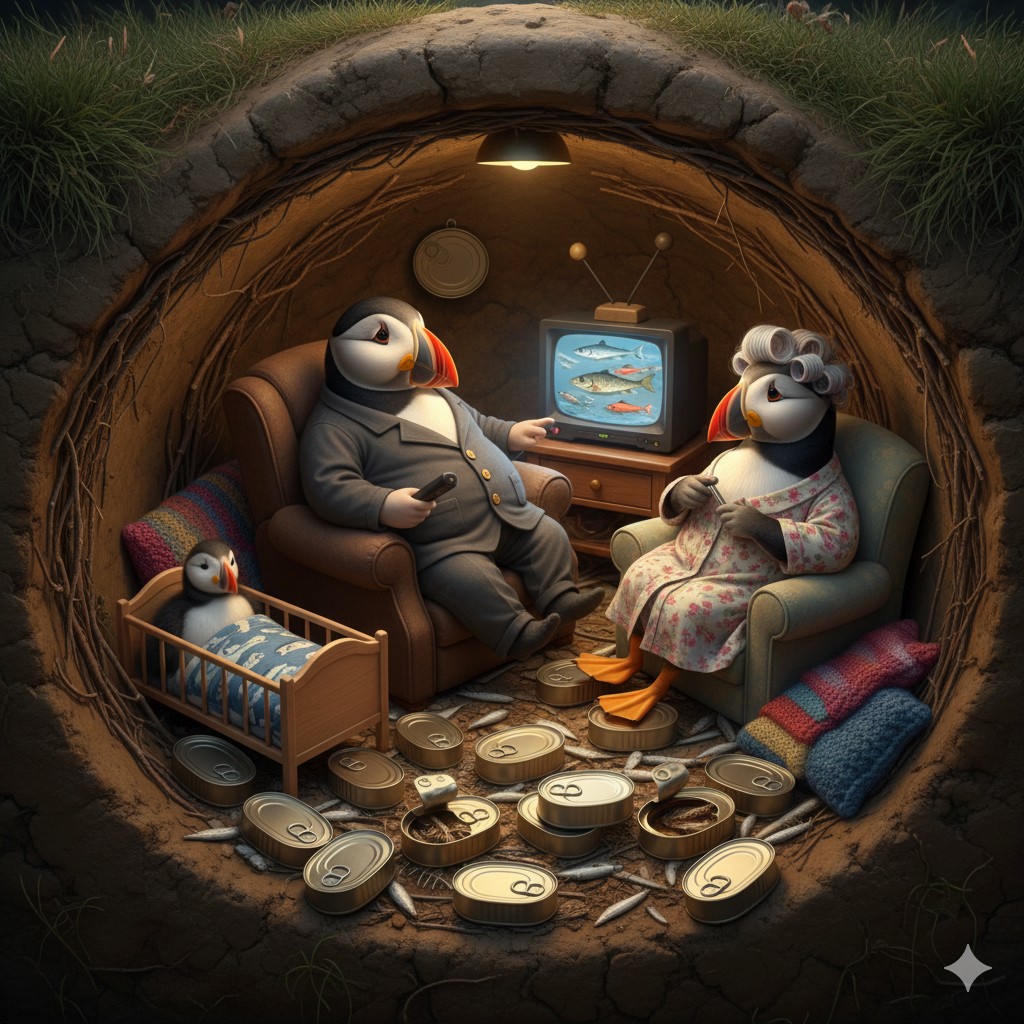
Puffins breed in colonies on coasts and islands; several current or former island breeding sites are referred to as Puffin Island. The male Atlantic puffin builds the nest and exhibits strong nest-site fidelity. Both sexes of the horned puffin help to construct their nest. Horned puffin burrows are usually about 1 meter (3.3 feet) deep, ending in a chamber, while the tunnel leading to a tufted puffin burrow may be up to 2.75 meters (9.0 feet) long. The nesting substrate of the tufted and Atlantic puffins is soft soil, into which tunnels are dug; in contrast, the nesting sites of horned puffins are rock crevices on cliffs. The Atlantic puffin burrow is usually lined with material such as grass, leaves, and feathers but is occasionally unlined. The eggs of the Atlantic puffin are typically creamy white but the occasional egg is tinged lilac.
Five Years at Sea Puffins form long-term pair bonds or relationships. The female lays a single egg, and both parents incubate the egg and feed the chick (or “puffling”). The incubating parent holds the egg against its brood patch with its wings. The chicks fledge at night. After fledging, the chicks spend the first few years of their lives at sea, returning to breed about five years later. Puffins in captivity have been known to breed as early as three years of age.
After breeding, all three puffin species winter at sea, usually far from coasts and often extending south of the breeding range.
Iceland is the home to most of the Atlantic puffins with about 10 million individuals. The largest single puffin colony in the world is in the Westmann Isles [Vestmannaeyjar] of Iceland. In 2009, scientists estimated the number of nests to be 1.1 million, and number of individuals there is estimated to be up to 4 million.
…the tunnel leading to a tufted puffin burrow may be up to 2.75 meters (9.0 feet) long
By Charles J. Sharp – Own work, from Sharp Photography, sharpphotography.co.uk, CC BY-SA 4.0, https://commons.wikimedia.org/w/index.php?curid=106949389
Elder G Tells a Remarkable Story
What happens in Vestmannaeyjar
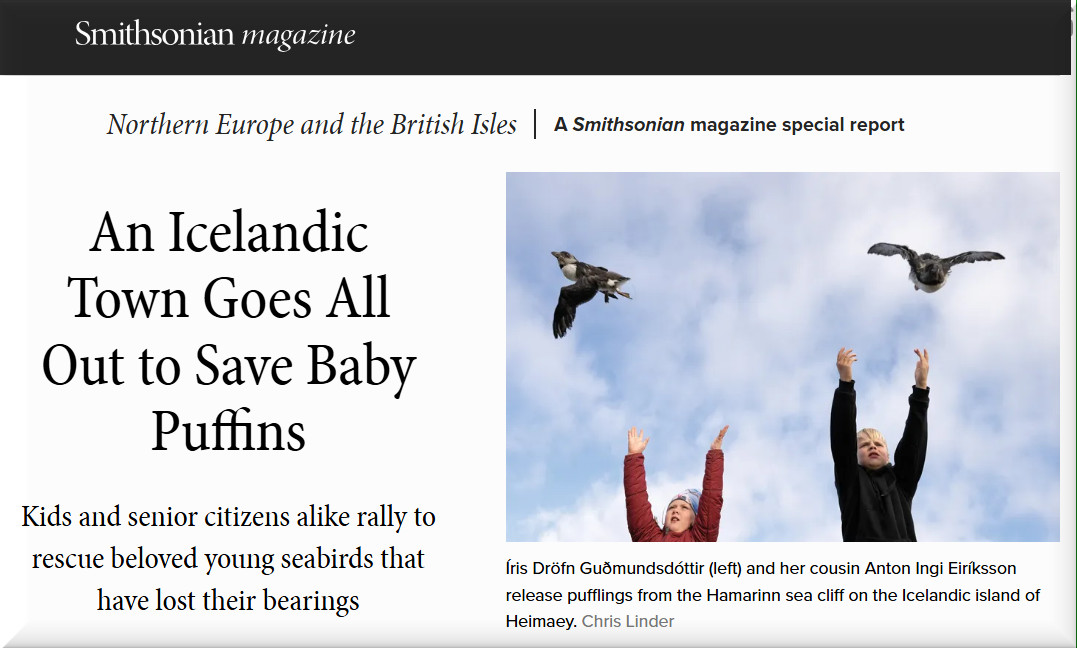
At the end of summer (late August / early September), puffins’ chicks leave their burrows at night and attempt their first journey toward the ocean.
But lights in the town confuse them, and many head inland or get stranded (roads, roofs, yards). Their wings are too weak to take off, so they’re in danger from predators, cars, etc.
So the local community organizes a nightly “Puffling Patrol” — volunteers, kids and adults wander the streets with flashlights and boxes to find and rescue stranded pufflings.
They keep them safely overnight (in cardboard boxes, usually) and the next morning, transport them to the cliffs and gently release them — often tossing them off cliffs so they can catch the wind (“glide”) towards the sea.
Cool 7 minute video from Cornell Ornithology (note: contains a short add for a bird-watching camera).
References
The ability to move is a fundamental property of animal life. Many factors, such as predator-prey interaction, reproductive behaviour and habitat selection, are of profound ecological importance and depend heavily on an animal’s capacity for movement.
Although rarely proven, intuitive logic would dictate that the ability to swim factors into Darwinian fitness(Arnold, 1983; Nelson, 1989). Despite this intuitive link to fitness, and despite the large number of studies conducted to date, the impact of water temperature on locomotor performance in fish still remains poorly described.
Sea bass: metabolism, swimming speed, and water temperature
Barry Shalowitz: What do you think? What would be the perfect flavor with this meal? Ira Shalowitz: Cherry vanilla? Barry Shalowitz: No. If it was Chinese food, right on the money, but this? Toasted almonds. Mitch Robbins: What’s going on? Ira Shalowitz: Barry can pick out the exact right flavor of ice cream to follow any meal. Go ahead. Challenge him. Mitch Robbins: Challenge him? Barry Shalowitz: Go on. Mitch Robbins: [shrugs] Franks and beans. Barry Shalowitz: Scoop of chocolate, scoop of vanilla. Don’t waste my time. [Flings plate at Mitch as if he throws down the gauntlet] Barry Shalowitz: Come on… Push me. Mitch Robbins: [Thinks] Sea bass. Barry Shalowitz: Grilled? Mitch Robbins: Sauteed. Barry Shalowitz: I’m with you. Mitch Robbins: Potatoes au gratin. Asparagus. Barry Shalowitz: [Concentrates heavily, and then relaxes, exhausted] Rum raisin! Barry Shalowitz, Ira Shalowitz: [high-fiving] WOOF! Mitch Robbins: Woof, what? How do you know he’s right? Ira Shalowitz: How do we know? 1400 retail outlets from coast to coast, that’s how we know. Barry Shalowitz, Ira Shalowitz: [They look at each other, and high-five each other again] WOOF!
AWK
Q: A book on AWK? Q2: Oh, really? A: No. O’Reilly!
AWK is a scripting language designed for text processing and typically used as a data extraction and reporting tool. Like sed and grep, it is a filter, and it is a standard feature of most Unix-like operating systems.
The AWK language is a data-driven scripting language consisting of a set of actions to be taken against streams of textual data – either run directly on files or used as part of a pipeline – for purposes of extracting or transforming text, such as producing formatted reports. The language extensively uses the string datatype, associative arrays (that is, arrays indexed by key strings), and regular expressions. While AWK has a limited intended application domain and was especially designed to support one-liner programs, the language is Turing-complete, and even the early Bell Labs users of AWK often wrote well-structured large AWK programs.
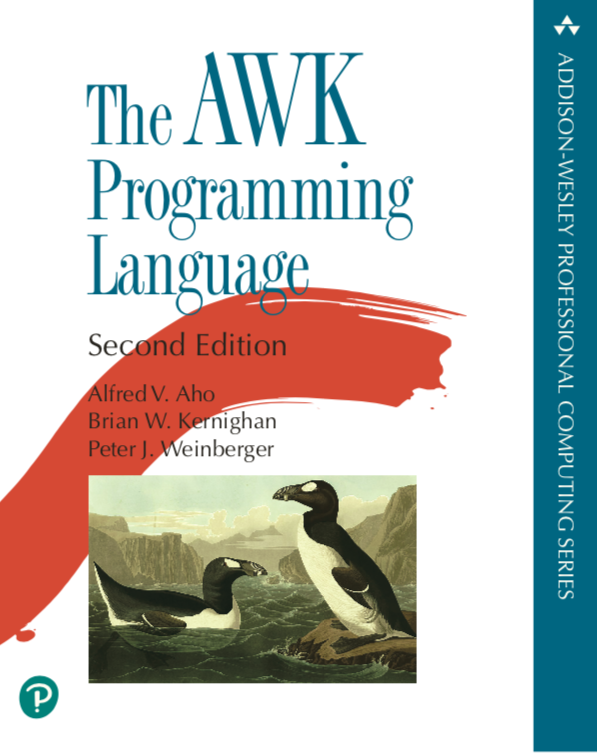
AWK was created at Bell Labs in the 1970s, and its name is derived from the surnames of its authors: Alfred Aho (author of egrep), Peter Weinberger (who worked on tiny relational databases), and Brian Kernighan. The acronym is pronounced the same as the name of the bird species auk, which is illustrated on the cover of The AWK Programming Language.
AWK was significantly revised and expanded in 1985–88, resulting in the GNU AWK implementation written by Paul Rubin, Jay Fenlason, and Richard Stallman, released in 1988. GNU AWK may be the most widely deployed version because it is included with GNU-based Linux packages. GNU AWK has been maintained solely by Arnold Robbins since 1994[1].
[1] Twenty one years of sole open source support? I can’t think of a more noble, and completely thankless, unappreciated task, except perhaps writing highly customized software for small non-profits.
(not WLBOTT original – scoured and scrapped from the series of tubes known as “The Internet”)
And finally…..
When Puffins Go Bad: The Puffin’ Puffin (Nod to Thundercloud Sub’s No Smoking sign)