New Crescent series Next in the series
We continue our series on The New Crescent – a Utopian agricultural community that resettles Palestine refuges in a peaceful, prosperous setting.
We try to answer some basic questions: How much land? How much water? How much electricity?
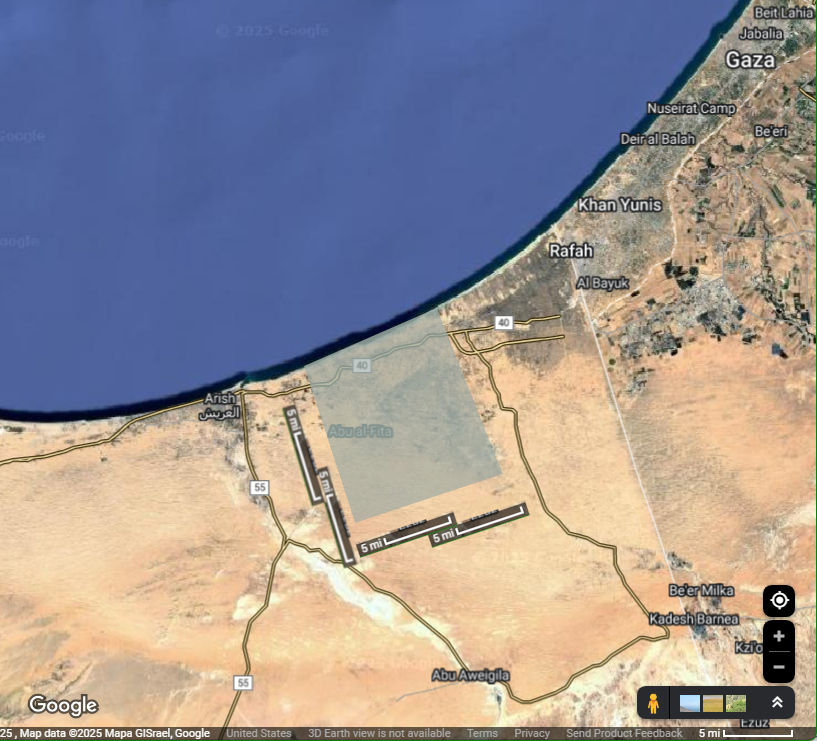
In our Utopia, Egypt has provided a chunk of desert on the northern border of the Sinai peninsula, where we will build a large desalination plant, taking water from the Mediterranean sea to irrigate our new paradise. A solar farm will power the reverse osmosis water purification.
Let’s do some top-down analysis. Let’s say our community will be 20,000 people, including children and elderly. Let’s say we want to provide a family income of $50,000 USD. Agriculture and related industries will be the main employer. We will have irrigated farm land as the basis for our agriculture. Let’s assume we produce labor intensive, high value produce, like olives, figs, tomatoes, etc. How many acres will we need to cultivate to achieve our income goals?
Elder G helps us out here….
Let’s zoom out and do a clean back-of-the-envelope for how many cultivated acres you’d need to fund a 20,000-person New Crescent with $50k per family.
1) Income target (top-down)
- Assume ~4 people/household ⇒ ~5,000 households.
- Target income: $50k × 5,000 = $250M/year (communitywide).
Not every dollar must come straight from fields (there’s packing, processing, logistics, services). I’ll show ranges where ag+agroprocessing contributes 60–70% of the income base.
2) Per-acre net margins (order-of-magnitude)
Indicative, irrigated, Med-climate, export-oriented:
- Olives for oil (super-high density): ~4 tons olives/acre; ~40 gal oil/ton ⇒ ~160 gal/acre. Egypt’s recent export price ≈ $2.22/kg ≈ $9.2/gal ⇒ ~$1,470 gross/acre; enterprise work suggests low net (hundreds $/acre). I’ll use ~$600 net/acre as a planning number (very conservative).
- Figs (dried or premium fresh): labor-intensive; yields ~3 t/ha dried (~1.2 t/acre) with multiple hand harvests; farms targeting fresh premium markets commonly achieve several thousand $/acre net. I’ll use ~$5,000 net/acre as a realistic export-grade target.
- Tomatoes (fresh/controlled env. & high-end open field): national processing benchmarks run ~50 t/acre at $123–$153/t (thin margins), but fresh-market / protected culture can net low-to-mid four figures per acre. I’ll use ~$6,000 net/acre for a mixed fresh/protected program aimed at export quality.
3) A sensible crop mix & the acreage math
Example portfolio (labor-intensive, export-friendly):
40% olives @ $600, 30% figs @ $5,000, 30% tomatoes @ $6,000
→ Weighted net ≈ $3,540 per acre.
Now solve for acres to cover community income where ag+agroprocessing contributes the bulk of it:
- If ag covers 60% of the $250M ⇒ $150M ÷ $3,540 ≈ 42,400 cultivated acres.
- If ag covers 70% ⇒ $175M ÷ $3,540 ≈ 49,400 acres.
Base answer: Plan on ~40–50k cultivated acres for that mix and income target.
Add ~20–30% extra for rotations, fallow, roads, windbreaks, housing, and nonbearing years ⇒ ~50–65k gross agricultural footprint.
4) What moves the number up/down
- More high-margin hectares (protected tomatoes, berries, herbs) → acreage requirement drops fast (e.g., at $10k net/acre, 60% share needs ~15k acres).
- More low-margin perennials (oil olives) → acreage rises sharply (pure-olive model would be impractically large at today’s producer prices).
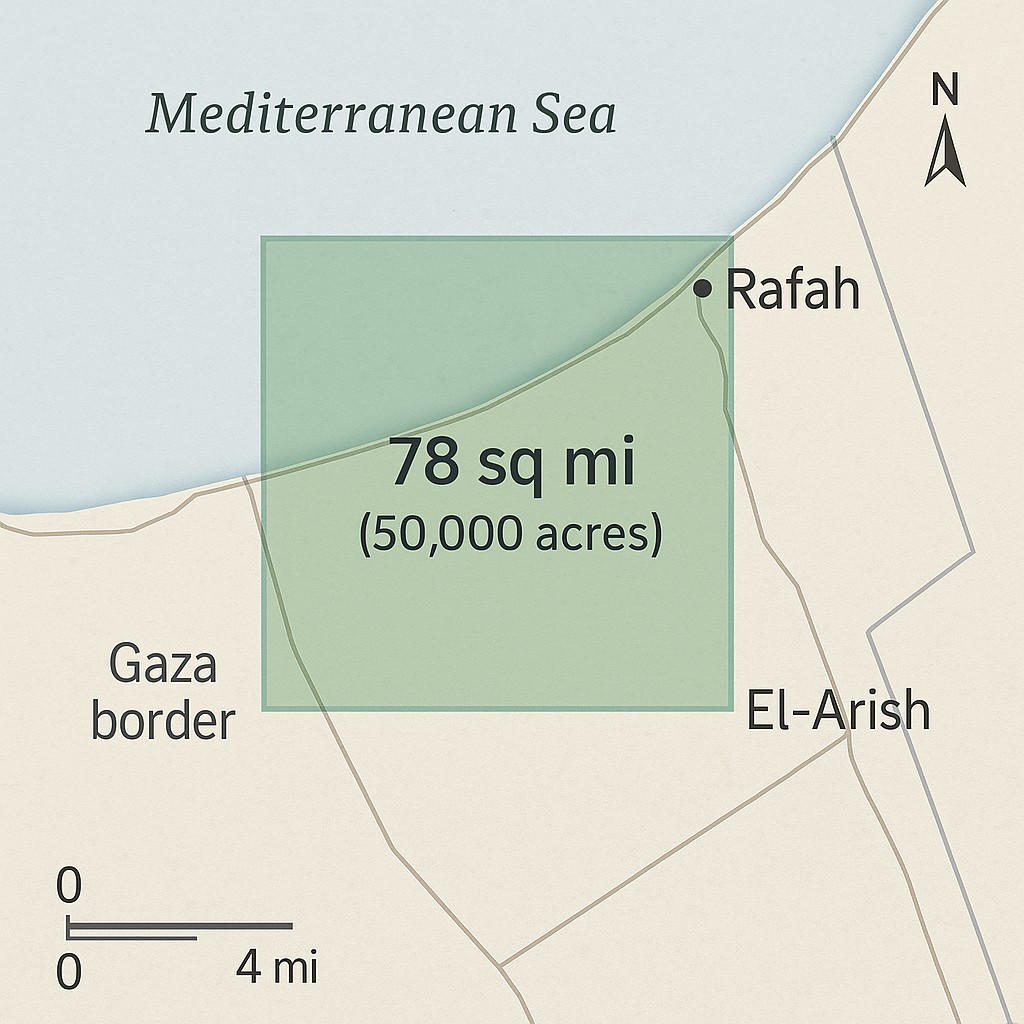
Let’s use 50,000 acres as our assumption for future planning. Let’s crunch that:
- 1 square mile = 640 acres
- 50,000 acres ÷ 640 = 78.125 square miles
So your cultivated footprint is about 78 square miles — think of a square roughly 9 miles by 9 miles.
WLBOTT:
Now here comes the key question for our community. How much water, on a daily basis, must be provided to irrigate 50,000 acres. Let’s assume the water will be desalinated from the north Sinai coast from the Mediterranean sea and pumped to all 50,000 acres. Power for the desalination plant and pumping will come from electricity provided by a large solar farm.
Elder G:
Awesome “key question.” Here’s a solid planning estimate for 50,000 irrigated acres on North Sinai’s coast (Med climate), assuming drip irrigation and desalinated seawater.
How much water per day?
Step 1 — Crop water need (ETc)
- Mid-summer reference evapotranspiration on the Mediterranean coast is typically ~5–6 mm/day. With mid-season crop coefficients near 1.0, that’s a good planner for peak ETc.
Per acre at 5–6 mm/day
- 5 mm/day = 0.197 in/day ⇒ ~20.3 m³/acre/day (≈ 5,360 gal/acre/day).
- 6 mm/day = 0.236 in/day ⇒ ~24.4 m³/acre/day (≈ 6,430 gal/acre/day).
(1 acre-inch = ~102.8 m³.)
For 50,000 acres (peak ETc, before losses):
- ~1.02–1.22 million m³/day (≈ 270–320 million gal/day).
Step 2 — Add irrigation realities
- Drip application efficiency ~90% (high, but realistic for well-run drip).
- Leaching fraction for salinity management: plan ~10–15% extra. (Standard FAO practice when using saline sources; handled via Kc/Ke or added allowance.)
Gross water to produce (peak-day):
Multiply by ~1.3 (= 1/0.9 × 1.15).
- ≈ 1.3–1.6 million m³/day (round: ~1.5 million m³/day).
Design takeaway: Size the water system for ~1.5 million m³/day peak to comfortably irrigate 50,000 acres in midsummer.
(Annual averages will be lower; Med-crop irrigation totals commonly run ~400–800 mm/yr, so annualized demand could average ~0.3–1.0 million m³/day, but the plant must meet the peak month/day. FAO-56 methods underpin these ranges.)
The WLBOTT Nutshell: To irrigate our 50,000 acres and meet peek demand in mid-summer, we need 1.5 million cubic meters of water per day.
Elder G ran several crop models. Here is the daily requirements, by month, for a mix of olives, figs, and tomatoes.
| Total Daily Water Requirements (cubic meters) | ||||
| Month | Olives (m3/day) | Figs (m3/day) | Tomatoes (m3/day) | total |
| Jan | 61,553 | 27,357 | 0 | 88,910 |
| Feb | 71,022 | 31,565 | 0 | 102,587 |
| Mar | 112,847 | 71,811 | 369,316 | 553,974 |
| Apr | 151,514 | 151,514 | 757,572 | 1,060,600 |
| May | 188,078 | 217,013 | 998,258 | 1,403,349 |
| Jun | 205,176 | 236,741 | 899,616 | 1,341,533 |
| Jul | 212,015 | 244,632 | 0 | 456,647 |
| Aug | 205,176 | 205,176 | 0 | 410,352 |
| Sep | 157,827 | 131,523 | 473,482 | 762,832 |
| Oct | 115,740 | 63,131 | 631,310 | 810,181 |
| Nov | 84,175 | 33,670 | 555,552 | 673,397 |
| Dec | 61,553 | 27,357 | 369,316 | 458,226 |
To run the desalination plant at max load, we’ll need about 5 GWh/day.
Just ballpark, to power our desalination plant, we’d need about one acre of solar panels for 10 acres of irrigated land. We can probably get these numbers down by half with clever storage and conversation methods, but still….
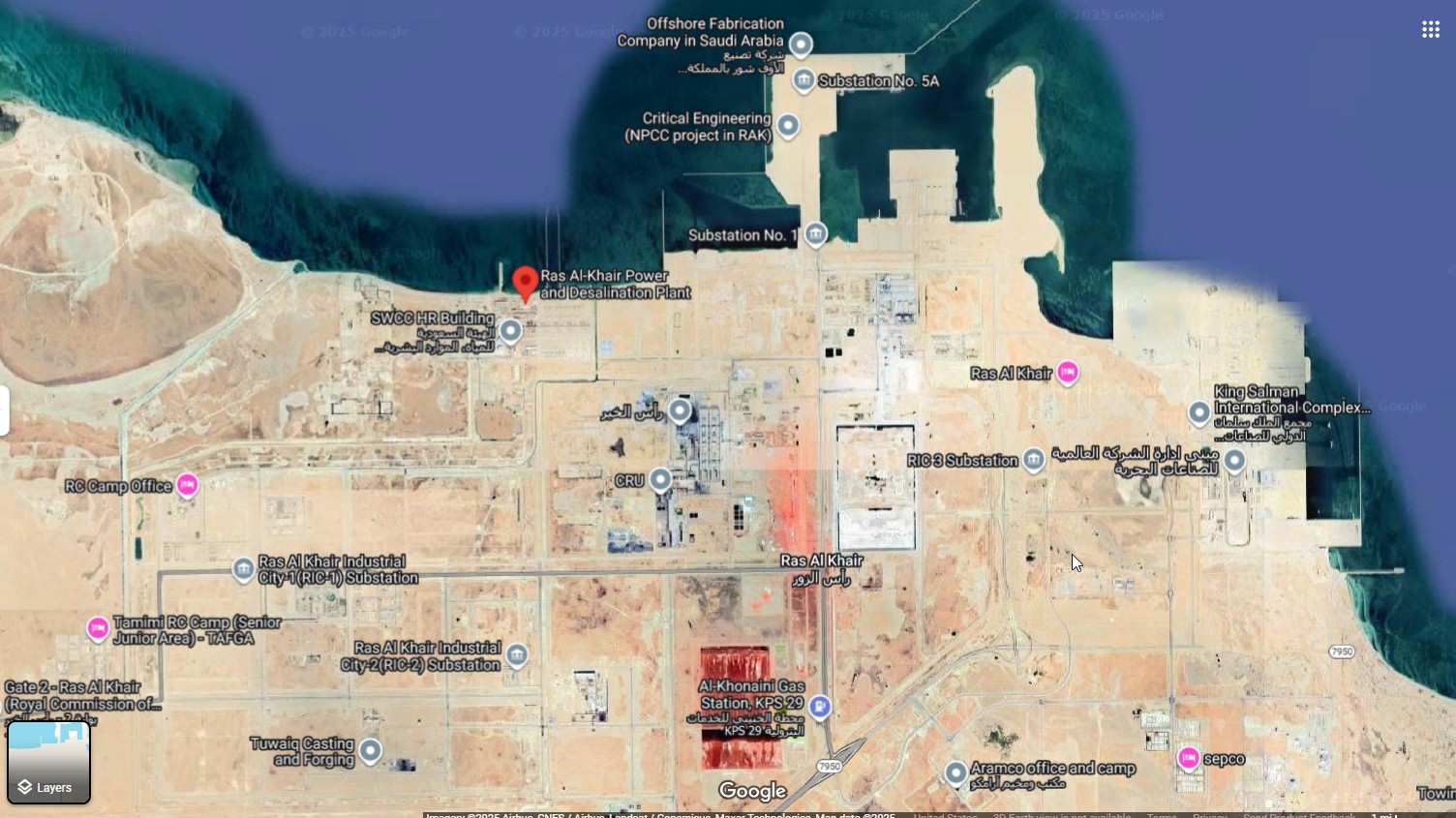
Ras Al-Khair Power and Desalination Plant
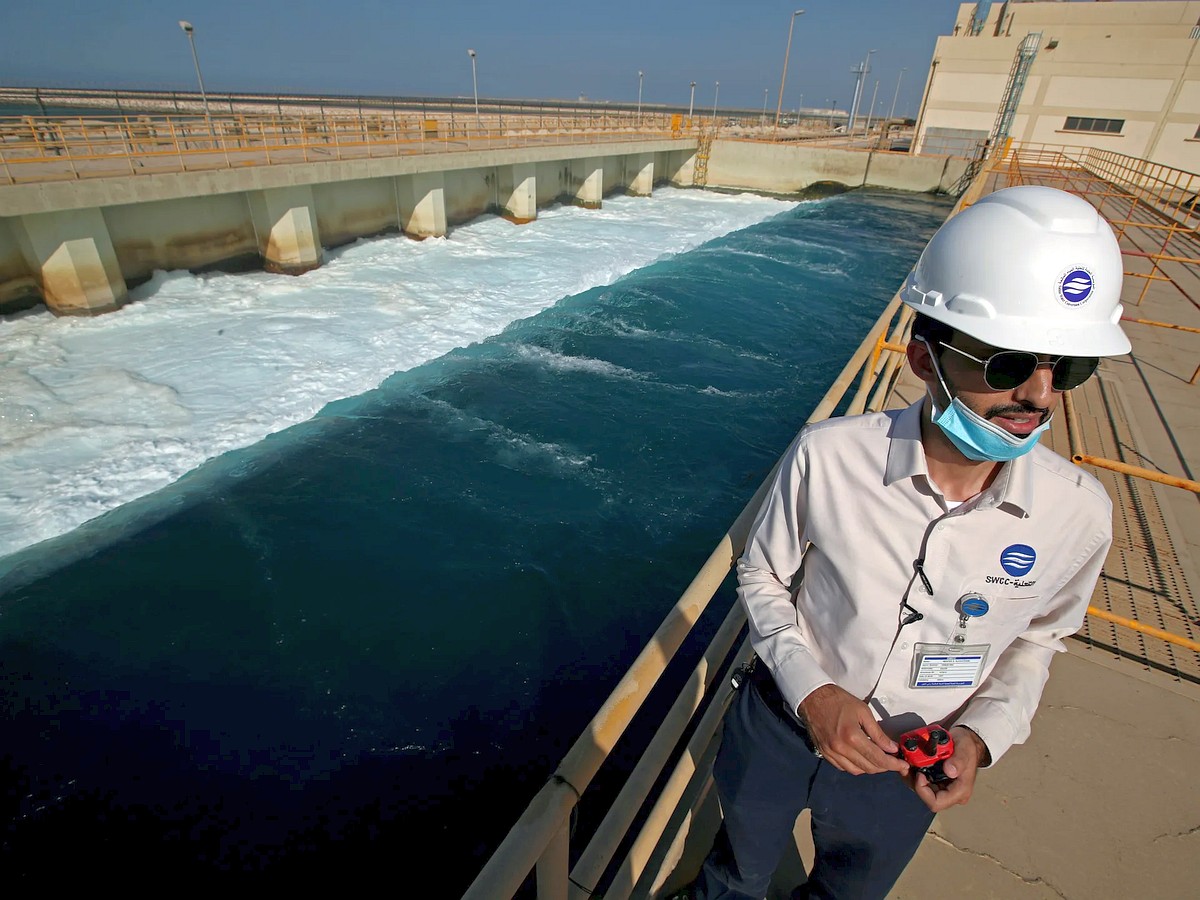
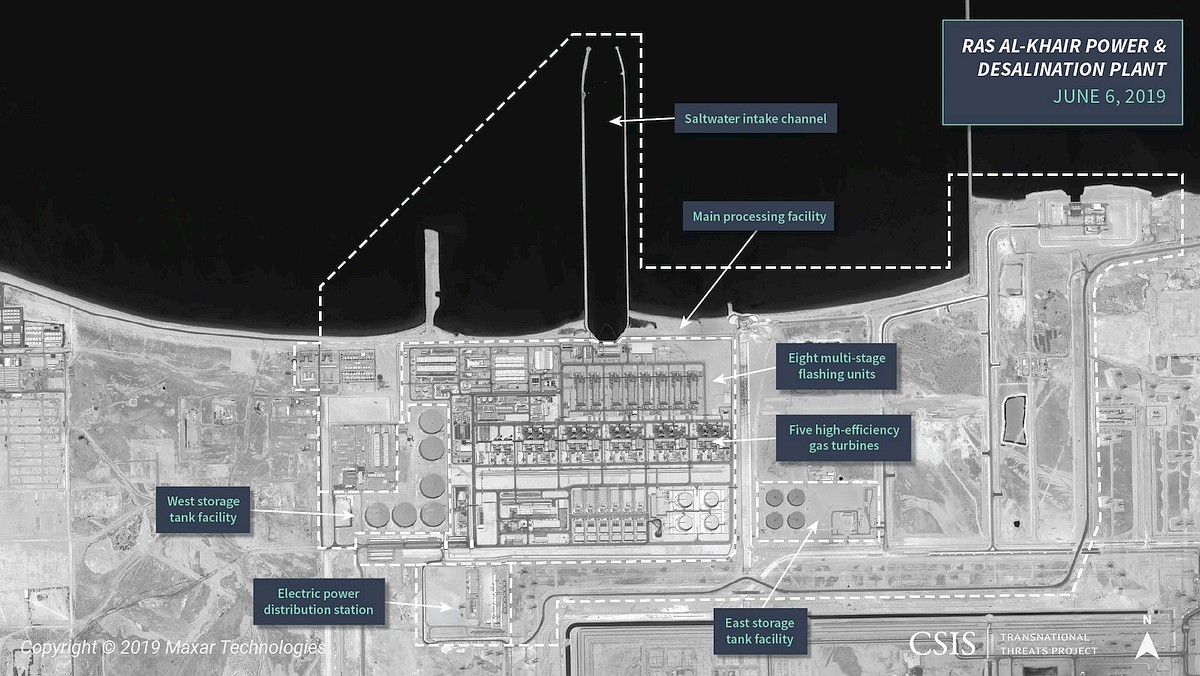
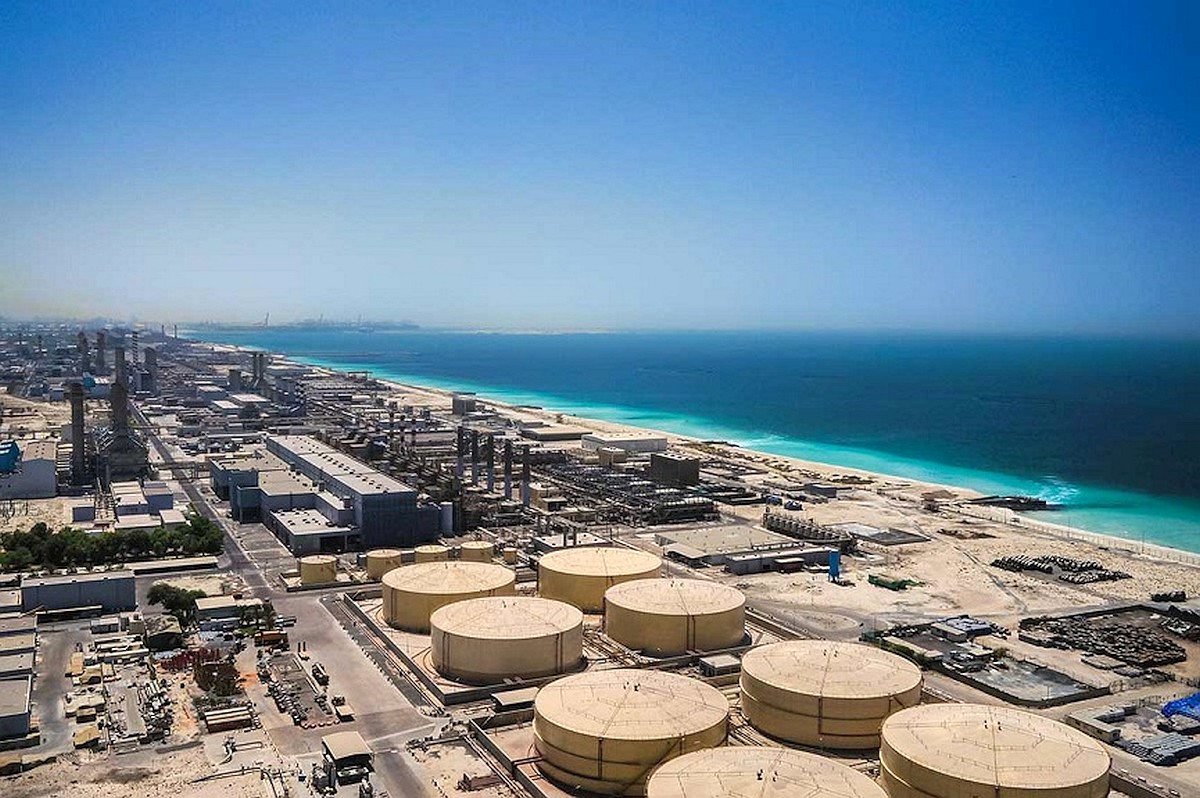
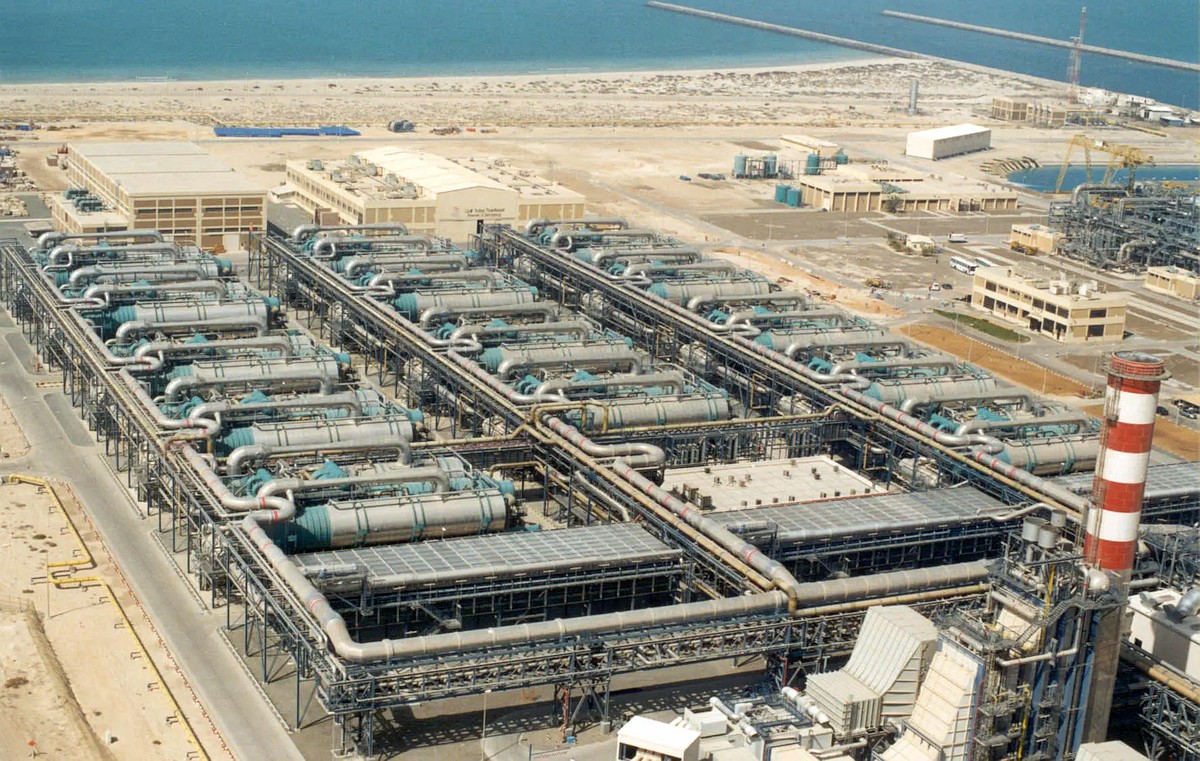
The largest desalination plant in the world is the Ras Al-Khair Power and Desalination Plant located in Saudi Arabia.
This is approximately the desalination capacity we’d need for one community in The New Crescent.
Ras Al-Khair has a production capacity of 1,036,000 cubic meters of water per day. Some sources indicate a capacity as high as 2,998,000 m3/day when including the total capacity of multiple facilities at the Shoaiba complex, but Ras Al-Khair is most consistently cited as the single largest plant.
The Ras Al-Khair Power and Desalination Plant
The Ras Al-Khair Power and Desalination Plant is a power and desalination plant located in Ras Al-Khair on the eastern coast of Saudi Arabia. It is operated by the Saline Water Conversion Corporation of Saudi Arabia. The plant began operating in April 2014 and, as of January 2017, is the world’s largest hybrid water desalination plant. The project includes a power plant capable of producing 2400 MW of electricity. In 2015, it won the Global Water Awards “Desalination Plant of the Year” award[1].
Operation
Water intake for the plant comes from the Persian Gulf, on the shore of which the plant sits. The plant includes five high-efficiency gas turbines operated in combined cycle mode and in single mode. It uses a hybrid system of eight multi-stage flashing units and 17 reverse osmosis units. Freshwater output from the plant is pumped via pipelines to Riyadh and Hafr Al-Batin. Electricity and freshwater output from the plant also supply a nearby aluminium oxide refinery. Of the 2400 MW electricity produced by the plant, 200 MW are used by the plant itself. Effluent from the plant is processed locally by a dedicated wastewater treatment plant and discharged into the Persian Gulf.Construction cost: $7.1 billion
IWPP water output: 1,036,000 m3/d
Wikipedia

[1] Not to be confused with the WLBOTT Lifetime Moisture Award.
How Much does Water Cost in Riyadh?
Elder G:
Saudi Arabia uses a progressive block tariff structure for domestic water consumption. The water and wastewater (sewer) tariffs for households as of January 2016 (still largely in effect) are approximately:
| Monthly Consumption (m³) | Water Tariff (USD/m³) | Sewage Tariff (USD/m³) | Combined (USD/m³) |
|---|---|---|---|
| 0–15 | $0.03 | $0.01 | $0.04 |
| 16–30 | $0.27 | $0.14 | $0.41 |
| 31–45 | $0.81 | $0.41 | $1.22 |
| 46–60 | $1.08 | $0.54 | $1.62 |
| 61+ | $1.62 | $0.81 | $2.43 |
1 cubic meter ≈ 264 gallons of water.
Riyadh Residential Water Tariffs (per gallon)
| Monthly Block (m³) | Tariff (SAR/m³) | Tariff (USD/m³) | Cost per Gallon (USD) | Cost per Gallon (cents) |
|---|---|---|---|---|
| 0–15 | 0.15 | $0.04 | $0.00015 | 0.015¢ |
| 16–30 | 1.54 | $0.41 | $0.00155 | 0.16¢ |
| 31–45 | 4.58 | $1.22 | $0.00462 | 0.46¢ |
| 46–60 | 6.08 | $1.62 | $0.00614 | 0.61¢ |
| 61+ | 9.11 | $2.43 | $0.00920 | 0.92¢ |
Key Takeaways
- First block (0–15 m³) is extremely cheap—virtually symbolic, encouraging essential water use.
- Subsequent blocks rise steeply, designed to discourage excessive use and move toward cost recovery.
- Overall, most residential consumers fall into the lower blocks and pay a very modest amount—often under 1 Saudi Riyal per cubic meter, unless consumption is high.
Perspective
- At the lowest block, Riyadh residents are paying essentially fractions of a cent per gallon — almost free.
- Even at the highest block, it’s still less than 1¢ per gallon, which is remarkably cheap compared to U.S. municipal rates (often 0.2–0.5¢ per gallon at the low end, and higher in drought-stricken areas).
- This shows how heavily subsidized desalinated water is in Saudi Arabia — the actual production cost can be several times higher.