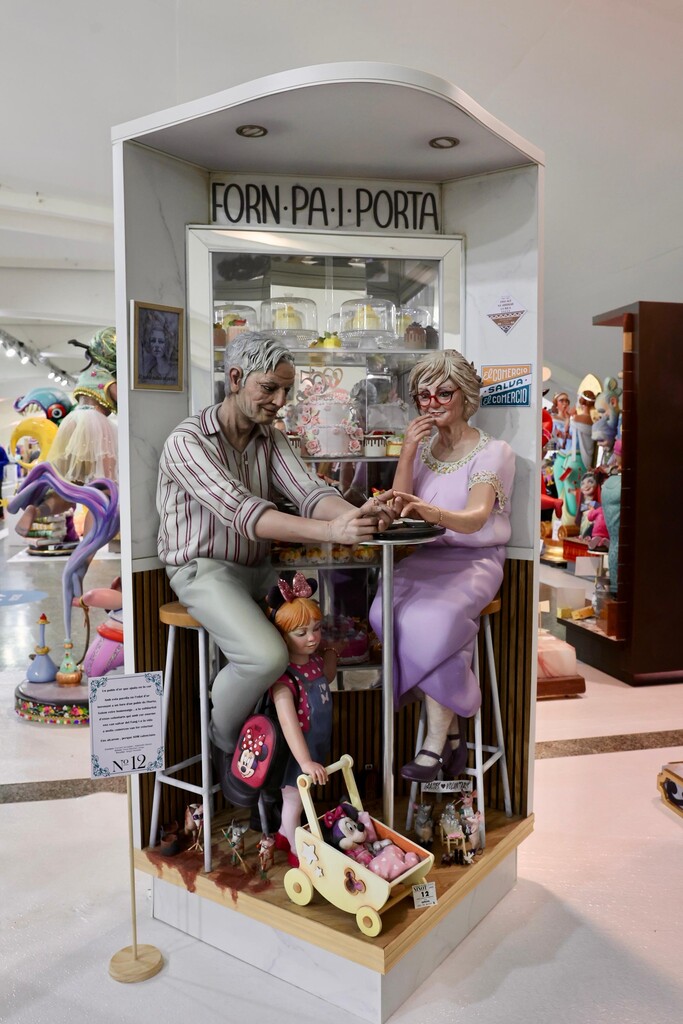
Good morning, World! One of our Elders, Elder KM, recently attended the Las Fallas festival in Valencia, Spain. She had a wonderful time. We were not familiar with the festival, so I’ve been doing a little research. The first question that came to mind is, “How much alcohol is consumed at this festival?” Elder G, help us out here!
Scientific Clue: Measuring Alcohol in the Sewers
Researchers have actually estimated alcohol consumption during Fallas by measuring biomarkers in wastewater.
One study measured a metabolite of alcohol (ethyl sulfate) in Valencia’s sewage during the festival and found:
Alcohol consumption peaked during Fallas compared with normal periods.
Estimated intake ranged up to about 56 mL of pure alcohol per person per day at the peak.
To translate that into ordinary drinks:
56 mL of pure alcohol ≈ about 4–5 standard drinks per person per day on average across the population.
But remember: that’s averaged across everyone in the city, including children, grandparents, and people quietly eating churros at home. In reality the drinking is concentrated among party-goers, which means the festival crowd likely consumes much more than that.
What is Fallas?
The Fallas is a traditional celebration held annually in the city of Valencia, Spain; it is the patronal festival of the town, for which the patron saint is Saint Joseph; therefore the festival takes place around this saint’s day, 19 March. The five main days celebrated are from 15 to 19 March, while the Mascletà, a pyrotechnic spectacle of firecracker detonation, takes place every day from 1 to 19 March. The term Fallas refers to both the celebration and the Falla monuments burnt during the celebration.
A Falla or monumento fallero is an artistic monument, usually large (three to twenty meters in height, sometimes higher) composed of figures called ninots, which typically encircle one or more bigger central figures, called remates. The fallas are placed in the streets during the Falles festival in Valencia (Spain), and in other towns with festivals inspired by it. The monument usually deals with a satirical subject connected with recent news or public controversies, and is covered in posters with words, verses and statements of a humorous nature. The monument is made with combustible materials (cardboard, wood, paper, clothing, expanded polystyrene, etc.) which are then burned in the streets after being on show for a few days.
Construction of the figures As the monuments can be very high (often more than 10 meters), a specific technique has been developed to build them. The step is to prepare a draft and perhaps a scale model which must be approved by the comisión fallera (a committee formed by a group of people who support or finance a falla in a neighborhood of Valencia) who hires the artist.
The structure (scaffold) is constructed of wood and then all materials (cardboard, wax, cloth, etc.) are used. Though years ago they could use wire, currently these materials are prohibited by the Junta Central Fallera (which regulates and coordinates this festivity). Ninots are traditionally constructed from molds, which are usually made of plaster, and are filled with pulp, which are painted after drying.
But today, for convenience and ease of use, new materials are used, such as porespan, resin or fiberglass. These new materials make the monuments lighter and the Falla artists can take risks to create bold and innovative forms.
Fallas themes The themes of the Fallas have changed throughout history. In the beginning, they served to criticize what happened in the neighborhoods or dealt with issues of a very local nature. But, little by little, sometimes in a hidden manner, they started to criticize people who were important locally. Since the Spanish transition to democracy the Fallas have turned to more global topics. Nowadays they criticize political and social issues from each community, national or global point of view. However, there are many Fallas which make use of their satirical purpose in order to criticize banal topics like TV shows, celebrities, etc.
The best falla of Valencia in 2025 is that of the commission Convento Jerusalén-Matemático Marzal, with a historic triplet, the first since 1990, with the award for best falla in Special, in Children and Ninot Indultat 2025.
There’s a certain Zen-like aspect to the festival. All the fallas are burnt at the end of the festival, like a Tibetan sand mandala disappearing in the wind. And there are so many categories related to the fallas that there isn’t really a “grand prize.”
Awards The Fallas monuments receive different prizes according to the categories of the Fallas and the subject matter. The most valued prize of all categories is the First Prize of all Sections. The most important prizes of each section are the first prize of section, the first one in inventiveness and grace, and the first prize to the alternative Falla. Furthermore, Generalitat Valenciana, Diputación de Valencia, Bonfires of Saint John and Junta Gestora de la Magdalena, as well as other private entities also give their own prizes which often include a sum of money.
A Short Word about Polystyrene – Many, Many Styrenes
The use of Polystyrene on the Fallas has allowed the floats to grow in size, and allowed the designers to expand their creativity. And it’s flamable!
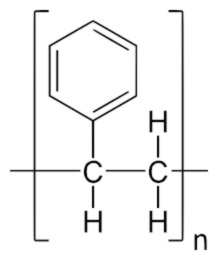
Polystyrene is a synthetic polymer made from monomers of the aromatic hydrocarbon styrene. Polystyrene can be solid or foamed. General-purpose polystyrene is clear, hard, and brittle.
Pound for pound it is a very cheap resin and a fairly poor barrier to oxygen and water vapor, with a relatively low melting point.
Expanded polystyrene is lightweight. This is a man in Guiyang, China carrying a lot of expanded polystyrene packaging. By Jonashtand – Own work, CC BY-SA 4.0, https://commons.wikimedia.org/w/index.php?curid=136802399(left) Discarded polystyrene cup on the shore of Lake Michigan By Visviva – Own work, CC0, https://commons.wikimedia.org/w/index.php?curid=86555898 (right) Disposable polystyrene razor By Hispalois – Own work, CC BY-SA 3.0, https://commons.wikimedia.org/w/index.php?curid=2062316Wikipedia
How Many is Many?
Very interesting. Lots and lots of styrenes. How many polystyrenes make up up a single packaging peanut?
Elder G does the heavy lifting for us:
Back-of-the-envelope version
A typical foam packing peanut is very light, maybe around 0.1 to 0.2 grams.
Each styrene repeat unit in polystyrene has a mass of about 104 grams per mole.
So for a 0.1 gram peanut:
moles of styrene units ≈ 0.1 / 104
≈ 0.00096 moles
multiply by Avogadro’s number
≈ 5.8 × 10^20 styrene units
For a 0.2 gram peanut, double that:
≈ 1.2 × 10^21 styrene units
So one humble packing peanut contains on the order of hundreds of quintillions to about a sextillion styrene units.
Was There a Misunderstanding? From Mole to Guacamole
What if “Avogadro’s number” was actually meant to be “Avocado’s Number?”
We asked the scientists at the WLBOTT Agricultural Extension Service (Go Waggies!) to look into this matter.
Fred Encounters Polystyrene
You recall Fred, our Intern Penitent. He is on an extended time out, due to the Whoopee cushion incident at St. Gangulf Middle School. Sister Magdalena, the headmistress, and entrusted Fred’s moral reclamation to the Elders of WLBOTT.
Fred is back on the “Bad Boy” list after ordering 144 (one gross) rubber chickens off the Dark Web. The Elders assigned him the task of counting, by hand, the number of polystyrene molecules in one of the packaging peanuts from the rubber chicken order.
Fred Before the Elders
The Elders are not happy when they get an email from Amazon, asking them to write a review for their recent purchase of 144 rubber chickens. They immediately think “Fred”!
Fred’s euphoria is quickly damped as he is called into an Executive Session of the Elders. His rubber chicken squeaks nervously.
The Molecular Penance
Since there are packing peanut all over the floor (and even in the hen house, were a few misguided hens are trying to hatch them), the Elders assign Fred his penance: count, by hand, each individual Polystyrene molecule in a single packaging peanut.
Mercy in the Laboratory
After four hours of “penitence counting”, Sister Magdalena pops in and whispers to Fred, “I think you’ve counted enough. I’ll straighten things out with the Elders.”
Epilogue
This is best laugh the Elders (and Sister Magdalena) have had in weeks.