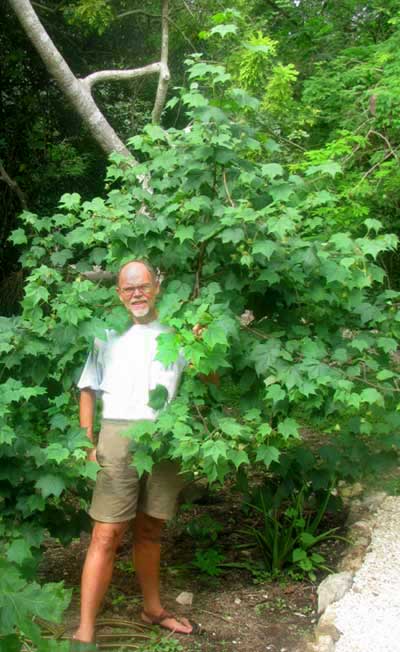
At the WLBOTT Ag Extension Service (Go Waggies!), we’re trying to replicate some of the major agricultural crops of Texas – cotton, sorghum, okra, peanuts….
Here’s our cotton field….
We gathered the elders for a quick WLBOTT blessing.
Our cotton field is directly west of our spinach field. The spinach did really well, but recently bolted (began to flower) which makes the spinach bitter. We used our electric mower to cut down the spinach, in preparation for our okra field.
Pro-Tip: when mowing a section of the garden, remove the soaker hoses FIRST.
Cotton: the Nuts and Bolts
The Bolts
A bolt is a piece of cloth woven on a loom or created by a knitting machine, as it is processed, stored or marketed. Consequently, its dimensions are highly variable – flexible and dependent upon the manufacturing, machinery, quantity, size, thickness and quality of the product.
Cottonseed is the seed of the cotton plant, formed inside the cotton boll. Cottonseed is the source of cottonseed oil and cottonseed meal. Cottonseed, like the rest of the cotton plant, contains high amounts of gossypol that can be toxic to humans.
Cottonseed meal can be fed to cows, whose ruminating digestive system has no problem with gossypol. The cottonseed oil is used in a lot of human foods, where the nasty gossypol is removed during the oil extraction process.
We purchased our seeds from a company called Kviter via Amazon, at a price of $0.40 per seed.
When we scale up, we’ll have to find a commercial seller of cotton seed. We’ll need about 200,000 seeds per acre, and buying the seeds from Amazon would cost $80,000 for a single acre.
Elder G nets out the economics for us:
The Industrial Reality of Cotton Seed
For large-scale farms, cotton seed is typically priced by the bag, not by individual seeds. Here’s how it usually breaks down:
A standard bag plants about 1 acre
Each bag contains roughly 200,000–250,000 seeds
Cost per bag:
Conventional varieties: $50–$100
Genetically engineered (very common today): $100–$200+
Cost per seed (industrial scale):
Roughly $0.0002 to $0.001 per seed
That’s a fraction of a penny per seed
GM Seeds
The two major genetic modifications in modern cotton are:
Roundup Resistance – allows farmers to use Roundup to kill weeds without worrying about harming the cotton
Genes from the soil bacterium Bacillus thuringiensis (BT). This is very cool – BT is toxic to a lot of insects
Gemini gives us the gory BT details:
Bt toxin kills insects by binding to specific receptors on the surface of their midgut epithelial cells, creating pores in the gut membrane. This action leads to perforation of the gut lining, causing the insect to stop feeding, experience gut cell swelling and lysis, and die of starvation or infection, typically within 1-5 days.
Cotton is actually a perennial plant
Cotton is the primary natural fibre used by humans today, amounting to about 80% of world natural fibre production. Where cotton is cultivated, it is a major oilseed crop and a main protein source for animal feed.
Generally shrubs or shrub-like plants, the species of this genus are extraordinarily diverse in morphology and adaptation, ranging from fire-adapted, herbaceous perennials in Australia to trees in Mexico.
(right) By Michael Bass-Deschenes(Commons User Mike Bass-Deschênes) – Cotton husk, CC BY 2.0, https://commons.wikimedia.org/w/index.php?curid=37045493
The plant is a shrub native to tropical and subtropical regions around the world, including the Americas, Africa (including Egypt) and India. The greatest diversity of wild cotton species is found in Mexico, followed by Australia and Africa. Cotton was independently domesticated in the Old and New Worlds.
A woman in Dhaka clad in fine Bengali muslin, 18th centuryWikipedia
Cotton has a dark, horrific history in the United States.
Production capacity in Britain and the United States was improved by the invention of the modern cotton gin by the American Eli Whitney in 1793. Before the development of cotton gins, the cotton fibers had to be pulled from the seeds tediously by hand. By the late 1700s, a number of crude ginning machines had been developed. However, to produce a bale of cotton required over 600 hours of human labor, making large-scale production uneconomical in the United States, even with the use of humans as slave labor.
A modern mechanical cotton gin was created by American inventor Eli Whitney in 1793 and patented in 1794. Whitney’s gin used a combination of a wire screen and small wire hooks to pull the cotton through, while brushes continuously removed the loose cotton lint to prevent jams. It made cotton farming more profitable, leading to a boom in cotton production in the United States. This inadvertently led to an increase in the use of slaves. Whitney had hoped his invention would do the opposite by reducing the amount of labor needed to process cotton, but he never invented a machine to harvest cotton. That job still had to be done by hand. Cotton harvesting machines did not show up until the 1930s. So as cotton farmers expanded their plantations, they bought more slaves to pick the cotton.
For the farmer, cotton farming is an agricultural rollercoaster. There are so many variables that are out of her control – the rain, the hail, the markets and futures markets, price of seed, price of fertilizer, price of diesel….
The WLBOTT garden is the home of the $1,000 salad, bug-infested. Not very cost effective at the moment. But yes, let’s look at the economic breakdown of our 25 seed cotton plot.
Elder G does the heavy lifting for us.
The $1,000 salad now has a sibling: the $10 cotton plantation.
WLBOTT 25-Seed Cotton Plot
Item
Estimate
Seeds planted
25
Seed cost per seed
$0.40
Total seed cost
$10.00
Approx. field equivalent
~0.0005 to 0.0008 acre
Expected lint cotton
~0.5 to 0.8 lb
Farm cotton price
~61¢ to 77¢/lb
Gross cotton value
~30¢ to 62¢
Profit/loss before water, labor, tools, compost, ceremony
–$9.38 to –$9.70
I’m using recent USDA yield and price context: USDA projected 2025/26 U.S. cotton yield around 929 lb/harvested acre, while recent U.S. upland farm and spot prices are roughly 61¢ to 77¢ per pound.
In official Ag Extension language: “The crop is economically indefensible, but spiritually magnificent.”
The only way to make this profitable is to sell it as WLBOTT Heritage Garden Cotton™, hand-raised in ceremonial micro-acreage, at about $18 per tuft.
Real World Economics
Again, Elder G nets it out for us:
What a U.S. Cotton Farmer Makes Per Acre
A Reasonable “Typical” Range
Good years: about $200–$400 profit per acre
Average-ish years: roughly $0–$200 per acre (break-even to modest profit)
Bad years:losses of -$100 to -$300+ per acre
So the honest answer is: Cotton farming can be moderately profitable… or quietly brutal.
Cotton is a crop that wakes up every morning and chooses unpredictability:
Weather: drought in Texas can erase profits overnight
Global prices: tied to textile demand worldwide
Input costs: fertilizer, fuel, and seed tech fees fluctuate
Yield sensitivity: you often need ~1,100–1,200 lbs/acre just to break even
Even well-run farms can lose money in a bad year.
The Mexican Cotton Tree
You can read about the ten foot tall Mexican tree cotton plant here.
I carried seeds home with me, they germinated and I planted the seedlings right before I left the Hacienda six months ago. This woody, ten-ft-tall plant with mostly five-lobed leaves is what grew from those seedlings! In our area we have two closely related cotton plants — both capable of producing woody shrubs as in our picture. – Backyard Nature
Laura Farms
We came across a very engaging YouTube channel: Laura Farms.
She’s been documenting her life as a Nebraska farmer for seven years.
2026 – my seventh year farming row crops (Corn and Soybeans) in Nebraska, USA!
Follow along as we learn how to farm…together! My channel features vlog-style videos of everyday life on the farm, as well as equipment demos, collaborations with other farmers, and off the farm, outdoor fun.
She and her husband have some really cool, massive farm equipment.
They were invited down to a large cotton farm outside of Lubbock, Texas, to observe and participate in the cotton harvest.
(Stills from her video…)
Sister Magdalena was inspired by several shrines to Our Lady of the Cotton in far West Texas and Mississippi, and suggested that we ask for Her guidance in our Ag Extension farm.
We liked the idea, but it ended up in endless debate. In the spirit of ecumenicalism, we suggested shrines that reflected the various cultures and beliefs where cotton has historically been grown.
Cotton in India
Cotton cultivation and weaving in India date back over 5,000 years to the Indus Valley Civilization, with India long serving as the world’s largest textile manufacturer and exporter. Renowned for quality, Indian textiles dominated global trade until British colonial policies in the 19th century transformed India into a raw material exporter for Lancashire mills. – Gemini
Cotton in Egypt
Now the loom turns westward, threads catching desert light. Ancient Egypt didn’t build its fame on cotton the way India did, but later periods—especially along the Nile—wove cotton into daily life. That gives us a beautiful creative tension: linen heritage meeting a newer fiber, all under a sky that has watched millennia pass like drifting sand. – Elder G
Cotton in Peru
Peru has a 7800-year history of cotton, considered a cradle of its domestication, with remnants found dating to 6000 BCE in Huaca Prieta. Indigenous cultures like Caral and Inca used native cotton (Gossypium barbadense) for textiles and nets. Today, Peru is famed for high-quality, long-fiber Pima and Tangüis cotton, along with sustainable organic. – Gemini