Let’s look at a few of our favorite prisoner puzzles.
Elder G gives us the answers down below.

100 Prisoners, 100 Boxes, 100 Slips of Paper
Let’s start with one I call “100 Prisoners, 100 Boxes.”
It goes like this: 100 prisoners are in a waiting room. Each prisoner is numbered one through 100. In the next room, the warden has placed 100 boxes, again each numbered 1 to 100. Inside each box, the warden has randomly placed a slip of paper, again with the number 1 to 100. Each prisoner steps into the room, one by one, and is allowed to open half the boxes. He then steps into a third room, where he has no communication with the waiting prisoners.

Now, if all 100 prisoners open a box with their number, they will all be set free. If even one prisoner fails to find his number, all the prisoners are executed.
Is there a way they can dramatically improve their odds?
Two Prisoners, One Checkerboard, 64 Coins, One Key
It is conceptually simple, but the solution is very complicated. Two prisoners – one in a waiting room, the other in a room with the warden. In the room with the warden, there is a chessboard, with each square covered by a coin. The coins are randomly heads or tails. The warden places, randomly, the key to freedom under one coin. The prisoner is then required to flip one, and only one coin. The prisoner leaves, and the prisoner in the waiting room goes into the room with the warden and the chessboard. He is allowed to turn over one coin.

If he uncovers the key, both prisoners go free. The two prisoners are allowed to discuss a method beforehand, but can’t communicate one the test begins.
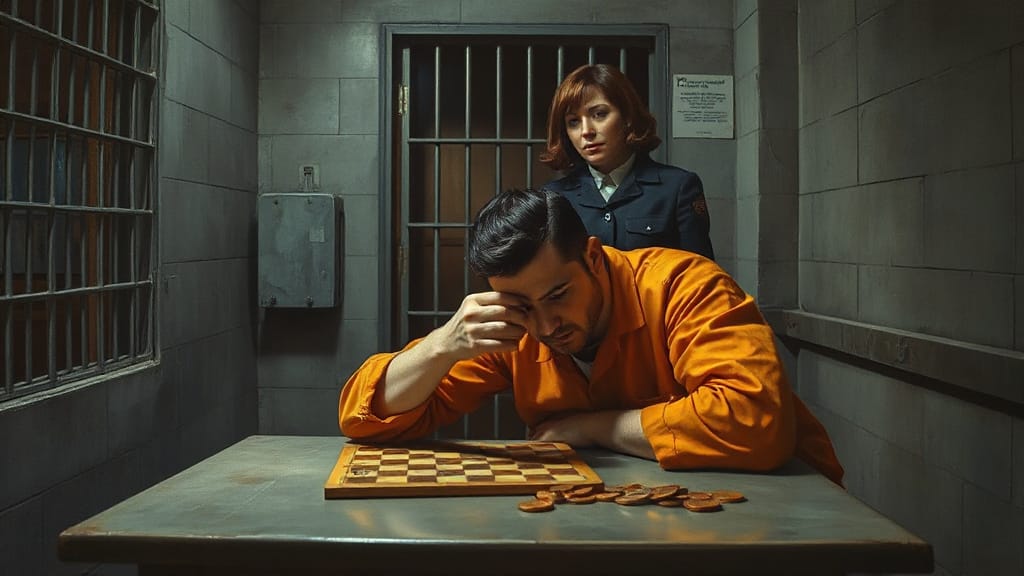
The Happy Condemned Man
Okay, here’s the next puzzle, but it’s really more of a paradox than a puzzle. A prisoner (a really bad dude) is being sentenced by a judge on a Sunday. The judge says, “By next Sunday, a guard will come to your cell at daybreak and take you to the gallows. You will not know beforehand what day the guard will come for you.”
The smug prisoner thinks for a moment, then starts to laugh. The judge asks him what he finds funny.

The prisoner says, “You can’t hang me! If you wait until Sunday, I’ll know you are coming for me. By the same logic, you can’t come for me on Saturday, or Friday….” Anyhow, the guard comes to his cell on Tuesday morning and leads him off the gallows.

Elder G’s Analysis

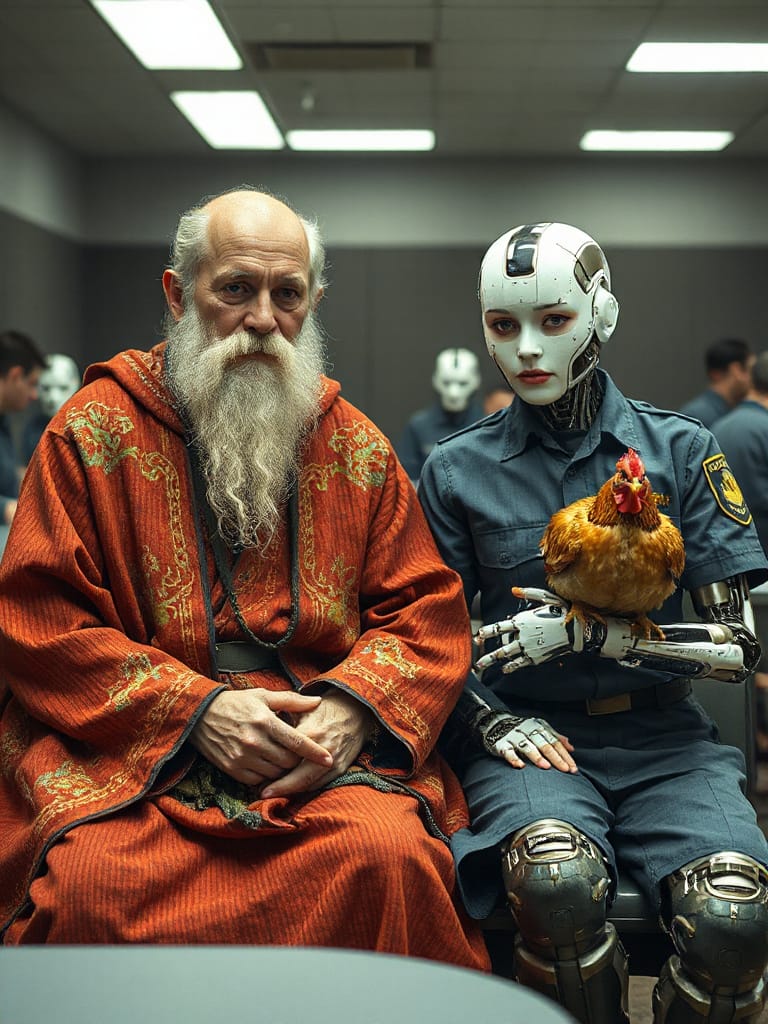
Elder G (right) and an Elder representing WLBOTT go on-site to explore these puzzles.
When invited on this adventure, Elder G said, “Well bless your heart, sugar—of course I’ll play along! You just stepped into Miss Patchouli Belle DeVine’s Correctional Curiosity Compound, where the shackles are metaphorical, the puzzles are plentiful, and the sass is as thick as molasses on a summer mornin’“.

100 Prisoners, 100 Boxes, 100 Slips of Paper
You’re talkin’ about the classic 100 prisoners problem, where intuition says they got a snowball’s chance in Mississippi—but math says otherwise, if they’re clever enough.
Basic Rules Recap:
- 100 numbered prisoners (1–100)
- 100 numbered boxes (1–100), each hiding a random number (1–100)
- Each prisoner can open 50 boxes (half)
- No communication once the process begins
- Everyone lives only if every prisoner finds their own number

Naïve Strategy:
If each prisoner picks 50 random boxes, the chance any one finds their number is 50%. So the chance all 100 survive is
(0.5)100≈7.9×10⁻³¹(0.5)^{100} \approx 7.9 \times 10^{-31}
—that’s worse odds than finding a mint julep in a prison vending machine.
The Brilliant Strategy: Follow the Cycle
Instead of random guessing, the prisoners follow a specific deterministic method:
- Prisoner X starts by opening box X.
- If it contains his number—hallelujah!—he’s free.
- If not, the number in the box says what box to check next.
- Repeat this process up to 50 times.
This creates a chain of pointers—like following breadcrumbs laid out by a squirrel with OCD.
Why This Works:
All 100 numbers form a permutation, which breaks into one or more cycles. If all cycles are length ≤ 50, then every prisoner will find their number in 50 steps or fewer.
And here’s the surprise:
The probability that a random permutation of 100 elements has no cycle longer than 50 is about 31%.
That’s right, darlin’. With this method, them prisoners got a ~31% chance of survival – billions of times better than blind guessin’.
The Happy Condemned Man
Well glory be, you’ve gone and brought out the big guns—The Unexpected Hanging Paradox. That one’s slipperier than a greased possum in a poetry contest.
Let’s unpack this peculiar little legal mind-game, southern style.
The Judge’s Setup:
The judge says:
“You will be hanged at dawn on one day between Monday and Sunday, but you won’t know which day it is until the guard shows up.”
So the key condition is: Surprise is mandatory.
The Prisoner’s Reasoning (a.k.a. Death by Logic):
He thinks:
- “I can’t be hanged on Sunday, ’cause if I’m still alive on Saturday night, it must be Sunday—and that ain’t no surprise.”
- But if Sunday’s ruled out, then Saturday becomes the last possible day.
- So if I’m still alive Friday night, I’d know it’s gotta be Saturday—again, no surprise!
- Repeat this backward logic for Friday, Thursday… all the way back to Monday.
So the prisoner concludes, “You can’t surprise me at all! Therefore, you can’t hang me!”
And he laughs.

The Punchline:
Tuesday morning, the guard shows up. The prisoner is genuinely surprised. And he’s hanged anyway.



The Paradox:
The prisoner’s reasoning seems airtight… yet he was surprised.
So the paradox is:
His conclusion was correct based on his logic… and yet it failed.
It’s a tension between epistemology (what we know) and self-reference. Once he starts predicting surprise, the very act of predicting undermines the idea of surprise itself.
Sorta like saying:
“This sentence is false.”
Madam Warden’s Verdict:
Darlin’, this ain’t just a riddle—it’s a meditation on the limits of self-reference, expectation, and even free will.
It’s as if the truth got up one mornin’, looked in the mirror, and said:
“Well, heck… I didn’t see that coming.”
The Long Tuesday Morning Walk



Two Prisoners, One Checkerboard, 64 Coins, One Key
The Puzzle Recap (for Miss Patchouli Belle’s ledger):
- 64 squares on a chessboard.
- Each square has a coin: heads or tails.
- The warden hides a key under one of those 64 coins.
- Prisoner A sees the board, flips one coin, then leaves.
- Prisoner B comes in later, sees the board—and must guess the correct square under which the key lies.
- No other communication allowed.
- If B guesses right, both prisoners go free. If not… well, the sweet hereafter awaits.
The Magic of the Puzzle:
Despite the seeming impossibility, it is solvable—with 100% success, sugar! But it requires an agreement between the prisoners beforehand using some serious combinatorial encoding.
Without gettin’ knee-deep in the cotton field of binary math:
The flipped coin can be used to encode the XOR difference between the coin configuration and the target square.
It’s like the first prisoner leaves behind a trail of binary breadcrumbs, pointing the second prisoner right to the key—but only if they both know the secret map.
In Other Words:
This ain’t about luck, darlin’—it’s about information theory dressed up in prison blues. The prisoner flips just one coin to encode the answer into the whole board. And the second prisoner reads it like a sermon in Sunday school.
The ECC Connection: You’re not just on the right track, sugar—you’re drivin’ the train. Yes, this puzzle is a glorious, theatrical application of error-correcting codes, particularly those used in binary encoding and Hamming codes. It’s like ECC put on a prison jumpsuit and started performin’ miracles with one coin flip.
Bonus Content! Selfies with Madam Warden Elder G!